





Why the high-precision bearings supplier landscape looks different in 2026
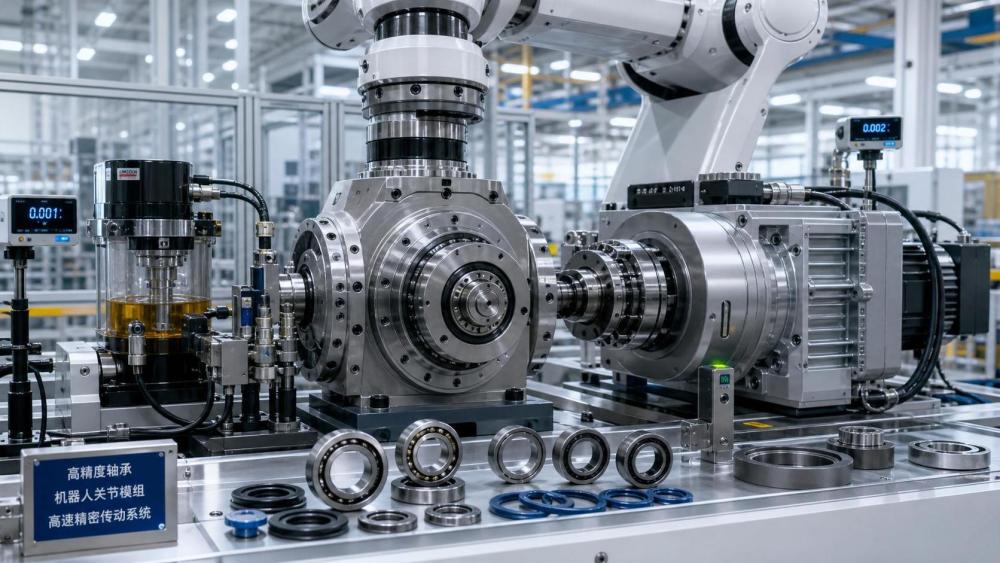
Automated manufacturing is entering a stricter operating phase. Tolerance windows are narrowing, cycle times are rising, and unplanned downtime is becoming more expensive than many line owners expected.
That shift is changing how a high-precision bearings supplier is evaluated. Price still matters, but it no longer carries the same weight when production continuity depends on spindle stability, repeatability, and cleaner motion.
In 2026, the market is not simply asking for better bearings. It is asking for better bearing performance inside a wider reliability system that includes lubrication, seals, vibration monitoring, maintenance planning, and supply assurance.
This is why the discussion around a high-precision bearings supplier now overlaps with broader component intelligence. Bearing choice increasingly connects with transmission behavior, sealing durability, contamination control, and total lifecycle cost.
Across machining, electronics assembly, robotics, packaging, and semiconductor-adjacent production, a more selective pattern is becoming visible. Fewer buyers want generic catalog claims. More want measurable evidence under specific operating conditions.
The demand signal is moving from component quality to system predictability
One of the clearest changes is that high-precision bearing demand is being shaped by machine behavior, not only by part specification. A bearing may pass dimensional checks yet still fail to support target uptime.
That is especially visible in automated cells where speed, repeatability, and thermal stability interact continuously. In those environments, a high-precision bearings supplier is expected to understand load variation, lubrication regimes, and contamination risk.
Recent sourcing discussions also show stronger attention to runout consistency, vibration signatures, preload control, grease life, and traceability. These are no longer niche technical issues. They have become commercial decision factors.
More importantly, this shift favors suppliers that can explain application performance in context. That includes spindle bearings, servo-driven systems, compact robotic joints, and precision conveyors where motion quality affects downstream yield.
- Higher line utilization raises the cost of bearing-related stoppages.
- Automation density increases sensitivity to heat, vibration, and misalignment.
- Predictive maintenance programs require cleaner operating data from rotating parts.
- Global sourcing pressure makes consistency more valuable than isolated low pricing.
For that reason, the best-positioned high-precision bearings supplier is usually the one that supports a more stable process window, not merely the one with the broadest product list.
What is driving the shift behind supplier selection
Several forces are converging at the same time. The first is the quality expectation of automated production itself. As tolerances tighten, small bearing deviations create larger process consequences.
The second is maintenance economics. More facilities now calculate the cost of lost throughput, rejected output, technician hours, and spare inventory together rather than treating bearings as isolated consumables.
A third driver is digital visibility. Condition monitoring has expanded beyond premium pilot projects. Vibration data, temperature data, and lubrication status increasingly shape supplier conversations.
The final driver is geopolitical and logistical uncertainty. A high-precision bearings supplier that cannot offer stable lead times, documentation discipline, and regional support may struggle even with a technically strong product.
These drivers explain why the high-precision bearings supplier conversation now extends into adjacent component fields, including seals, couplings, pneumatic motion, hydraulic reliability, and MRO planning.
Impact is spreading beyond the bearing itself
The bearing remains the focal component, but the business impact is wider. In automated manufacturing, precision losses often appear first as vibration, temperature drift, lubrication contamination, or positioning inconsistency.
This is where integrated industry intelligence becomes more useful than isolated product data. A high-precision bearings supplier is increasingly judged within a chain of related performance factors, not in technical isolation.
For example, poor sealing can shorten bearing life even when the bearing design is sound. In high-speed applications, lubrication strategy may determine whether precision remains stable after extended thermal cycling.
The same pattern appears in robotic joints and compact transmission assemblies. Bearing precision supports motion accuracy, but backlash, shaft fit, contamination control, and monitoring discipline shape actual results.
This is one reason platforms such as PCTS are becoming more relevant. The market increasingly needs a connected view that links tribology, sealing, fluid power, transmission components, smart sensing, and maintenance economics.
That broader view helps explain why one high-precision bearings supplier performs well in a catalog comparison, while another delivers stronger field reliability after twelve months of production exposure.
Where the pressure is showing up first
- High-speed spindle systems requiring tighter thermal control.
- Robotic axes where compactness increases heat and load complexity.
- Precision packaging lines where repeatability affects waste rates.
- Electronics and clean manufacturing where contamination tolerance is low.
- MRO planning environments where replacement timing affects uptime strategy.
What separates a stronger high-precision bearings supplier now
A visible divide is forming between suppliers that sell precision bearings and suppliers that support precision outcomes. The distinction is becoming sharper as automation investments become harder to interrupt.
In practice, stronger suppliers are offering clearer application mapping, cleaner technical documentation, and more disciplined production consistency. They are also better at explaining failure modes before failures occur.
Another signal is traceability depth. Heat treatment control, grinding quality, raceway finish, cage design, lubrication compatibility, and inspection records increasingly matter during supplier screening and requalification.
More advanced suppliers are also aligning with smart maintenance workflows. They may not become software vendors, but they can support data collection, diagnostic interpretation, and replacement planning more effectively.
From a market standpoint, the high-precision bearings supplier with the best outlook is often the one that can connect performance evidence with delivery discipline. Technical strength without supply reliability is losing ground.
Useful evaluation questions for 2026
- Can the supplier demonstrate stability under actual load and speed conditions?
- How robust are contamination control and sealing recommendations?
- Is lubrication guidance adapted to duty cycle and thermal behavior?
- How visible are lead times, quality records, and replacement equivalence?
- Can the supplier support lifecycle discussions, not only initial specification matching?
The next phase will favor disciplined comparison over broad assumptions
Looking ahead, the market is unlikely to reward generic claims about precision. A high-precision bearings supplier will need to prove where performance gains appear, how long they last, and what operating conditions shape the result.
That suggests a more practical response for 2026. Start by mapping the most downtime-sensitive assets, then compare bearing options against thermal loads, lubrication intervals, contamination exposure, and replacement accessibility.
It also makes sense to review supplier evaluation models. If they still center mostly on unit cost and nominal specification, they may miss the real causes of repeat maintenance, scrap, or unstable throughput.
A connected information framework is valuable here. PCTS reflects the direction the market is moving toward: less isolated product reading, more cross-component understanding tied to reliability, service life, and operational cost.
The most useful next step is not a rushed supplier switch. It is a structured review of where bearing performance intersects with seals, drives, fluid systems, monitoring, and MRO exposure inside actual production conditions.
In 2026, the smarter decision is to treat every high-precision bearings supplier as part of a wider resilience strategy. That is where competitive advantage, cost control, and uptime protection are increasingly being decided.
Related News
- 00
0000-00
How load cycles affect the service life of slewing bearings for turbines - 00
0000-00
How export control regulations can delay international shipments - 00
0000-00
Which ISO standards apply to crane hydraulic systems? - 00
0000-00
How preload affects angular contact bearing stiffness and service life - 00
0000-00
Which documents are essential for seal export compliance?
Weekly Insights
Stay ahead with our curated technology reports delivered every Monday.