





When sealing systems operate in high-temperature service, the most critical sealing material properties are not just heat resistance, but also compression set, chemical compatibility, elasticity retention, and long-term dimensional stability. For technical evaluators, these factors directly determine leak prevention, service life, and maintenance cost in demanding industrial applications. Understanding how sealing material properties change under thermal stress helps identify the right material for reliable performance, reduced downtime, and lower total cost of ownership.
In practice, many seal failures blamed on “high temperature” are really caused by a combination of heat, media exposure, pressure cycling, and mechanical stress. A material may tolerate the temperature on paper, yet still harden, shrink, crack, or lose sealing force after a few weeks in service. That is why selection should move beyond a simple temperature rating and examine how the material behaves over time in the actual operating environment.
Heat resistance is necessary, but not enough
Temperature rating is usually the first filter in selection, and it matters. If a seal is exposed to oil, steam, gas, or hot process fluid beyond its thermal limit, the material may degrade quickly. But the rated maximum temperature alone does not tell the full story. Some materials survive brief heat exposure yet age poorly under continuous service. Others remain stable in dry heat but fail when pressure and chemicals are added.
This is why technical evaluators should ask a more practical question: not “Can it survive heat?” but “Can it keep sealing after repeated thermal cycles, under load, in the real medium?” That is where the rest of the material properties become decisive.
Compression set often decides whether a seal still seals
Compression set is one of the most important properties in high-temperature sealing. It describes how much a material permanently loses its ability to recover after being compressed. In simple terms, a seal with poor compression set may look fine at installation, but after heat aging it no longer presses firmly against the groove or mating surface.
In static seals, this can lead to slow leakage. In dynamic applications, it may cause friction changes, seal flutter, or premature wear. High temperatures accelerate molecular relaxation, so materials that perform well at room temperature can lose resilience much faster in hot service. For this reason, compression set data after heat aging is often more useful than short-term tensile strength figures.
Elasticity retention matters more than initial softness
Many buyers focus on how soft or flexible a seal feels before installation. That can be misleading. A material that is too soft may extrude, deform, or lose dimensional control under load. A material that starts out firmer may actually perform better if it preserves elastic recovery after thermal exposure.
Elasticity retention is especially important when equipment sees thermal cycling. As temperatures rise and fall, the seal must expand and contract without becoming brittle or permanently flattened. If elasticity drops too quickly, the sealing interface becomes less forgiving, and small surface irregularities begin to leak.
For engineers evaluating sealing material properties, the key is not just room-temperature flexibility, but how well the material rebounds after hours or days at operating temperature.
Chemical compatibility can change everything at high temperature
Heat rarely acts alone. In pumps, engines, process lines, reactors, and compressed fluid systems, seals are often exposed to oils, solvents, fuels, acids, alkalis, refrigerants, or steam. Higher temperature usually accelerates chemical attack, so a material that is acceptable in one medium may fail quickly in the same medium when the temperature rises.
At elevated temperature, swelling can increase, extraction of additives can accelerate, and the seal surface may soften or embrittle. This is why chemical compatibility should be checked at the actual service temperature, not only at ambient conditions. The seal must resist both the medium and the heat-driven aging process that changes how the material interacts with that medium.
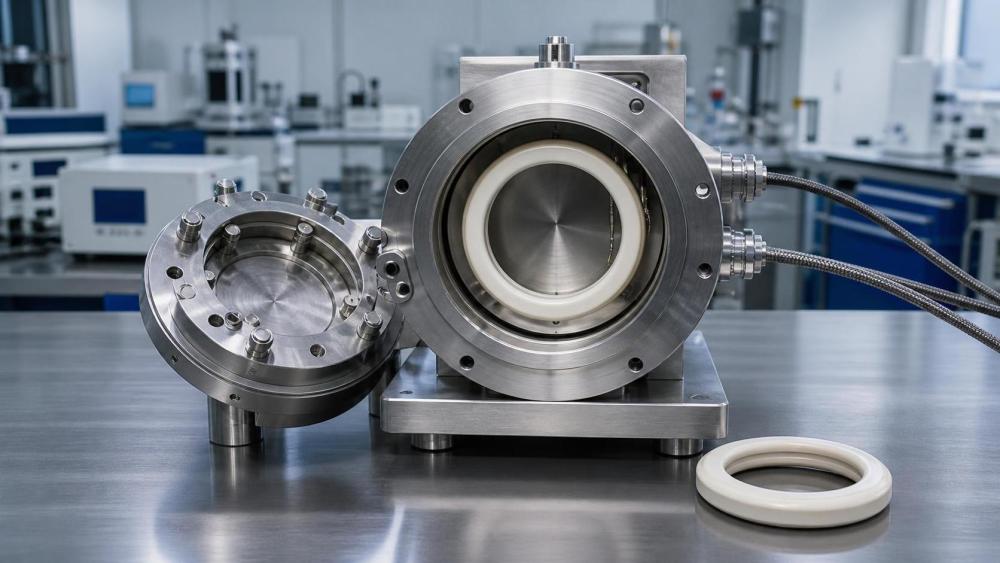
Dimensional stability protects the seal geometry
High-temperature service can slowly alter the shape of a seal. Some materials shrink after heat aging, while others expand unevenly or warp under load. Even small dimensional changes matter because seal performance depends on controlled contact pressure and fit.
Dimensional stability becomes especially important in precision components, hydraulic systems, rotating equipment, and compact assemblies where clearances are tight. If the material changes size too much, installation force may increase, grooves may no longer retain the seal correctly, or the contact line may shift away from the intended zone.
For decision-makers comparing candidate materials, thermal expansion behavior and post-aging dimensional change should be reviewed alongside hardness and elasticity. A seal that keeps its shape often outperforms one that merely withstands short-term heat.
Hardness, wear resistance, and friction still have a role
Although heat survival is the headline issue, mechanical behavior still matters. In dynamic applications, higher temperature can reduce lubricant film stability and increase wear risk. A seal material that becomes too hard may raise friction and damage mating surfaces. One that becomes too soft may wear rapidly or extrude under pressure.
The right balance depends on whether the seal is static or moving, and on the kind of motion involved. Rotary shafts, reciprocating rods, and oscillating joints all create different demands. In these cases, wear resistance and friction behavior should be checked together with thermal aging data, because a material that looks excellent in a lab oven may behave differently on a live machine.
How evaluators should compare materials
A practical selection process starts with the service environment, not the material catalog. Ask four questions:
- What is the continuous and peak operating temperature?
- Which fluids, gases, or chemicals will contact the seal?
- Is the seal static, dynamic, or exposed to pressure cycling?
- What failure mode would be most costly: leakage, wear, extrusion, or shutdown?
From there, compare candidate materials using property data that reflects real service conditions: heat aging, compression set, tensile retention, volume change, and compatibility with the process media. If possible, request test results at temperature rather than relying on room-temperature specifications. For critical equipment, prototype testing in the actual duty cycle can reveal issues that standard datasheets miss.
In many industrial applications, common elastomers may be suitable only up to a moderate temperature window, while fluorinated or specialty materials are considered for harsher environments. The best choice is not always the highest-temperature option. It is the material that holds sealing force, remains chemically stable, and preserves geometry for the longest practical service interval.
Common mistakes in high-temperature seal selection
One frequent mistake is choosing a material based on peak temperature alone. Another is assuming a seal that works in oil will also work in hot oil, steam, or solvent vapors. A third is ignoring installation stress: even a good material can fail early if the groove design, surface finish, or compression level is wrong.
There is also a tendency to overlook aging behavior. Some seals perform well in the first month and then decline as thermal oxidation, additive loss, or hardening accumulates. For maintenance teams, this can create a frustrating pattern: the seal seems “fine” during commissioning but becomes a recurring failure later.
The more demanding the service, the more important it becomes to think in terms of lifetime behavior rather than initial appearance.
Choosing for reliability, not just survival
In high-temperature service, the best sealing material is the one that keeps its mechanical recovery, resists the process media, stays dimensionally stable, and maintains enough contact force over time. That combination is what prevents leakage and protects uptime.
If you are evaluating sealing material properties for industrial equipment, focus on long-term aging data, compression set, compatibility, and geometry retention before making a final selection. In real systems, those properties usually matter more than a single temperature number on a datasheet.
Heat exposure is only the beginning. A seal earns its value when it remains dependable after the temperature rises, the load cycles continue, and the equipment must keep running without interruption.
Related News
- 00
0000-00
Where are axial piston pumps used in mining equipment? - 00
0000-00
Embodied AI Robotics and Drive Control Forum Held in Shanghai - 00
0000-00
How does seal service life affect the total cost of ownership? - 00
0000-00
Schaeffler to Cut 3,460 Jobs and Close Five European Plants - 00
0000-00
How does system size affect the price of a belt drive system?
Weekly Insights
Stay ahead with our curated technology reports delivered every Monday.