





Why is predictive maintenance technologies implementation getting board-level attention?
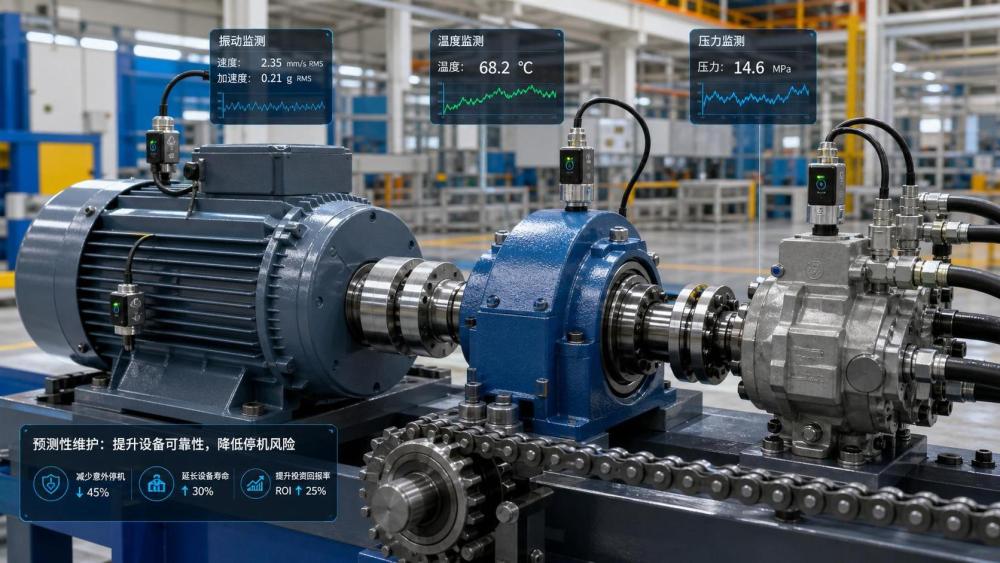
Unplanned downtime is no longer treated as a maintenance issue alone. It affects delivery risk, inventory exposure, service quality, and capital planning.
That is why predictive maintenance technologies implementation now sits closer to asset strategy than routine upkeep.
In practical terms, the goal is simple. Detect failure patterns early enough to avoid emergency shutdowns, rushed spare purchases, and repeat breakdowns.
For rotating and fluid power assets, that often means watching vibration, temperature, pressure, flow, lubrication condition, and energy behavior.
The strongest use cases usually involve bearings, hydraulic pumps, motors, cylinders, chains, belts, couplings, seals, and other reliability-critical components.
This is especially relevant in operations where a small component failure can stop an entire line or damage adjacent equipment.
PCTS frequently frames these decisions through total cost of ownership. That matters because predictive maintenance technologies implementation should be judged by avoided loss, not sensor price alone.
What does a workable implementation actually include?
Many teams assume predictive maintenance means buying software first. In reality, software is only one layer of the stack.
A workable implementation usually combines sensing, connectivity, asset context, alarm logic, and a response process that maintenance can actually execute.
For example, bearing health may depend on vibration signatures and lubrication trends. Hydraulic systems may need pressure ripple, temperature, contamination, and duty-cycle data.
Chains and belts may require wear, tension, alignment, and slip indicators. Seal-heavy systems may need leakage, heat, pressure variation, and chemical exposure tracking.
The implementation becomes useful when these signals are linked to failure modes, spare parts planning, and intervention thresholds.
A simple way to view the structure is below.
The table matters because predictive maintenance technologies implementation succeeds when technical signals and business decisions are tied together from the start.
Where do cost and downtime savings usually show up first?
Most savings do not come from eliminating every failure. They come from changing the timing and severity of failures.
A bearing replaced during a planned stop is cheaper than a seized shaft that damages housings, seals, and connected transmission parts.
A hydraulic pump with monitored wear can be serviced before pressure instability causes scrap, overheating, or downstream actuator problems.
In many plants, the early gains appear in four areas:
- Reduced emergency maintenance labor and overtime
- Lower secondary damage to couplings, belts, seals, and adjacent assemblies
- Fewer expedited spare parts purchases and less stockpiling of uncertain demand items
- Longer useful life through better lubrication, alignment, and load management
That last point is often underestimated. Predictive maintenance technologies implementation can improve asset life even before a single failure is avoided.
Why? Because better visibility exposes chronic issues such as contamination, misalignment, over-tension, thermal stress, or unsuitable seal material selection.
Those findings support broader reliability improvements across transmission systems, fluid power circuits, and MRO planning.
How should ROI be judged before committing budget?
The cleanest ROI model starts with one question. What is the hourly cost of an unexpected stop on the assets being considered?
That figure should include lost production, quality losses, emergency labor, spare parts premiums, restart waste, and possible customer penalties.
Next, compare those losses against implementation cost over a realistic period, usually twelve to thirty-six months.
The budget side generally includes sensors, gateways, analytics, installation, integration, training, and review time from engineering and maintenance.
It is also useful to separate direct ROI from strategic value. Direct ROI is measurable cost avoided. Strategic value includes resilience, better planning, and stronger supplier decisions.
In sectors handling precision bearings, sealing systems, pneumatic actuation, and high-duty transmission components, lead time risk can materially change the business case.
A replacement component with a long sourcing cycle raises the value of earlier warning.
PCTS often highlights this procurement angle. Monitoring data is not only a maintenance tool. It can improve reorder timing, supplier comparison, and lifecycle cost decisions.
A quick decision filter
Before expanding investment, it helps to score candidate assets against a few practical questions.
What mistakes make predictive maintenance technologies implementation underperform?
The most common mistake is trying to monitor everything at once. Broad rollout feels ambitious, but it usually dilutes data quality and internal follow-through.
Another problem is relying on generic dashboards without failure-mode logic for specific assets.
A wind turbine bearing, a chemical pump seal, and a pneumatic actuator do not degrade in the same way. The monitoring model must reflect that.
There is also a human factor. If alerts do not connect to inspection routines, lubrication checks, or planned shutdown windows, teams stop trusting the system.
Needless complexity can be just as damaging. Some sites need advanced edge analytics. Others need disciplined threshold monitoring and cleaner maintenance records.
In real deployments, these warning signs deserve attention:
- No agreed list of critical assets
- Sensor placement chosen for convenience, not signal relevance
- No baseline data for downtime or maintenance spend
- No process for converting alarms into work orders
- Success measured by data volume instead of avoided loss
A narrower, disciplined start usually produces stronger ROI than a large but weakly governed rollout.
How can companies move from pilot to a defensible rollout?
The best path is rarely a full-site launch. A focused pilot on critical assets creates better evidence.
Choose assets where failure is expensive, measurable, and technically detectable. Rotating equipment, hydraulic power units, conveyors, and sealing-intensive systems are common starting points.
Then define success in business terms. Examples include fewer stoppage hours, lower emergency part orders, improved mean time between failures, or reduced scrap from unstable motion systems.
It also helps to align monitoring with component sourcing realities. If bearings, seals, or couplings have long lead times, build reorder signals into the review process.
This is where a sector intelligence source such as PCTS becomes useful. Technical content, supplier visibility, and lifecycle analysis can support better implementation assumptions.
Over time, predictive maintenance technologies implementation should mature into a decision framework, not just a technology layer.
The next step is practical. Map critical failure points, estimate real downtime cost, verify which signals matter, and set review standards before scaling budget.
That approach makes cost, downtime reduction, and ROI easier to defend when the rollout moves beyond the pilot stage.
Related News
- 00
0000-00
Which documents are essential for seal export compliance? - 00
0000-00
When do fluid power systems need closed-loop control? - 00
0000-00
How to vet an industrial sealing solutions supplier for critical equipment - 00
0000-00
When wireless intelligent condition monitoring justifies retrofit costs - 00
0000-00
When does an export compliance service reduce shipment delays?
Weekly Insights
Stay ahead with our curated technology reports delivered every Monday.