





In industrial operations, maintenance often fails not because teams lack skill, but because the work is planned around urgency instead of plant reality. Emergency repairs interrupt production, consume overtime, and push spare parts buying into a reactive mode. That is where shutdown scheduling becomes valuable. When it is built into Equipment Maintenance Planning, planned outages turn into controlled windows for inspection, replacement, cleaning, alignment, and verification. For project managers and engineering leads, the benefit is not just fewer failures. It is better coordination across labor, materials, safety controls, and recovery timing.
Shutdown scheduling works best when it is treated as a planning discipline rather than a calendar entry. A shutdown is a constraint-heavy event: production is paused, access is limited, contractors may be on site, and every hour has a cost. If maintenance tasks are not sequenced properly, the outage becomes a compressed scramble where high-risk work is rushed and low-value work steals critical time. By contrast, a well-structured shutdown plan makes it possible to bundle tasks that would otherwise require repeated line stoppages, especially on assets such as bearings, seals, chains, belts, couplings, hydraulic pumps, cylinders, and pneumatic actuators.
The practical value is easiest to see in equipment that degrades gradually. Bearings show rising vibration and temperature before failure. Seals may begin with minor leakage that becomes contamination. Transmission systems can lose tension or alignment. Hydraulic and pneumatic components may still function, but with lower efficiency and higher internal wear. These issues rarely justify immediate shutdown on their own, yet they are ideal candidates for planned intervention. Scheduling them into a shutdown window reduces the chance that a small defect escalates into a line-wide breakdown.
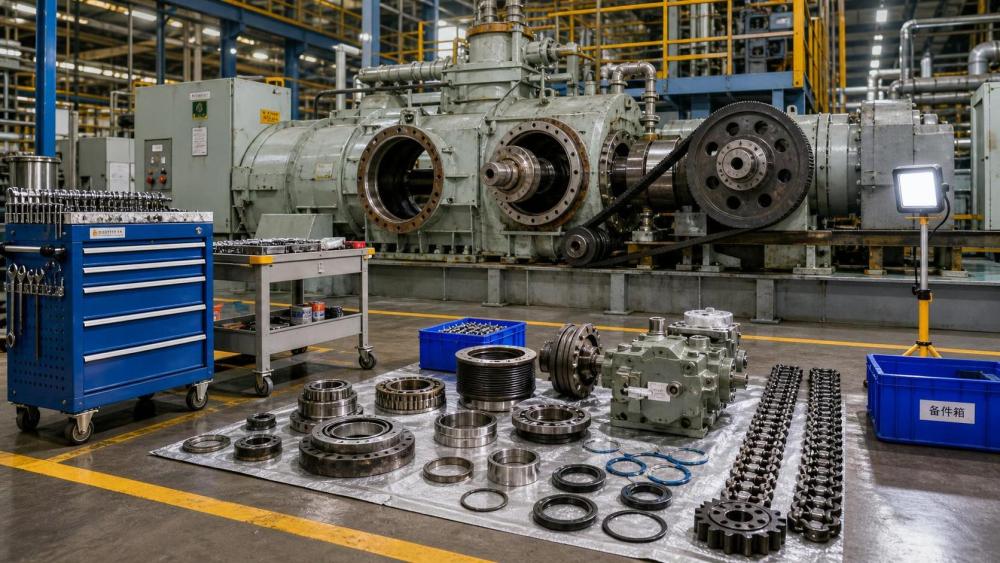
Why shutdown scheduling improves maintenance outcomes
The core advantage is timing. Maintenance performed during a planned outage is easier to resource, easier to inspect, and easier to verify. Teams can isolate equipment properly, apply lockout/tagout procedures, stage lifting tools, and coordinate specialist contractors without competing with active production. That matters in multi-trade environments where mechanical, electrical, hydraulic, and automation tasks overlap. A bearing replacement may depend on shaft inspection. A seal change may require fluid cleanliness checks. A chain or belt renewal may be useless if sprockets or pulleys are already worn beyond tolerance.
Shutdown scheduling also improves the quality of decision-making. When planners have a fixed outage date, they can inspect asset condition ahead of time and decide what truly needs to be done. That prevents two common mistakes: over-maintaining healthy equipment and under-maintaining degraded equipment because the opportunity was missed. For project managers, this means maintenance scope can be matched to actual risk rather than assumptions. It also gives procurement teams more time to verify lead times, especially for specialized components with long delivery cycles or application-specific specifications.
There is a cost advantage as well. Emergency work usually carries premium labor, expedited freight, and higher failure damage. Planned outage work may still be expensive, but the cost is visible earlier and can be spread across a controlled maintenance budget. That improves forecasting accuracy and supports lifecycle cost management. In sectors where downtime cost exceeds part cost, this difference can be decisive.
What changes in planning when shutdowns are scheduled properly
A shutdown plan changes maintenance from isolated tasks into a sequence of dependencies. The planner has to ask which assets share access constraints, which components must be removed before others, and which inspections should happen before replacement decisions are locked in. This sequencing is especially important for rotating equipment and power transmission systems. For example, replacing a belt without checking pulley wear can shorten the benefit of the intervention. Replacing a hydraulic seal without verifying fluid condition may lead to repeated leakage. Swapping a bearing without confirming alignment or lubrication practice can simply move the failure point downstream.
Another practical shift is spare parts preparation. Planned outages give teams time to identify critical spares, validate dimensions and material grades, and confirm compatibility with the installed base. That matters because components that look similar may not perform the same under load, pressure, temperature, or chemical exposure. For industrial MRO teams, the value is not just stock availability. It is matching the right component to the right failure mode. Shutdown scheduling makes this possible because the team is no longer buying in panic.
It also improves workforce allocation. Skilled technicians are often the limiting factor, not parts alone. A shutdown window allows supervisors to schedule mechanical fitters, riggers, inspectors, and commissioning staff in a tighter sequence. In larger projects, this helps reduce idle time between trades. In smaller facilities, it prevents one maintenance activity from blocking another. The result is more work completed per outage hour.
Where project managers usually underestimate the risk
One of the biggest planning mistakes is assuming the outage duration can absorb every task discovered on site. In reality, hidden defects expand scope quickly. A corroded fastener, worn coupling, or contaminated bearing housing can turn a routine replacement into a time-critical repair. Good shutdown scheduling includes contingency time, but it also defines what will not be attempted if the risk is too high. That discipline is often missing when teams rely on informal decision-making in the field.
Another common issue is poor readiness before the outage starts. If drawings are outdated, spare parts are unconfirmed, access equipment is unavailable, or permits are incomplete, the shutdown begins with friction already built in. For project managers, this is usually where schedule overruns originate. A strong plan does not just list tasks; it confirms prerequisites. That includes isolation plans, lifting studies, material kits, inspection criteria, contractor roles, and restart checks.
Condition data can also be misread. Some teams treat monitoring results as a reason to delay maintenance because the equipment is still running. Others replace parts too early because a single alarm looks alarming without trend context. Shutdown scheduling works best when condition monitoring is used to decide timing, not to replace planning. Vibration analysis, oil inspection, temperature trends, and leak observations should feed the schedule, but they do not eliminate the need for a structured outage plan.
How to build a shutdown plan that supports maintenance, not production pressure
Effective shutdown scheduling starts with criticality. Not every asset deserves the same level of attention. Equipment that can stop an entire production line, contaminate a process, or create safety risk should be prioritized first. For these assets, the maintenance plan should be built backward from the recovery requirement. What must be inspected? What parts must be available? What tests are needed before restart? What could delay return to service?
From there, tasks should be grouped by access and dependency. Jobs that require the same isolation, scaffolding, or lifting setup should be bundled together. Inspections should be sequenced before irreversible replacement work whenever possible. If a bearing housing, shaft, and seal stack all need attention, the inspection should determine whether the shaft can remain in service before parts are installed. This avoids rebuilding a problem area around an unverified foundation.
Material readiness deserves equal attention. For transmission parts, fluid power components, and sealing products, late part changes are a common cause of shutdown delay. Planners should verify not only quantity but also specification, batch traceability where relevant, and storage condition. Elastomer seals and O-rings can be compromised by age, heat, or contamination long before use. Hydraulic components may require cleanliness control. Belts and chains should be checked for matching dimensions and duty requirements. These details are minor on paper and expensive in a shutdown window.
Restart planning is often weaker than the outage plan itself. Yet the return-to-service phase is where many problems become visible. A proper shutdown schedule includes commissioning checks, trial runs, lubrication verification, torque confirmation, leak testing, and vibration confirmation. Skipping this stage saves minutes and creates days of future troubleshooting.
Why this matters for industrial components and MRO strategy
For plants that depend on precision mechanical components, shutdown scheduling is not just a maintenance technique. It is a supply and reliability strategy. Bearings, hydraulic systems, pneumatic actuators, seals, O-rings, chains, belts, and couplings all have wear patterns that are easier to manage when intervention is planned. The business value comes from turning uncertain failures into scheduled decisions. That reduces scrap, protects uptime, and gives procurement a clearer signal for replenishment.
It also changes how suppliers are evaluated. Vendors that can support accurate technical matching, short lead times, and consistent quality become more valuable when outages are planned on a fixed window. For companies with global sourcing or export operations, this matters even more. Cross-border delivery risk, documentation, and compliance delays can all affect whether a shutdown finishes on time. A component may be technically correct but operationally wrong if it cannot arrive, clear customs, or meet plant requirements before the outage.
For project managers, the strategic takeaway is simple: maintenance planning should not be built only around asset condition, and it should not be built only around production demand. The stronger approach is to connect both through shutdown scheduling. That is where inspection logic, spare parts planning, contractor coordination, and restart assurance come together.
In mature operations, the best shutdowns are not the ones that do the most work. They are the ones that complete the right work, in the right order, with the least uncertainty. That is what turns Equipment Maintenance Planning from a reactive cost center into a controlled reliability process.
Related News
- 00
0000-00
Which ISO standards apply to crane hydraulic systems? - 00
0000-00
How preload affects angular contact bearing stiffness and service life - 00
0000-00
Which documents are essential for seal export compliance? - 00
0000-00
When do fluid power systems need closed-loop control? - 00
0000-00
How to vet an industrial sealing solutions supplier for critical equipment
Weekly Insights
Stay ahead with our curated technology reports delivered every Monday.