





What should you really look for in a Precision Transmission Systems supplier?
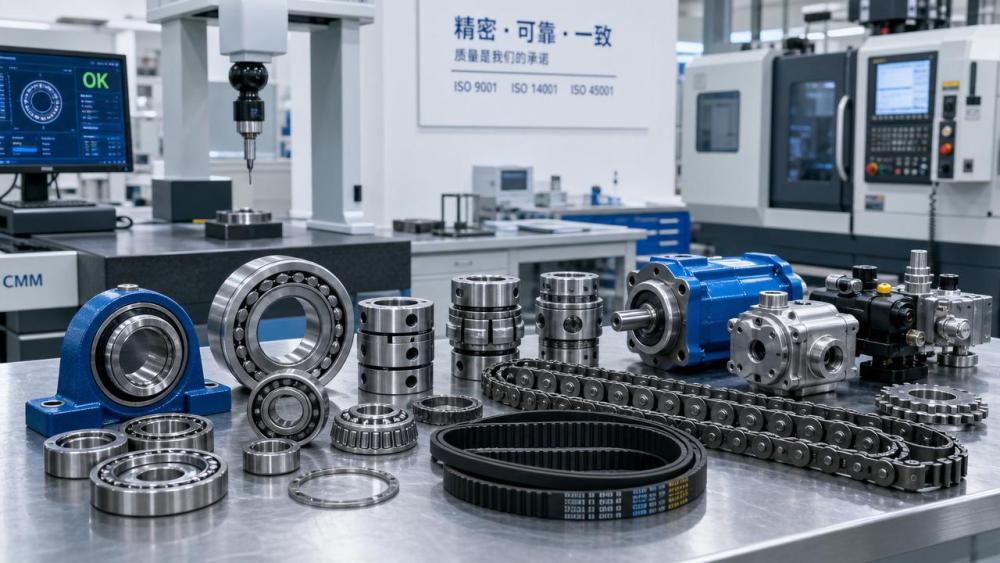
A Precision Transmission Systems supplier affects more than parts availability. It influences uptime, maintenance intervals, energy efficiency, and the cost of getting replacements wrong.
That is why a quick catalog review is rarely enough. In practice, the better question is whether the supplier can support performance under real operating conditions.
This matters across bearings, couplings, chains, belts, seals, hydraulic units, and related MRO components. Weak links usually appear where load, speed, contamination, or heat are underestimated.
A strong Precision Transmission Systems supplier usually combines product depth with engineering clarity. The goal is not only to ship parts, but to reduce lifecycle uncertainty.
Platforms such as PCTS have made comparison easier by organizing technical and market intelligence around rotating, sealing, lifting, and fluid power components. That wider context helps separate capable suppliers from resellers with limited technical control.
Is product range enough, or does engineering support matter more?
A broad product range helps, but it should not be the main decision factor. Many supply problems begin when a supplier offers many categories without application-specific understanding.
For example, a transmission component may meet basic dimensions and still fail early because lubrication, misalignment, shock load, or sealing material were not reviewed carefully.
A capable Precision Transmission Systems supplier should be able to discuss operating speed, torque variation, shaft tolerance, duty cycle, ambient temperature, and contamination risk.
That technical conversation becomes even more important when the scope includes hydraulic pumps, pneumatic actuators, spindle bearings, heavy-duty chains, or high-temperature seals.
Useful signs of engineering capability often include:
- Application review before quotation, not only after order placement.
- Material and design recommendations linked to actual duty conditions.
- Failure analysis support for wear, leakage, vibration, or slippage.
- Documentation that explains limits, not just marketing claims.
In other words, engineering depth is often the difference between buying components and buying reliability.
How can you judge quality consistency before placing a large order?
Quality consistency is where supplier evaluation becomes practical. One acceptable sample does not prove that batch control, process stability, and traceability are equally strong.
A dependable Precision Transmission Systems supplier should explain how quality is controlled from raw materials to final inspection. That is especially relevant for precision-ground bearings, machined couplings, sealing surfaces, and hydraulic assemblies.
Ask for evidence that connects manufacturing discipline to product performance. The most useful checkpoints are usually easy to compare side by side.
If a supplier cannot answer these points clearly, the risk is usually hidden in future variation, not in the first shipment.
What delivery and supply-chain signals should not be ignored?
Late delivery is not always a logistics issue. It can reflect weak production planning, poor subcontractor control, or unstable sourcing of steel, elastomers, castings, or machined parts.
For that reason, evaluating a Precision Transmission Systems supplier should include supply resilience, not just quoted lead time.
More reliable suppliers usually provide a realistic view of capacity, safety stock, packaging standards, and replacement planning for MRO demand.
In actual sourcing work, these questions are often more revealing than price:
- Are lead times stable across standard and custom items?
- Can urgent orders be prioritized without quality drift?
- How are export packing, labeling, and moisture protection handled?
- Is there a plan for alternates when one material source tightens?
PCTS-related market coverage is useful here because it connects supplier visibility with broader trends in bearings, seals, fluid power, and industrial transmission. That makes it easier to judge whether a delay is isolated or structural.
When does compliance become a deciding factor instead of a formality?
Compliance becomes critical when the component enters regulated, export-sensitive, or high-risk operating environments. In those cases, missing documentation can delay approval more than the component itself.
A Precision Transmission Systems supplier should be ready to discuss standards, material declarations, test reports, and application limits without hesitation.
This is especially relevant for chemical-resistant seals, hydraulic assemblies, safety-related motion systems, and components used in food, energy, semiconductor, or heavy process applications.
Need-to-confirm items may include:
- Material certificates and compound identification.
- RoHS, REACH, or other destination-specific declarations.
- Dimensional, pressure, leakage, or durability records.
- Clear statements on excluded operating conditions.
The best suppliers are usually precise about limitations. Vague answers often create expensive interpretation problems later.
How do you compare total cost instead of chasing the lowest quote?
The lowest unit price can still produce the highest annual cost. That happens when replacement frequency, leakage, belt slip, bearing noise, or downtime are left out of the comparison.
A better way to evaluate a Precision Transmission Systems supplier is to compare ownership impact across service life, maintenance effort, and failure consequences.
For instance, a more stable chain system may reduce tension adjustments. A better seal material may cut contamination risk. A well-matched hydraulic unit may lower energy loss and heat generation.
This is where technical intelligence becomes valuable. PCTS often frames component decisions around tribology, fluid power behavior, smart monitoring, and lifecycle economics rather than headline pricing alone.
A practical comparison can include:
- Expected service life under actual duty conditions.
- Maintenance intervals and lubrication requirements.
- Energy loss from friction, leakage, or poor fit.
- Downtime cost if the part fails unexpectedly.
- Availability of emergency replacement or local stock.
Once these factors are visible, the cheapest quote often stops looking like the safest decision.
What mistakes are most common when shortlisting a Precision Transmission Systems supplier?
One common mistake is focusing on dimensions and ignoring operating context. Another is treating all suppliers as equivalent if they can match the drawing.
In real projects, the larger risk usually sits in application mismatch, inconsistent batches, weak after-sales analysis, or unrealistic lead-time promises.
It is also easy to overlook support after installation. When vibration rises, seals harden, or chains stretch early, response speed matters just as much as the original quotation.
A sensible shortlist usually favors suppliers that can prove four things: they understand the application, control the process, communicate limits clearly, and stay responsive after delivery.
Before making the final choice, build a simple review sheet covering engineering fit, quality evidence, lead-time realism, compliance readiness, and ownership cost. That turns supplier comparison into a repeatable decision instead of a price-based guess.
If several candidates look similar, use a pilot order or defined trial batch. Small-scale validation often reveals more than a polished presentation.
Related News
- 00
0000-00
How FFKM O-rings reduce seal failure in corrosive media - 00
0000-00
What global equipment manufacturing in the USA means for supply chain risk - 00
0000-00
How FFKM outgassing performance affects vacuum seal selection - 00
0000-00
When should heat resistant metallurgy belts be replaced? - 00
0000-00
When does a fluid power maintenance service reduce unplanned downtime?
Weekly Insights
Stay ahead with our curated technology reports delivered every Monday.