





Why does a shortlist of global industrial components suppliers need deeper risk screening?
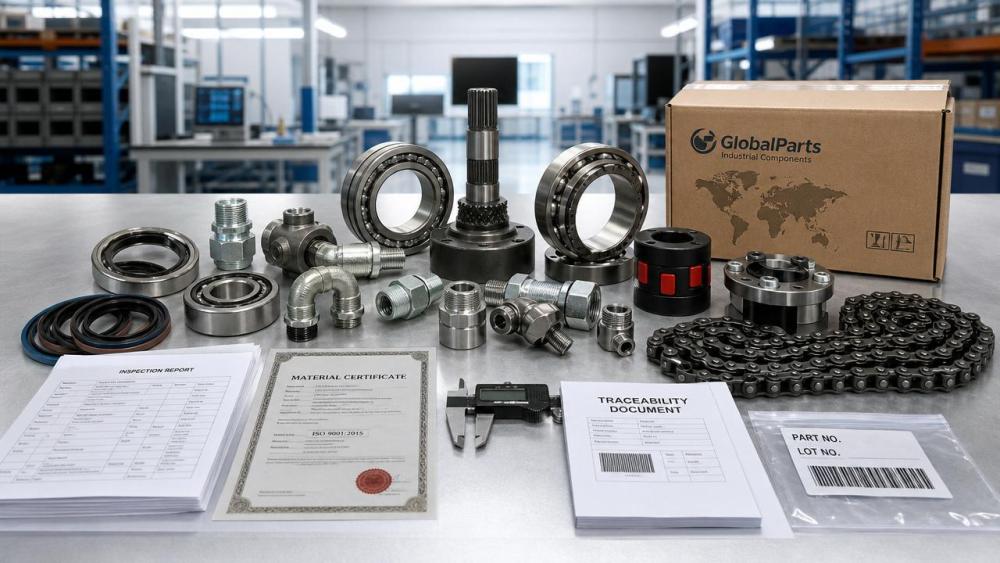
A quick quote comparison rarely shows the real sourcing risk.
When evaluating global industrial components suppliers, the hidden issues usually appear after approval, not before it.
That is especially true for bearings, hydraulic parts, pneumatic components, seals, chains, belts, couplings, and MRO-critical replacements.
A low unit price can still mean higher lifecycle cost.
Common losses come from unstable tolerances, delayed documentation, weak traceability, and poor technical support during installation or failure analysis.
In practice, the most reliable global industrial components suppliers prove value across quality, compliance, continuity, and service responsiveness.
This matters even more in cross-border sourcing, where language, standards, freight timing, and warranty handling add complexity.
Platforms such as PCTS help make that screening more practical.
They connect component knowledge with supplier visibility, application context, and reliability-focused market intelligence.
So the goal is not simply to find suppliers.
The goal is to remove avoidable risk before the shortlist becomes a contract discussion.
What should you verify first: trading company profile or actual manufacturing capability?
Start with the operating model behind the quotation.
Many global industrial components suppliers present broad catalogs, but the real question is who controls production, quality planning, and engineering decisions.
That difference changes risk dramatically.
A capable trading partner is not automatically a weak option.
However, it should clearly explain factory ownership, subcontracting scope, inspection authority, and escalation paths.
For precision bearings or seals, vague answers are usually a warning sign.
Ask for evidence tied to the supplied category.
- Factory audit reports or recent production images
- Process lists, such as grinding, heat treatment, molding, or machining
- Inspection capability for runout, hardness, leakage, pressure, or dimensional tolerance
- Named engineers or quality contacts for technical clarification
If a supplier cannot explain how a part is made, it may not control the outcome.
That is a serious issue when sourcing transmission systems, hydraulic pumps, or application-specific sealing parts.
How do you tell whether quality claims are real or just brochure language?
This is where many shortlists fail.
Terms like high precision, durable material, or long service life sound useful, but they do not support a sourcing decision by themselves.
More useful evidence is measurable and repeatable.
For example, bearing suppliers should discuss tolerance grade, lubrication approach, fatigue performance, and operating speed limits.
Seal suppliers should address media compatibility, temperature range, compression set, and leakage prevention conditions.
Hydraulic and pneumatic suppliers should explain pressure stability, cycle life, contamination sensitivity, and field maintenance requirements.
A practical comparison table helps separate marketing from operational reality.
This kind of review is especially useful when screening global industrial components suppliers across several product families.
PCTS-style technical content is valuable here because it links supplier claims with engineering context, not just listings.
Are certifications enough, or do compliance risks still remain?
Certifications help, but they are not the full answer.
A valid certificate shows a framework.
It does not automatically prove that every bearing, belt, seal, or actuator shipped will match the declared standard.
The more important check is alignment between documents and actual delivery practice.
For regulated industries or export-sensitive destinations, request confirmation on labeling, origin records, test reports, and restricted substance declarations where relevant.
Need-to-know details often include revision control and document consistency.
If drawings, packing labels, and inspection sheets do not match, customs or acceptance problems can follow.
A stronger supplier will also explain what standards apply by product type.
That may include ISO systems, material conformity records, pressure testing evidence, or sealing material performance data for aggressive media.
In short, compliance is not a checkbox.
It is a control chain that must survive inspection, shipping, installation, and warranty review.
When lead times look acceptable, what delivery risks are still easy to miss?
Quoted lead time is only one part of delivery reliability.
More common failures come from capacity swings, missing raw materials, unstable sub-suppliers, and weak export coordination.
This becomes critical for replacement chains, custom seals, precision bearings, and hydraulic assemblies needed during shutdown windows.
A useful question is not, “What is your lead time?”
A better question is, “What makes your lead time fail?”
That wording reveals whether the supplier understands risk drivers.
- Ask about safety stock for critical materials
- Check order visibility from production to shipment
- Confirm packaging standards for moisture, corrosion, and impact protection
- Review performance on partial shipments and urgent replacements
Reliable global industrial components suppliers normally share realistic schedule buffers rather than overpromising a perfect date.
That honesty is often a better predictor than the shortest quoted lead time.
How much does after-sales support really matter in the total cost picture?
More than many teams expect.
A supplier may pass price, sample, and documentation checks, then fail when a field issue appears.
That is where total cost of ownership changes quickly.
For industrial components, downtime cost often exceeds purchase price by a wide margin.
If a seal fails in chemical service, or a bearing overheats in a high-speed spindle, response quality matters immediately.
Look for structured support, not polite promises.
Useful signs include failure analysis capability, replacement logic, application review, and support for preventive planning.
This is also where industry intelligence platforms become practical tools.
PCTS, for example, organizes topics such as lubrication, vibration monitoring, seal materials, belt slip prevention, and spare parts cycles.
That context helps evaluators judge whether a supplier understands equipment reliability, not just order handling.
If technical support is weak, the lowest quote may become the most expensive supplier in the shortlist.
So what does a practical six-check shortlist process look like?
A workable process should stay simple enough to repeat.
The six checks below cover the risks that most often distort supplier comparisons.
- Confirm operating model, factory control, and subcontracting boundaries
- Test quality claims using application-specific evidence
- Review traceability, certificates, and document consistency
- Check lead-time resilience, packaging, and shipment visibility
- Assess engineering support and failure-response discipline
- Compare total cost, not only quoted unit price
Used together, these checks give a clearer picture of global industrial components suppliers across technical, commercial, and operational risk.
That is particularly useful when comparing suppliers across bearings, hydraulics, pneumatics, transmission parts, sealing products, and industrial MRO items.
Before moving forward, refine the requirement by duty condition, replacement urgency, compliance scope, and expected service life.
Then score each shortlisted supplier against the same evidence standard.
That approach creates better sourcing decisions than price-first filtering, and it reduces surprises after award.
Want to dive deeper into these market dynamics, or need data-driven support for your next business move? Drop a line below and let the analysts at PCTS provide customized insights.
We respect your privacy. Your information is strictly confidential.
Related News
- 00
0000-00
How to check vibration analysis software for sensor compatibility - 00
0000-00
IndexBox Forecasts 3.8% Annual Growth for Global Radial Seals Market Through 2035 - 00
0000-00
How to assess the chemical compatibility of FFKM sealing sheets - 00
0000-00
IndexBox Forecasts 3.6% Annual Growth for Construction Bearings Market - 00
0000-00
When do hydraulic components require an export license?
Weekly Insights
Stay ahead with our curated technology reports delivered every Monday.