





Start with the parts that keep stopping your orders
If you buy bearings, seals, chains, belts, couplings, hydraulic parts, or pneumatic components across more than one plant or supplier, standardization stops being an engineering preference and turns into a purchasing control tool. The practical value is simple: fewer part variations, fewer surprises in incoming quality, fewer compatibility arguments between maintenance and procurement, and less time wasted chasing substitutes when lead times stretch out.
Most sourcing delays do not start with freight. They start earlier, when the same function is being fulfilled by five slightly different SKUs, three drawing versions, and two naming systems. By the time a buyer discovers that a seal groove changed, a bearing clearance class was never specified, or a cylinder mounting pattern is plant-specific, the delay is already built in.
That is where Industrial Component Standardization pays off. Not as a theory, but as a checklist: what should be unified, what must stay application-specific, and what has to be locked down before a purchase order goes out.
Check whether you are standardizing the right layer
A common mistake is trying to standardize complete assemblies before standardizing the critical interfaces. For procurement, the better sequence is usually this: standardize dimensions, mounting interfaces, material callouts, performance class, and documentation requirements first. After that, decide whether the full part number can be consolidated.
Take seals as an example. Standardizing only the supplier name does very little if media compatibility, temperature range, groove dimensions, and material grade are still being interpreted differently by each site. The same logic applies to bearings, where boundary dimensions alone are not enough if internal clearance, cage type, lubricant condition, and sealing arrangement are left open.
- If the part mates with other equipment, lock the interface first.
- If failure risk comes from operating conditions, lock the performance-critical fields next.
- If replenishment speed is the main issue, clean up SKU duplication before negotiating volume.
This sounds basic, but it prevents a lot of expensive false standardization, where purchasing thinks two items are interchangeable and the field team knows they are not.
Build a controlled interchangeability list, not a loose substitute list
Many delays come from buyers asking for “equivalents” too late, usually when the original supplier cannot meet the date. That approach creates quality risk because the substitute decision gets made under schedule pressure.
A cleaner method is to maintain an approved interchangeability list by component family. For each item, define which characteristics must match exactly, which can vary within limits, and which require engineering review before release.
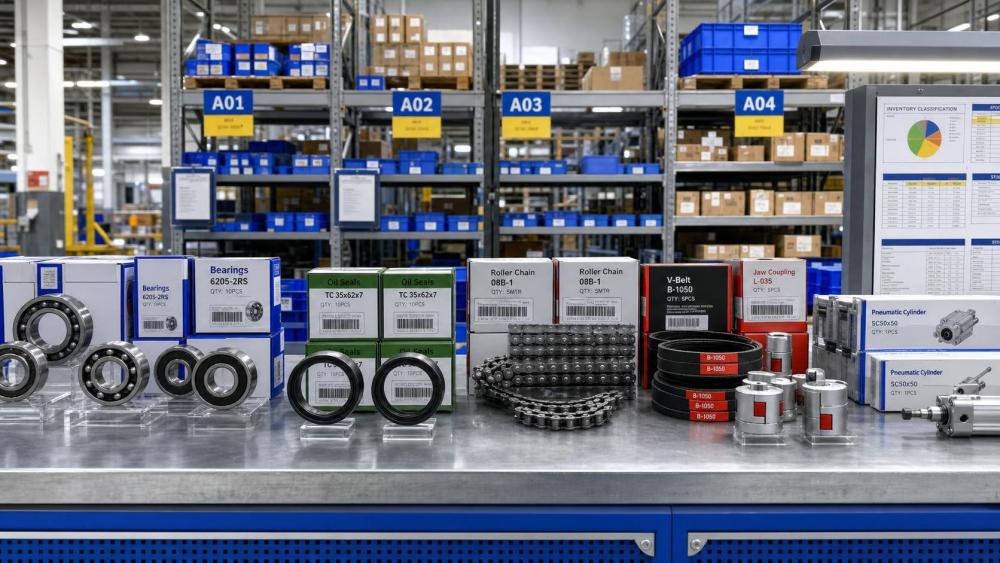
That list should live next to your approved vendor logic, not inside someone’s email archive. When a shortage hits, the buyer needs a pre-cleared path, not a fresh technical debate.
Clean up the specification before negotiating price
Procurement teams often try to consolidate spend while the technical description is still messy. That usually backfires. Suppliers quote conservatively when part definitions are vague, and they protect themselves with exclusions, long lead times, or broad tolerance assumptions.
Before asking for volume pricing on standardized items, check these points:
- Is there one approved part description for each item, including revision status?
- Are units of measure consistent across ERP, drawings, and supplier quotes?
- Are material and performance requirements written in a way suppliers can quote against?
- Do packaging, preservation, and shelf-life rules matter for this part family?
- Is there a receiving inspection method tied to the specification?
If the answer is no on any of these, your standardization work is incomplete. You may still get a lower piece price, but you are not reducing sourcing risk yet.
Separate true customization from inherited variation
Some variation is real. A high-temperature seal in aggressive media should not be forced into the same standard as a general-duty maintenance part. A spindle bearing application should not be bought with the same decision logic as a standard mounted bearing. The problem is that many purchasing portfolios carry variation that no longer has a technical reason behind it.
Ask a hard question: if this part were introduced today, would anyone still specify it this way? If the only answer is “that’s what the old machine uses,” review whether adapter kits, revised housings, or planned replacement during maintenance shutdown could move the asset into a standard family. That single decision can reduce years of emergency buying.
Use failure mode, not annual spend, to set standardization priority
High-spend items get attention, but low- to mid-value components often create the worst downtime. A small seal, coupling element, belt profile, or pneumatic fitting can hold up a full line if it is not standardized and stocked correctly.
A practical prioritization screen looks like this:
- How many assets depend on the part?
- What happens if the wrong version is installed?
- Can maintenance identify a mismatch before startup, or only after failure?
- How many approved sources exist today?
- Is lead time volatile because of material, machining, or imported subcomponents?
Parts with hidden mismatch risk and weak source coverage should move to the front of the standardization queue, even if their unit price is modest.
Make supplier approval narrower than part approval
This is where many programs drift off course. A supplier may be approved for industrial bearings in general, but not for every bearing class your operation uses. The same applies to sealing products, hydraulic assemblies, and transmission parts. Standardization only lowers quality risk when approval is tied to the exact part family, operating duty, and documentation level required.
For each standardized category, define what the supplier must provide with the quote and with the shipment. That may include dimensional records, material identification, pressure or performance-related documentation, traceability fields, shelf-life marking, batch identification, or storage instructions, depending on the component. If those requirements are not part of the sourcing package, “approved supplier” becomes a label with too much room inside it.
Standardize how your plants name and receive parts
One plant calls it a rod seal kit, another books it as a hydraulic seal set, and a third receives the same item under a machine-specific spare code. Buyers then think they are managing three products. They are not. They are managing one part with three identities, and that creates duplicate stock, fragmented demand history, and weak forecasting.
Your item master should carry a standard description structure, key dimensional fields, legacy cross-references, approved substitute logic, and a clear status for active, restricted, and obsolete variants. This is dull work. It is also where sourcing delays quietly disappear, because the wrong part stops entering the system in the first place.
Do not standardize away application risk
There is a point where standardization becomes too aggressive. Procurement sees a chance to reduce SKUs; maintenance later gets leakage, premature wear, heat build-up, or shortened life because the chosen standard ignored the operating environment.
When the part is exposed to pressure, speed, contamination, temperature extremes, corrosive media, or unusual duty cycles, treat standardization as a controlled family decision, not a universal replacement rule. In practice, that means grouping parts into application bands: general duty, harsh environment, high precision, chemical exposure, high temperature, and so on. You still reduce complexity, but you do it without flattening real technical differences.
Tie inventory policy to the new standard, or nothing changes
Standardizing components without changing stocking rules only gives you cleaner paperwork. The operational gain comes when demand from several old SKUs is combined into one replenishment signal. That improves reorder accuracy and usually gives buyers better leverage on call-off volumes, stocking agreements, or regional supply coverage.
Watch for one trap: old variants often continue to sit in stores because nobody formally blocks them. Once a new standard item is released, define the depletion path for replaced stock, the cutover date in ERP, and the exception process for machines that still require the old version during transition.
Use a short release gate before full rollout
You do not need a massive transformation project to make Industrial Component Standardization work. You do need a release gate. Before adding a standardized part to wide use, confirm that engineering, maintenance, procurement, quality, and stores are all reading the same item the same way.
A practical gate can be handled in one review:
- Approved technical definition
- Qualified source list by part family
- Receiving and traceability requirements
- ERP item master and cross-reference cleanup
- Inventory cutover and obsolete-stock handling
If you want fewer delays and fewer quality disputes, begin with the components that fail in silence: the parts that look similar, get described loosely, and are hard to substitute under pressure. Standardize those first. Lock the interfaces, narrow the approval logic, clean the item master, and connect the new standard to inventory and sourcing rules. That is usually where the savings show up fastest, and where downtime risk starts to come down for real.
Related News
- 00
0000-00
How FFKM O-rings reduce seal failure in corrosive media - 00
0000-00
What global equipment manufacturing in the USA means for supply chain risk - 00
0000-00
How FFKM outgassing performance affects vacuum seal selection - 00
0000-00
When should heat resistant metallurgy belts be replaced? - 00
0000-00
When does a fluid power maintenance service reduce unplanned downtime?
Weekly Insights
Stay ahead with our curated technology reports delivered every Monday.