





Bearing Fault Diagnostics Is Not Just Vibration Alarms
Bearing fault diagnostics is often misunderstood as a narrow maintenance task: collect vibration data, look for a peak, replace the bearing. In practice, it is a broader reliability discipline used to determine whether a rolling bearing is healthy, degrading, misapplied, poorly lubricated, or being damaged by conditions elsewhere in the machine. That distinction matters. A bearing rarely fails in isolation. What looks like a bearing problem may actually begin with shaft misalignment, contamination ingress, improper preload, lubrication film collapse, electrical discharge, looseness in the housing, or dynamic loading beyond the original design assumptions.
For technical evaluators, the real value of bearing fault diagnostics is not simply detecting damage after it exists. It is establishing how early a condition can be detected, how confidently it can be distinguished from other machine faults, and whether the monitoring method fits the operating environment. A slow-speed conveyor pulley, a machine tool spindle, a wind turbine main shaft, and a hydraulic motor support bearing do not generate the same signal quality or the same diagnostic difficulty. The term covers methods, signal interpretation, failure progression, and decision criteria, not just instrumentation.
In industrial procurement and asset management, this is where diagnostics becomes commercially relevant. The bearing itself is only one cost element. Downtime, secondary damage, inspection labor, spare part lead time, lubrication practices, and replacement interval uncertainty usually carry more financial weight than the bearing purchase price alone.
What Engineers Mean by a “Bearing Fault”
A bearing fault is not limited to a cracked raceway or spalled rolling element. In diagnostic language, it can refer to any detectable condition that indicates abnormal contact, material distress, lubrication breakdown, or instability in the bearing system. Some faults are geometric and localized, such as defects on the inner race, outer race, cage, or rolling elements. Others are systemic: surface distress from inadequate lubrication, false brinelling during standstill vibration, corrosion from moisture ingress, smearing from sliding, or fluting caused by electrical current passage.
This is why good diagnostics starts with failure mode thinking. If a monitoring result shows elevated high-frequency energy, that does not automatically mean a raceway defect. It may indicate lubrication starvation. If overall vibration rises, the source may be imbalance or soft foot rather than bearing damage. The diagnostic task is to relate the signal to a physically credible mechanism.
That mechanism also changes with bearing type and application. High-speed angular contact bearings in precision equipment are sensitive to preload, lubrication regime, and thermal behavior. Spherical roller bearings in heavy process machinery may tolerate more contamination but operate under much higher shock and load variation. Identical signal-processing logic will not always produce equally reliable conclusions across both cases.
The Main Diagnostic Methods and Where They Work Best
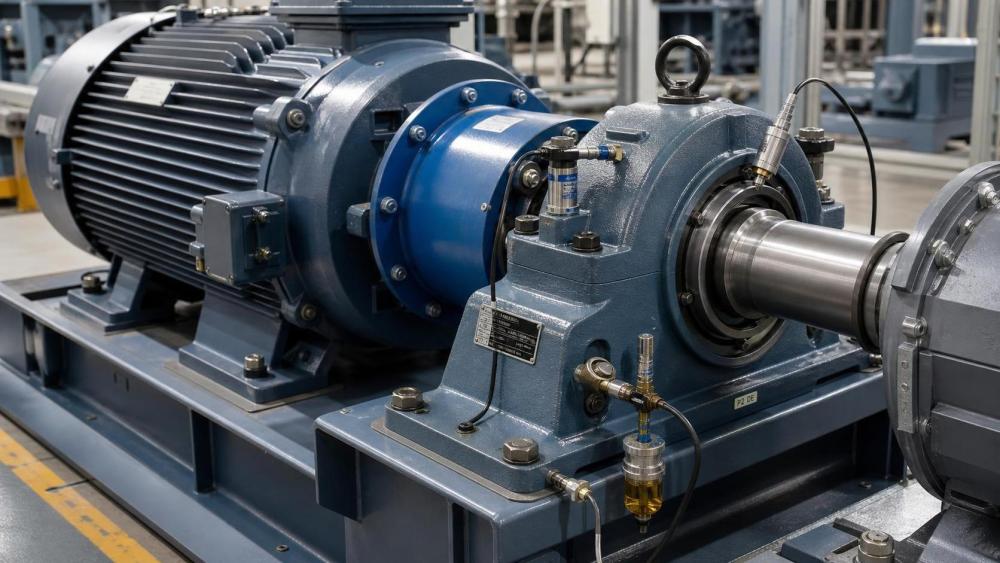
Vibration analysis remains the core method because rolling element defects create repetitive mechanical impacts as damaged surfaces pass through the load zone. Those impacts modulate machine vibration and, when conditions are favorable, produce characteristic frequencies linked to bearing geometry and shaft speed. Analysts often track these patterns using time waveform, FFT spectrum, and envelope or demodulation techniques. For medium- and high-speed rotating equipment, this approach is usually the most information-rich.
Still, vibration is not always sufficient by itself. Acoustic emission can detect very early surface interaction and microscopic distress in some applications, especially where conventional vibration trends are still weak. Temperature monitoring is less sensitive as an early detector, but it is useful for confirming worsening friction, lubrication problems, or load-related thermal stress. Lubricant analysis adds another layer by revealing wear debris, contamination, water presence, or grease degradation. In electrically stressed systems, shaft grounding checks and current-related inspection may be necessary because the bearing damage mechanism is not purely mechanical.
A practical way to view the methods is this:
No single method owns the whole problem. In critical assets, the strongest diagnostic programs combine at least two information sources so that a suspicious signal can be cross-checked against operating temperature, lubrication condition, or process behavior.
Why Signal Interpretation Is More Difficult Than It Looks
The textbook idea is straightforward: a defect produces characteristic bearing frequencies, and those frequencies identify the damaged component. Real machines are noisier. Speed variation smears spectral lines. Structural resonance amplifies some frequencies and hides others. Gearmesh, blade pass, pump pulsation, and belt dynamics can overlap with bearing-related content. A signal may show sidebands, harmonics, or broadband energy growth without giving a neat diagnostic signature.
That is why trend quality matters as much as absolute amplitude. A modest but persistent change in high-frequency vibration, especially when correlated with lubrication events or load changes, can be more useful than a single high reading. The question is not only “Is this value above alarm?” but also “What changed, when, under what operating condition, and does the pattern match a plausible degradation path?”
For evaluators comparing monitoring approaches, this becomes a standards and workflow issue. Data collection must be repeatable. Sensor placement must be consistent. Machine speed and load context should be captured. Otherwise, the signal history becomes difficult to trust, and diagnostics turns into subjective interpretation rather than defendable condition assessment.
Early Warning Signs Before a Bearing Fails Catastrophically
Early warning signs rarely arrive as dramatic symptoms. More often, they appear as small but persistent departures from the machine’s normal signature. These may include rising envelope acceleration, increased ultrasonic activity, a gradual shift in temperature baseline, grease leakage or discoloration, shortened relubrication effectiveness, or intermittent noise during startup and coastdown. In some assets, operators notice subtle changes first: a different sound under load, more torque fluctuation, or a change in product quality linked to spindle or roller stability.
The key point is that early warning does not always mean visible damage. Surface distress and lubrication film failure can exist well before spalling is obvious. By the time temperature rises sharply or audible noise becomes constant, the defect may already be advanced enough to threaten surrounding components such as shafts, housings, seals, or couplings.
There is also a difference between detectable and actionable. A highly sensitive system may flag a weak anomaly months before failure, but if the machine duty cycle is irregular or access for planned shutdown is limited, maintenance teams still need a threshold for intervention. Good diagnostics supports that decision by showing progression, not by generating alerts in isolation.
Common Misreadings in Bearing Diagnostics
One common mistake is assuming all repetitive vibration in a rotating machine comes from the bearing. Misalignment, looseness, resonance, gear defects, and hydraulic or aerodynamic excitation can create patterns that appear similar at first glance. Another mistake is treating bearing defect frequency calculations as absolute proof. Those frequencies are useful guides, but signal quality depends on load zone behavior, slip, mounting stiffness, and rotational stability.
A different kind of error appears in procurement and specification. Some teams assume that installing a higher-grade or more expensive bearing will solve recurring failures without revisiting contamination control, fit tolerances, sealing, lubrication delivery, or shaft current mitigation. Diagnostics often shows that the bearing is the victim, not the origin of the problem.
There is also overconfidence in generic alarm thresholds. Broad vibration severity standards are useful for machine condition screening, but they are not a substitute for application-specific baseline knowledge. A low-speed heavily loaded bearing may need different monitoring logic from a fast electric motor bearing, even when both are formally within acceptable vibration classes.
What Technical Evaluators Should Actually Look For
When assessing a bearing diagnostic method, the important questions are practical. Can it detect early-stage defects under the actual operating speed range? Does it separate bearing damage from neighboring fault sources? Can the plant collect data consistently enough to build trustworthy trends? Does the method work on grease-lubricated and sealed-for-life units, or only on accessible oil-lubricated systems? How dependent is it on specialist interpretation?
It is also worth checking whether the monitoring strategy matches the consequence of failure. Critical continuous-process assets justify more advanced sensing and analytics than non-critical intermittent machines. In some cases, handheld route-based vibration checks are enough. In others, permanently mounted sensors, edge processing, and alarm logic integrated with maintenance planning are easier to defend economically because the failure cost is far higher than the monitoring cost.
For portals and technical intelligence platforms serving bearings, transmission parts, seals, hydraulic systems, and industrial MRO, this broader perspective is essential. Bearing fault diagnostics intersects with lubrication practice, sealing performance, contamination control, load transmission quality, and total cost of ownership. A bearing can only be evaluated properly inside that whole mechanical system.
A Useful Working Definition
A useful working definition is this: bearing fault diagnostics is the disciplined process of detecting, interpreting, and validating signals that indicate abnormal bearing condition early enough to guide maintenance, specification, and risk decisions. That process draws from vibration, acoustic, thermal, lubrication, and application knowledge. It is not just about finding a damaged part. It is about understanding when the bearing condition changed, why it changed, how quickly it is progressing, and whether the observed evidence supports intervention.
For anyone evaluating machines, suppliers, monitoring systems, or lifecycle risk, that is the level at which the term becomes useful. Once diagnostics is treated as a decision tool rather than a single test method, it becomes much easier to judge bearing performance realistically and much harder to be misled by isolated signals.
Related News
- 00
0000-00
How FFKM O-rings reduce seal failure in corrosive media - 00
0000-00
What global equipment manufacturing in the USA means for supply chain risk - 00
0000-00
How FFKM outgassing performance affects vacuum seal selection - 00
0000-00
When should heat resistant metallurgy belts be replaced? - 00
0000-00
When does a fluid power maintenance service reduce unplanned downtime?
Weekly Insights
Stay ahead with our curated technology reports delivered every Monday.