





How Real Time Condition Monitoring Solutions Reduce Unplanned Downtime
For industrial leaders, unplanned downtime is more than a maintenance issue. It shows up as missed output, overtime labor, expedited parts, unstable delivery dates, and uncomfortable conversations with customers. Real time Condition Monitoring Solutions earn attention because they help teams catch early signs of bearing wear, seal failure, vibration drift, lubrication problems, hydraulic instability, and transmission losses before a stoppage turns into a plant-wide problem.
The useful question is not whether monitoring sounds modern. It is whether the system will actually help your operation make better decisions in time. That is where many projects either pay back quickly or end up as another dashboard nobody trusts. If you are evaluating a solution for rotating equipment, fluid power assets, conveyors, gearboxes, pumps, fans, compressors, or critical process lines, this is the checklist experienced buyers usually work through.
Start with the assets that hurt when they fail
Do not begin with “everything.” Start with the machines that create the worst business impact when they stop. In most plants that means one of three groups: bottleneck production assets, safety-critical equipment, or machines with long lead-time spare parts.
A bearing failure on a non-critical utility skid is annoying. The same failure on a main process fan, packaging line gearbox, hydraulic power unit, or wind-up transmission stage can shut down an entire shift. Decision-makers should ask maintenance and production teams the same blunt question: if this machine goes down tonight, what happens by morning?
- Does it stop upstream or downstream lines?
- Is there a standby unit that actually works, not just one shown on a P&ID?
- Are replacement bearings, seals, couplings, belts, or hydraulic components in stock?
- Will failure damage adjacent parts, shafts, housings, or product quality?
If you cannot rank assets by consequence, your monitoring rollout will be too broad and too slow to show value.
Check whether the failure modes are monitorable in real time
Not every maintenance issue benefits equally from continuous monitoring. The strongest use cases are failures that give off detectable signals before breakdown: vibration change, temperature rise, pressure instability, acoustic anomalies, motor current variation, lubricant contamination, or abnormal speed and torque behavior.
For example, rolling-element bearings often show warning signs through vibration patterns and temperature trends. Mechanical seals may reveal trouble through leakage indicators, temperature change, pressure fluctuation, or associated pump vibration. Belt drives and chain systems can show misalignment, slip, tension issues, or wear through speed variance, vibration, or load response. Hydraulic pumps and motors may expose internal wear through pressure ripple, heat, flow instability, or energy consumption changes.
If the dominant failures in your plant come from human setup errors, contamination during maintenance, or infrequent misuse, sensors alone will not solve the problem. They can still help, but the business case should include procedure control and training, not only technology.
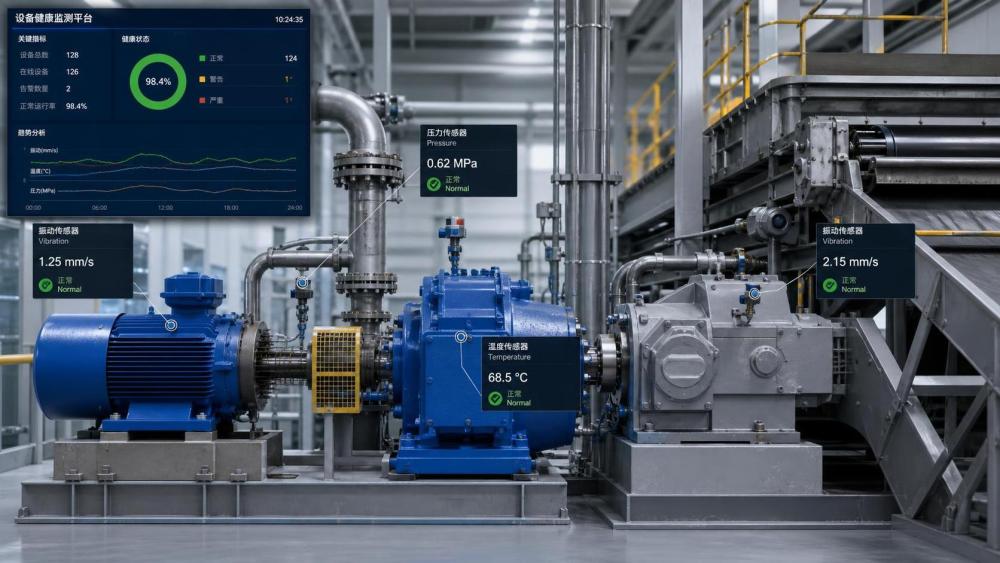
Make sure the sensors fit the physics of the machine
A surprising number of condition monitoring projects underperform because sensor selection was driven by catalog convenience instead of machine behavior. A slow-speed bearing, a high-speed spindle, a hydraulic power pack, and a bulk conveyor drive do not produce the same signals or need the same sensing strategy.
This sounds obvious, but it is where buyers need to press suppliers for specifics. Ask where each sensor should be mounted, what sampling behavior is required, what failure modes it can and cannot detect, and how false positives are handled. If the answer stays generic, keep asking.
Do not buy alerts before you understand baseline behavior
Real time Condition Monitoring Solutions are only as useful as their baseline. Machines behave differently depending on load, speed, product mix, ambient temperature, lubrication condition, and maintenance history. A pump that vibrates slightly more during one product run may be healthy. A gearbox that runs warmer in summer may still be within its normal envelope.
So before asking for “AI alerts,” ask a simpler question: how will the system learn what normal looks like here? That may involve collecting operating data across multiple duty cycles, shift patterns, and seasonal conditions. Without that step, teams often get either alert fatigue or dangerous silence.
A practical sign of maturity is whether the provider can separate threshold alarms from condition trends. Thresholds catch obvious trouble. Trends catch degradation early enough to plan an intervention. You need both.
Tie the system to maintenance action, not just visibility
If an alert appears on a screen and nobody knows who owns it, the project has already lost part of its value. Monitoring should connect to an action path: inspect, lubricate, align, rebalance, swap a seal, plan a bearing replacement, verify contamination, or reduce load until a shutdown window opens.
This is where operations, maintenance, and procurement intersect. The maintenance team needs clear escalation logic. The planner needs enough notice to schedule work. Procurement needs lead-time visibility for critical spares. On some imported components, especially specialty bearings, high-performance seals, and custom hydraulic parts, replacement timing can be the difference between a controlled repair and a week of waiting.
A good internal check is simple: when the system flags a likely fault, can your team describe the next three actions without holding another meeting?
Watch the economics, not just the technology
Decision-makers do not need a lecture on digitization. They need a believable downtime reduction case. In practice, that case usually comes from one or more of these levers:
- Fewer catastrophic failures that damage shafts, housings, rotors, or adjacent systems
- Less emergency labor and fewer off-hours interventions
- Lower spare-parts waste from replacing components too early
- Better shutdown planning and less production disruption
- Longer useful life from bearings, seals, belts, chains, lubricants, and hydraulic assemblies when issues are corrected sooner
What you should be careful with is optimistic ROI math based on assumptions nobody has documented. If your plant has not tracked downtime cost, emergency repair frequency, or repeat failure patterns, say so and start collecting those numbers now. It is better to build a conservative case than to promise savings you cannot later prove.
Check integration before rollout gets complicated
Many condition monitoring failures are integration failures wearing a technical disguise. Sensors may work fine, but data never reaches the CMMS, plant historians, SCADA environment, or maintenance workflow in a useful way. Someone then exports spreadsheets, and the “real time” part quietly disappears.
Before signing anything, confirm how the solution will handle data transfer, alarm routing, user roles, site access, cybersecurity responsibilities, and retention of historical records. If you run multiple facilities, ask whether the same architecture can compare asset health across plants without forcing every site into the same operating assumptions.
For regulated or quality-sensitive environments, also verify who can edit thresholds, who approves condition-based maintenance triggers, and how changes are logged. The answer may differ by industry and internal policy, so this should be checked against your own governance requirements.
Be careful with environments that damage sensors faster than machines
Heavy washdown areas, corrosive media, high-temperature zones, dusty bulk handling lines, outdoor wind exposure, and high-vibration mounting points can all shorten sensor life or distort readings. This is especially relevant in operations involving aggressive chemicals, hot process fluids, abrasive particulates, or strong electromagnetic noise.
This is where practical engineering details matter more than software screenshots. Ask about ingress protection, cable routing, connector durability, mounting hardware, calibration intervals, and replacement procedure. If a sensor is difficult to replace safely, budget for that reality now. A maintenance technology that adds avoidable access risk is a poor bargain.
Run a pilot, but make it a real pilot
A useful pilot is not a demo on your easiest asset. Pick equipment that matters, has a known failure history, and operates often enough to generate meaningful data. Then define what success looks like before installation starts.
That success definition might include earlier fault detection, fewer nuisance alarms, better maintenance scheduling accuracy, or measurable reduction in emergency interventions over a review period. If you skip this, everyone will later remember the pilot differently.
Also, resist the temptation to judge the system only by whether it “caught a failure.” In some plants, the value of a pilot is that it shows which assets are stable, which thresholds are wrong, and where maintenance records are too weak to support condition-based decisions. That is still useful, and often more honest.
What experienced buyers usually ask before approval
- Which specific failure modes can this solution detect on our bearings, seals, pumps, drives, or transmission components?
- How much site-specific baseline data is needed before alerts become trustworthy?
- What happens when the network is down or a sensor fails?
- Can the system support both maintenance teams and plant management without drowning either group in detail?
- How are false alarms reviewed and tuned out over time?
- Will the provider support installation, interpretation, and onboarding, or just ship hardware?
That last point matters more than many buyers expect. Real time Condition Monitoring Solutions are rarely just products. They sit at the intersection of mechanical reliability, instrumentation, data interpretation, and maintenance planning. The teams that get results usually treat them as an operating discipline, not a one-time purchase.
If your goal is to reduce unplanned downtime, the best next step is usually narrow and practical: identify a handful of high-consequence assets, map the likely failure modes, confirm the sensing method, and define what action should follow an alert. Once those pieces are clear, the technology becomes easier to judge, and the downtime story becomes a lot less theoretical.
Related News
- 00
0000-00
How FFKM O-rings reduce seal failure in corrosive media - 00
0000-00
What global equipment manufacturing in the USA means for supply chain risk - 00
0000-00
How FFKM outgassing performance affects vacuum seal selection - 00
0000-00
When should heat resistant metallurgy belts be replaced? - 00
0000-00
When does a fluid power maintenance service reduce unplanned downtime?
Weekly Insights
Stay ahead with our curated technology reports delivered every Monday.