





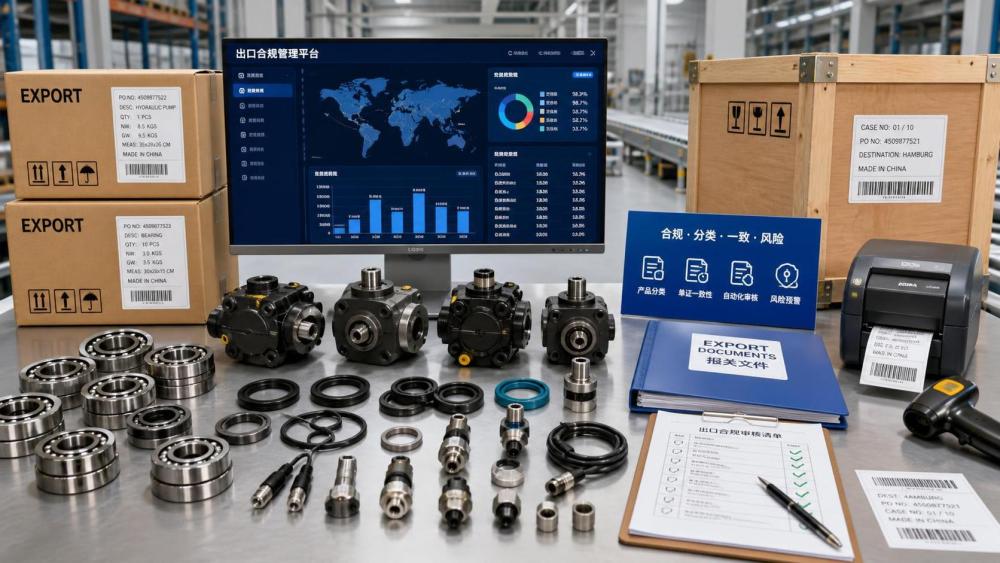
An export compliance platform should automate the points where shipment decisions are made repeatedly, under time pressure, and with incomplete visibility. In most industrial trade environments, that starts with denied party screening, product classification support, document consistency checks, and shipment-level risk review. These tasks sit directly between order release and cargo movement, so small mistakes can hold a bearing shipment at the port, delay a hydraulic pump replacement, or trigger a manual escalation over a seal kit that looks ordinary in commercial terms but may require tighter control in technical terms.
The first automation target is usually denied party screening because it is frequent, repetitive, and easy to mishandle when done by email or spreadsheet. Names appear in different formats, distributors may operate through affiliates, and consignee details often change late in the process. A platform should screen customers, intermediaries, freight forwarders, end users, and service locations against relevant lists at the moment a quote becomes an order, again before shipment booking, and once more if core transaction data changes. The useful part is not only matching names. It is controlling false positives, preserving the audit trail, and linking the screening result to the exact shipment record rather than leaving screenshots in separate folders.
Industrial component trade adds another layer. A precision bearing, servo-related pneumatic assembly, high-performance sealing set, or monitoring-enabled transmission part may move through multiple entities before reaching installation. If screening is automated first, the system can detect whether a previously cleared customer now uses a different ship-to site, whether a service contractor has become part of the transaction, or whether the stated end user conflicts with earlier account history. Those are the kinds of changes that manual teams often miss because the commercial data still looks routine.
Classification Is the Next Serious Bottleneck
After screening, the next process worth automating is product classification support. This does not mean a system should invent legal judgments on its own. It means it should structure the inputs that humans actually need: technical description, material composition, pressure rating, temperature range, control capability, software content, sensor integration, sealing media compatibility, and intended industrial application. Many export delays begin because the product master only says something vague such as "bearing unit," "pump assembly," or "seal component." That may be enough for internal sales coding, but it is often too thin for export review.
A good export compliance platform should automatically collect the product attributes already stored across ERP, PLM, quality records, and engineering files, then present them in a classification workflow. If a hydraulic component includes proportional control electronics, if a spindle bearing is built to unusually high tolerance and speed conditions, or if a condition-monitoring unit includes data transmission capability, those details should surface automatically. The goal is to stop classification from depending on whoever happens to remember an old email thread or a retired spreadsheet note.
Automation is especially valuable when the same part number is described differently across departments. Engineering may use a detailed specification, procurement may use a supplier item name, and logistics may use a shortened customs description. The platform should flag these inconsistencies before documents are issued. A mismatch between internal classification logic and shipping paperwork creates avoidable risk even when the product itself is not restricted.
Document Control Should Follow the Decision Logic
Once screening and classification data are reliable, document control becomes the next logical area to automate. Commercial invoices, packing lists, end-use statements, shipping instructions, and supporting declarations often repeat the same information in slightly different wording. That is exactly where errors enter. One document might describe a shipment as "industrial seals," another as "FFKM O-rings," while the internal review file refers to "chemical-resistant elastomer kits." None of those descriptions is necessarily wrong, but if they imply different technical interpretations, manual reviewers will hesitate and customs authorities may ask questions later.
An export compliance platform should generate controlled data fields that feed all required documents from one reviewed source. Product description, quantity, unit of measure, origin, destination, consignee identity, and license-related conditions should not be typed repeatedly by different teams. When a shipment includes mixed industrial parts such as couplings, belts, cylinders, and replacement seal packs, the system should maintain line-level integrity so that one edited description does not quietly break the consistency of the full document set.
Version control matters as much as field accuracy. Industrial orders are often split, partially shipped, or rerouted because of lead times, maintenance urgency, or packaging constraints. If one carton leaves now and the remaining items ship later, the platform should preserve which compliance decision applied to each release. Without that granularity, teams end up relying on assumptions such as "this was already approved last month," even though the destination, intermediary, or content mix may no longer be the same.
Shipment Risk Review Deserves Early Automation
The fourth area to automate early is shipment-level risk review. Screening tells you who is involved. Classification helps determine what the item is. Shipment risk review asks whether this particular movement makes sense as presented. It combines destination, route, end use, urgency, special handling, Incoterms, and the pattern of the order itself.
In industrial supply chains, unusual combinations often matter more than any single red flag. A standard pneumatic actuator may not draw attention by itself, but an urgent request to send it with sparse end-use detail, through a new intermediary, to a maintenance location not seen before should trigger review. The same applies when a shipment mixes ordinary MRO items with a technically sensitive assembly, or when the packaging and declared use appear inconsistent with the stated project. These are not conclusions by themselves. They are signals that deserve structured escalation.
Automation here should use rules that are understandable and adjustable. A platform that simply generates opaque risk scores will frustrate reviewers. What works better is a rules engine that shows why a shipment was held: destination change after screening, end-user declaration missing, classification unresolved on one line item, mismatch between technical description and commercial document, or previous transaction pattern inconsistent with the current route. When reviewers can see the exact trigger, the workflow moves faster and the audit record becomes more defensible.
Where Companies Often Automate the Wrong Thing First
A common mistake is starting with dashboarding instead of decision control. A polished compliance dashboard may show open tasks, monthly volumes, and escalation counts, but it does not reduce the underlying risk if screening is still manual and product data is still fragmented. Another weak starting point is automating document generation before the source data is governed. That usually produces cleaner-looking paperwork with the same hidden inconsistencies embedded inside it.
Another misstep is trying to automate licensing in full before the organization has stable rules around screening, classification, and exception handling. Licensing workflows can be important, but they usually depend on disciplined upstream data. If the item description is unclear and the parties are not confidently screened, the licensing step turns into a holding area for basic cleanup work that should have happened earlier.
Industrial Detail Changes the Automation Sequence
The correct order of automation can shift slightly depending on the product mix. In a business handling mostly standard replacement chains, belts, gaskets, and bearings with stable destinations, denied party screening and document control may create the quickest risk reduction. In a portfolio containing smart sensing modules, controlled motion components, high-pressure hydraulic assemblies, or specialized materials designed for corrosive media and extreme temperatures, classification support may need equal priority from the start.
Packaging and spare-parts practice also matter. Industrial exports frequently include service kits, repair bundles, loose accessories, and substitute parts approved at the last moment due to stock constraints. Those situations create a gap between the original order and the shipped configuration. A platform should therefore automate comparison between sales order, pick list, packing data, and final invoice lines. If a replacement O-ring compound, alternative seal material, or upgraded sensor-enabled subassembly was inserted after engineering review, the system should require confirmation that the compliance decision still fits the shipment.
Maintenance-driven exports create additional pressure because downtime often compresses review time. Urgent air shipment of a failed pump subassembly or bearing replacement set can push teams toward verbal approvals and post-shipment paperwork repair. Early automation should be designed to resist that pattern. Fast processing is useful only if the platform enforces the same critical checks on urgent orders as it does on routine container loads.
What the First Workflow Should Look Like
The strongest first workflow is narrow enough to be reliable and broad enough to stop obvious errors. A typical sequence would begin when an order is ready for export review. The system pulls party data from the order record, screens all relevant entities, attaches the result to the transaction, retrieves product attributes for each line, compares those attributes with existing classification records, and blocks document release if required information is missing or contradictory. Only then does it generate shipment documents from the approved dataset and apply shipment-risk rules before final release.
That workflow should also include exception routing. If a name match is uncertain, if the technical description is too generic, or if one item in a mixed shipment lacks classification support, the case should move to a reviewer with the complete transaction context already assembled. Manual review is still necessary in many exports. The difference is that automation should remove the clerical search work and leave only the judgment work.
Recordkeeping should be built into the first phase rather than treated as a later improvement. Every screening event, data change, override reason, and document version should be retained in context. Industrial trade often involves repeat orders months apart, and future reviews are faster when the prior rationale is visible. A platform that cannot show why a shipment was cleared is only automating task movement, not compliance control.
The right first automation is therefore not the loudest feature or the broadest promise. It is the set of controls closest to release decisions: screening the parties, structuring classification inputs, keeping document data consistent, and testing each shipment for contextual risk before cargo moves.
Related News
- 00
0000-00
How FFKM O-rings reduce seal failure in corrosive media - 00
0000-00
What global equipment manufacturing in the USA means for supply chain risk - 00
0000-00
How FFKM outgassing performance affects vacuum seal selection - 00
0000-00
When should heat resistant metallurgy belts be replaced? - 00
0000-00
When does a fluid power maintenance service reduce unplanned downtime?
Weekly Insights
Stay ahead with our curated technology reports delivered every Monday.