





Downtime falls when maintenance finds the failure chain early enough to break it
A fluid power maintenance service reduces unplanned downtime when it detects and corrects degradations before they turn into a loss of machine function. That sounds straightforward, but it sets a higher bar than performing periodic inspections or responding faster to breakdown calls. A service program has to identify conditions that are both measurable and actionable: contamination that is accelerating pump wear, a pressure trend that points to internal leakage, heat that is damaging seals, air quality that is affecting valve performance, or cylinder drift that could interrupt a production sequence.
For a project leader, the practical question is not whether hydraulic and pneumatic equipment needs maintenance. It is whether the maintenance approach can protect the schedule of the equipment or process that depends on it. A hydraulic press, mobile lifting system, injection molding machine, automated assembly cell, or packaging line may contain components that are individually repairable. The operational disruption comes from discovering their condition only after the machine can no longer meet force, speed, position, or safety requirements.
Maintenance produces the strongest downtime reduction when it is focused on critical assets, tied to known failure modes, and supported by a response plan. Without those conditions, routine visits can become a list of observations that does little to prevent the next outage.
Maintenance is most effective where a small fault can stop a larger process
Fluid power systems deserve priority when their failure creates a production bottleneck, a safety exposure, a difficult restart, or a delay to dependent work. The cost of a failed pump or pneumatic valve is rarely limited to the part itself. A failed hydraulic power unit can stop several functions at once. A leaking cylinder can compromise positioning and force control. A compressed-air problem can create intermittent faults across multiple actuators, sensors, and tools that share the same supply.
This is why a useful maintenance service starts with asset criticality rather than with an identical checklist for every system. A project team should distinguish between equipment that can be bypassed or repaired during a planned window and equipment whose failure halts commissioning, production, loading, testing, or a critical construction activity.
Priority is usually justified where one or more of the following conditions apply:
- A hydraulic or pneumatic system serves a single point of failure in the process.
- The equipment operates under high load, high cycle frequency, elevated temperature, outdoor exposure, or dirty conditions.
- A failure requires specialist labor, extended isolation, fluid cleanup, or lengthy recommissioning.
- Replacement pumps, motors, valves, cylinders, seal kits, or filtration elements have material lead times.
- The system has a history of recurring leaks, overheating, erratic motion, pressure instability, or abnormal component replacement.
- Machine availability is contractually linked to project milestones, throughput commitments, or shutdown windows.
Lower-criticality systems still need care, but they do not always justify the same inspection frequency, diagnostic effort, or spares holding. Applying intensive service to every actuator can consume maintenance capacity while the few systems that genuinely threaten the schedule remain under-monitored.
Condition signals must lead to a specific maintenance decision
A maintenance service becomes preventive only when its findings trigger a clear decision: filter the fluid, repair a leak, investigate a pressure loss, replace a worn hose, adjust lubrication, rebuild a component, improve air treatment, or order a spare before the operating margin disappears. Data collection without defined intervention criteria can create reports, but not availability.
For hydraulic systems, fluid condition is often one of the earliest and most useful warning areas. Contaminants can damage pump surfaces, spools, servo components, and proportional valves long before an obvious breakdown. Water ingress, air entrainment, oxidation, viscosity change, and depleted additive performance can also affect lubrication, heat control, and response stability. The service value comes from connecting these observations to the particular system: its fluid type, filtration arrangement, operating pressure, cleanliness sensitivity, duty cycle, and component design.
Pressure and temperature trends add context. A system operating at a higher temperature than its established normal range may be experiencing relief-valve losses, restricted flow, cooling problems, internal bypassing, unsuitable fluid condition, or excessive load. A pressure loss may indicate external leakage, pump wear, internal leakage through valves or cylinders, damaged seals, or an incorrect adjustment. Treating every abnormal reading as a component failure is as unhelpful as ignoring the reading. The technician must establish whether the trend affects machine performance and which test can isolate the source.
Pneumatic systems present a different diagnostic pattern. Their most damaging problems are often dismissed because compressed air is inexpensive at the point of use. Yet pressure drop, moisture, oil carryover, contamination, leaking fittings, poor drainage, and undersized distribution can make actuators slow, inconsistent, or unable to complete a cycle. In an automated process, intermittent cylinder motion can be more disruptive than a visible failure because it generates nuisance stops, sensor timing faults, rejected parts, and repeated operator intervention.
A practical service scope should connect symptoms, measurements, and actions. For example:
Thresholds should not be copied blindly from another machine. An acceptable condition for a simple low-pressure clamping circuit may be unacceptable for a high-response hydraulic control system or a tightly timed pneumatic automation cell. Equipment manuals, component requirements, failure history, and the consequences of lost performance should shape the limits.
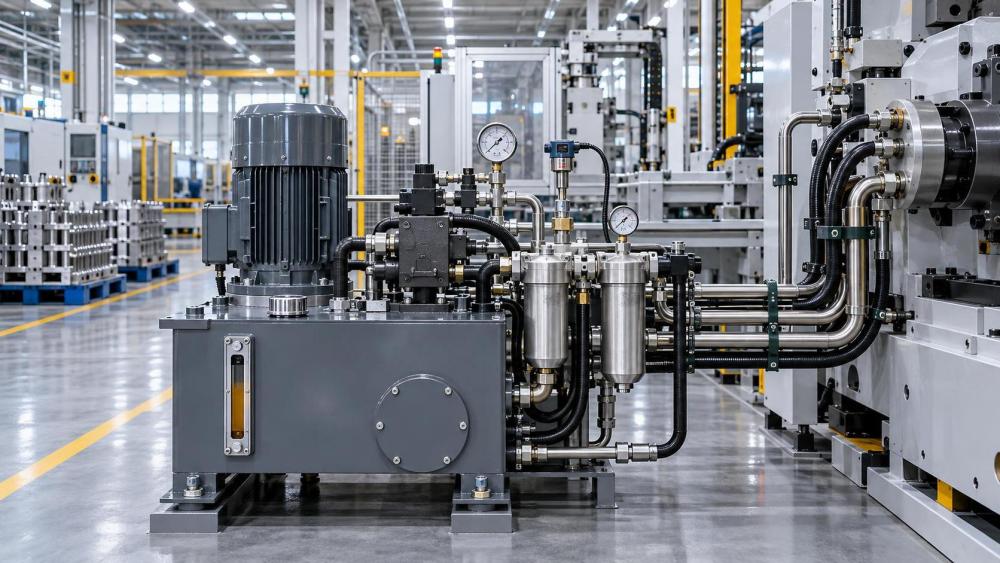
The service interval should follow degradation and consequence, not the calendar alone
Calendar-based service has a role. It creates accountability for basic checks, fluid sampling, filter review, hose inspection, air preparation maintenance, and housekeeping. It is particularly useful when equipment has limited instrumentation or when operating hours are poorly recorded. But a fixed interval alone does not respond well to uneven duty cycles, changing loads, seasonal temperatures, contamination events, or a machine that has moved from normal production into a high-demand project phase.
Condition-based elements improve the program when the team can observe meaningful changes and act before failure. This does not require every system to have a complex sensor package. Many decisions can be supported by disciplined inspection, trend records, fluid analysis, pressure and temperature checks, leak mapping, and performance tests. Online monitoring becomes more attractive where the asset is highly critical, access is difficult, the failure develops quickly, or a short warning period has major operational consequences.
Project leaders should be wary of a common promise: that predictive maintenance will eliminate unexpected failures. No service program can remove every failure mode. Hoses can be damaged externally, seals can fail after an abnormal event, electrical faults can imitate hydraulic problems, and a component can suffer a sudden defect. The aim is more realistic and more valuable: reduce the probability that known, progressive failure mechanisms reach the point where the system stops without warning.
The service interval also needs to account for maintenance-induced risk. Opening a hydraulic circuit without effective cleanliness control can introduce the contamination the work was meant to prevent. Replacing a pneumatic component without checking pressure, flow capacity, and installation orientation can create a new performance issue. A competent scope therefore includes isolation procedures, contamination control, correct fluid handling, post-maintenance functional checks, and records of what changed.
Downtime reduction depends on planning the repair path, not just detecting the fault
Early warning only protects the schedule if the organization can convert it into planned work. A report stating that a pump is deteriorating has limited value when no approved repair window, spare, repair vendor, or budget route exists. The same applies to a cylinder seal issue that requires removal equipment, a contaminated reservoir that needs flushing capacity, or a pneumatic valve bank that cannot be changed without production engineering support.
A fluid power maintenance service should therefore produce outputs that a project manager can use: fault priority, likely consequence, recommended action, urgency, expected isolation requirements, parts needed, and the risk of deferral. The detail does not need to become a lengthy engineering report for every minor observation. It must be sufficient to decide whether the work belongs in the next planned stop, requires an immediate controlled intervention, or can be monitored until a defined trigger is reached.
Spare-parts planning is especially important for systems containing critical pumps, proportional valves, specialty seals, large cylinders, custom hose assemblies, or components with configuration-specific requirements. Holding every conceivable spare is expensive and often impractical. The better approach is to identify which failure items have a high operational consequence, long replacement path, or limited repairability. For each, decide whether to stock a complete unit, a repair kit, a hose assembly, a seal set, a filtration element, or only maintain qualified supply and repair arrangements.
Parts management must preserve technical accuracy. A replacement seal material may be incompatible with the fluid or temperature. A hydraulic filter may fit physically while providing a different filtration performance. A pneumatic valve may have a similar port size but inadequate flow capacity or a different electrical interface. Downtime is not reduced when a rushed substitute restores motion briefly and then creates an early repeat failure.
Coordinate fluid power work with the full machine condition
Fluid power faults are often symptoms of an issue elsewhere in the machine. A hydraulic circuit can run hot because of a mechanical load problem. Cylinder seal life can be shortened by rod damage, misalignment, side loading, or contaminated environments. Pneumatic actuators can appear underpowered because the air distribution has excessive pressure loss. A pump may show abnormal wear because the reservoir, breather, or service practice allows contamination into the system.
For that reason, maintenance coordination should include the people responsible for mechanical alignment, electrical controls, process settings, cooling systems, and operating practices. The objective is not to broaden every service visit into a full machine overhaul. It is to avoid repeatedly replacing fluid power components when the causal condition remains in place.
This cross-functional view matters during commissioning and project ramp-up. Systems that appear healthy during short functional tests may reveal overheating, leakage, pressure instability, or cycling problems only after sustained duty begins. Establishing baseline pressure, temperature, cycle behavior, fluid condition, and leakage observations during stable operation gives later inspections something meaningful to compare against. Without a baseline, teams often debate whether a reading is abnormal only after production is already affected.
How to judge whether the service is delivering availability
The measure of a maintenance service is not the number of inspections completed or components replaced. It is whether critical fluid power issues are being found earlier, converted into planned work, and prevented from causing disruptive stops. A useful review looks at the pattern of repeat leaks, emergency callouts, recurring pressure or temperature deviations, postponed corrective actions, repeat failures after repair, and the gap between identified risks and completed work.
Where unplanned downtime persists, the first response should be to examine the maintenance logic. Are inspections aimed at the components that actually stop the process? Are findings ranked by consequence? Are fluid and air-quality issues being traced to their sources? Are recommendations actioned within a realistic timeframe? Are repair records feeding back into intervals, spare decisions, and equipment modifications?
A fluid power maintenance service earns its place in a project or operations plan when it gives the team time to choose the interruption. It cannot make hydraulic and pneumatic systems failure-proof. It can turn many foreseeable failures into scheduled work, provided that condition evidence, technical diagnosis, parts readiness, and maintenance coordination are treated as one operating system rather than separate tasks.
Related News
- 00
0000-00
How FFKM O-rings reduce seal failure in corrosive media - 00
0000-00
What global equipment manufacturing in the USA means for supply chain risk - 00
0000-00
How FFKM outgassing performance affects vacuum seal selection - 00
0000-00
When should heat resistant metallurgy belts be replaced? - 00
0000-00
When does a fluid power maintenance service reduce unplanned downtime?
Weekly Insights
Stay ahead with our curated technology reports delivered every Monday.