





Seal failure in corrosive service is rarely caused by a single material property. A seal may survive a chemical immersion test yet fail in equipment because the medium penetrates the elastomer under pressure, temperature accelerates chemical attack, thermal cycling relaxes the contact load, or a damaged groove creates an extrusion path. FFKM O-rings reduce these failure mechanisms because their highly fluorinated polymer structure offers unusually broad resistance to aggressive process media while retaining elastomeric sealing behavior at temperatures that exceed the useful range of many conventional compounds.
That advantage is significant, but it is not absolute. “FFKM” identifies a family of perfluoroelastomer materials, not one universal formulation. The actual sealing outcome depends on the compound, the chemical composition and concentration of the fluid, temperature, pressure, cycle profile, gland geometry, surface finish, and installation condition. A technically sound evaluation therefore treats FFKM as a material platform for severe duty, then verifies whether a specific grade controls the dominant failure mechanism in the application.
Why corrosive media defeat ordinary elastomer seals
An O-ring works by being compressed in a controlled gland so that its elastic recovery maintains contact stress against the mating surfaces. Corrosive fluids challenge this simple mechanism through several interacting pathways.
Chemical swelling occurs when molecules from the process medium diffuse into the elastomer network. The seal grows, softens, and loses dimensional stability. Moderate swelling may temporarily increase contact pressure, but it can also cause installation damage, stick-slip, excessive friction in dynamic assemblies, and eventual loss of mechanical integrity. When the fluid is removed, shrinkage may leave a permanent leak path.
Chemical degradation is different from swelling. Reactive species can alter polymer chains or the crosslink network, leading to softening, embrittlement, cracking, weight loss, or a severe reduction in tensile properties. Strong oxidizers, high-temperature acids, reactive gases, and plasma-related environments can produce failure patterns that are not predicted by room-temperature compatibility charts.
Compression set becomes critical when a seal remains compressed for long periods at elevated temperature. Compression set is the permanent deformation remaining after the O-ring has been compressed and released under defined test conditions. If the material cannot recover sufficiently, contact stress falls. The result may be external leakage, internal bypass, or contamination ingress during cooldown and pressure cycling.
Thermal and pressure cycling amplify all of these effects. Temperature changes alter seal dimensions, fluid viscosity, and chemical reaction rates. Pressure changes can force media into microscopic surface defects and can drive an inadequately supported O-ring into the extrusion gap. A chemically resistant elastomer still fails if its mechanical strength, hardness, or gland design is unsuitable for the pressure differential.
Conventional nitrile rubber, EPDM, fluorocarbon elastomer (FKM), silicone, and fluoro-silicone each have useful operating windows. Their limitations become more apparent when several stresses are present together: hot concentrated chemicals, vacuum-to-pressure transitions, mixed solvents, high-purity process fluids, or long maintenance intervals. FFKM is used where the combined exposure exceeds the realistic capability of these more common materials.
What the perfluorinated structure changes
FFKM elastomers contain a very high level of fluorination. In broad terms, the carbon-fluorine bond is strong and chemically stable, and the polymer backbone has fewer chemically vulnerable sites than less-fluorinated elastomers. This structure helps limit interaction with many aggressive media, including a wide range of acids, bases, solvents, fuels, and process chemicals.
The practical value is not simply that an FFKM O-ring “does not react.” Its value lies in controlling changes that matter to sealing: volume change, hardness shift, tensile loss, crack formation, and compression set. In a well-matched compound, lower fluid uptake helps preserve dimensions and gland fill; chemical stability helps retain mechanical properties; and a crosslink system designed for temperature resistance helps retain enough elastic recovery to maintain a seal load.
FFKM compounds also differ from one another because fillers, cure chemistry, processing aids, pigmentation, and post-curing methods affect the final balance of properties. A formulation optimized for broad chemical compatibility may not provide the best low-temperature flexibility. A high-temperature grade may have different plasma resistance, steam behavior, or mechanical strength than a grade developed for semiconductor wet processing. Selection at the polymer-family level is therefore incomplete.
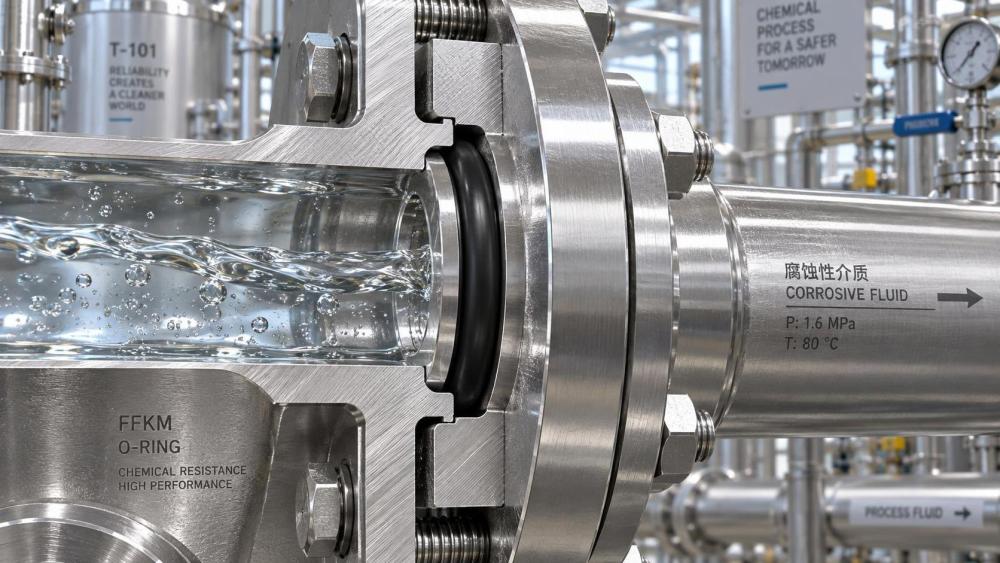
Swelling control is often the first reliability benefit
In corrosive liquid service, swelling is a leading cause of functional failure because O-ring dimensions directly influence squeeze, stretch, and groove fill. When an elastomer swells excessively in a confined gland, it can become over-compressed. This raises friction in moving components, increases the chance of spiral damage, and may generate high local stress at sharp groove edges. In static joints, excessive swell can force material into the clearance gap and make removal difficult during maintenance.
When swelling is followed by extraction or evaporation of the absorbed fluid, the material may shrink below its original dimensions. The recovered shape is not always uniform. This produces flat spots, surface roughness, or loss of sealing contact. In equipment exposed to alternating chemicals or rinse-and-dry cycles, evaluating the seal only while immersed can miss this post-exposure risk.
FFKM compounds can reduce swelling because their fluorinated structure limits absorption of many fluids that readily penetrate hydrocarbon-based elastomers. However, compatibility must be assessed against the actual process stream rather than the primary chemical name alone. Proprietary formulations may include stabilizers, catalysts, dissolved gases, cleaning agents, or solvent mixtures that materially alter elastomer behavior. Chemical concentration also matters: a dilute acid, an aqueous solution at elevated temperature, and a nearly anhydrous acid can create very different exposure conditions.
Useful evaluation data include change in volume, mass, hardness, tensile strength, elongation, and visual condition after exposure. ASTM D471 and ISO 1817 provide recognized methods for determining the effect of liquids on rubber properties. These tests provide a controlled comparison basis, but they do not reproduce every field condition. Test temperature, immersion duration, specimen geometry, post-exposure conditioning, and whether the material is tested under compression all affect how representative the result will be.
Compression set links material stability to leakage resistance
Corrosion resistance alone does not keep a joint sealed. A static O-ring must retain enough restoring force after long exposure to compensate for surface irregularities, pressure fluctuations, thermal contraction, and minor changes in gland dimensions. This is why compression set deserves the same attention as chemical compatibility.
At elevated temperatures, elastomer chains can rearrange, crosslinks can change, and plasticizing effects from absorbed media can alter the material’s recovery behavior. A seal may appear chemically intact when removed from service but have insufficient resilience to maintain contact pressure. This is especially relevant in flanged connections, valve bodies, pump casings, filter housings, semiconductor process chambers, and instrumentation systems where leakage may emerge only after a shutdown or cooldown.
Compression-set values are commonly generated using methods such as ASTM D395 or ISO 815. Those results should be compared only when test conditions are equivalent. A value generated at one temperature and duration cannot be treated as a universal material ranking. More importantly, a laboratory compression-set result in air does not automatically describe behavior after hot chemical exposure. Where failure consequences are high, the more relevant evidence is aged-property data generated in the actual or closely simulated medium, followed by an assessment of sealing force or leakage under representative conditions.
FFKM can provide better retention of sealing function than less chemically robust elastomers when heat and corrosive media act together. Yet an inappropriate FFKM grade can still take excessive set, particularly if it is operated beyond its continuous temperature range or exposed to media that affect its specific cure system. The correct question is not whether FFKM has “low compression set” in general; it is whether the selected compound retains adequate recovery after the expected time-temperature-chemical profile.
Pressure resistance depends on the whole sealing system
FFKM does not remove the need for proper mechanical seal design. High differential pressure can extrude any elastomer O-ring through the clearance between mating parts. Chemical exposure may soften the seal, while high temperature lowers modulus, making extrusion more likely. A seal with excellent immersion resistance can therefore fail by nibbling, tearing, or permanent deformation at the extrusion gap.
Critical design checks include gland dimensions, radial and axial clearance, expected pressure direction, pressure cycling rate, O-ring cross-section, surface finish, edge breaks, and the need for anti-extrusion devices. Backup rings may be required in high-pressure service, but their own material compatibility must be verified. A backup ring that deforms, cracks, or is attacked by the medium can compromise the entire assembly.
Dynamic applications require additional caution. Reciprocating rods, rotating shafts, and valves introduce frictional heating, abrasion, lubrication conditions, and surface-speed limits. An FFKM O-ring may be chemically suitable but mechanically unsuitable as the primary dynamic sealing element at a given speed or stroke frequency. In these cases, the sealing system may require a different profile, energizer design, surface treatment, or a dedicated dynamic seal material rather than a simple substitution of one O-ring compound for another.
Temperature limits are compound-specific, not a generic FFKM number
FFKM is frequently selected because severe chemical service often occurs at high temperature. That relationship is valid, but it can lead to an unsafe shortcut: assuming every FFKM grade is equally capable at the maximum process temperature. Temperature capability depends on formulation and the definition of the operating condition. Continuous exposure, short-term excursions, dry heat, steam, vacuum, oxygen-rich conditions, and contact with reactive chemicals place different demands on the polymer.
Temperature also changes chemical compatibility. A material that shows minimal change in a fluid at moderate temperature may swell, lose strength, or suffer rapid compression set at a higher temperature. Reaction rates generally increase with heat, and process fluids may change phase or composition. For example, trace moisture, dissolved gases, or solvent vapor can become important in hot or vacuum cycling service.
The applicable design temperature should include more than the nominal fluid temperature. Frictional heating, heat tracing, sterilization cycles, cleaning cycles, localized hot spots, and upset conditions can all expose the O-ring to higher temperatures. Conversely, low-temperature starts or rapid depressurization can make flexibility and thermal contraction important. A compound selected solely around a high-temperature rating may be too stiff for the lowest operating condition.
Application-specific evaluation avoids the “universal chemical resistance” mistake
FFKM is widely associated with semiconductor, chemical processing, oil and gas, pharmaceutical, analytical, and high-purity industrial systems, but the failure criteria differ substantially across these environments. In semiconductor equipment, particle generation, extractables, plasma exposure, and resistance to aggressive cleaning chemistries may be as important as basic leakage control. In chemical processing, media concentration, temperature, pressure, and maintenance accessibility often dominate. In high-purity fluid handling, contamination risk may require scrutiny of additives, surface cleanliness, and batch consistency.
Steam and hot water deserve particular care. Broad resistance to many chemicals does not mean equal resistance to all hot aqueous conditions. Strong bases, amines, oxidizing media, and certain high-temperature water or steam exposures can challenge specific FFKM formulations. The same caution applies to combinations of chemicals: a process medium may be compatible during normal operation but incompatible during cleaning, regeneration, or decontamination.
Gas service creates another distinction. Permeation through an elastomer can occur without visible chemical attack. Under high-pressure gas conditions, rapid gas decompression can produce internal blistering or cracking when pressure is released quickly. Whether this risk is relevant depends on gas type, pressure, decompression rate, seal geometry, and compound design. A chemical compatibility statement alone is not sufficient for this duty.
How to build a defensible FFKM selection decision
A reliable specification begins with an exposure definition detailed enough to reveal the real failure drivers. The fluid name is only the starting point. The specification should identify concentration, contaminants, temperature range, pressure range, cycling behavior, exposure duration, cleaning agents, sterilization or purge steps, vacuum conditions, and whether the seal is static or dynamic. It should also state the consequence of failure: external emissions, cross-contamination, process upset, safety exposure, or loss of vacuum integrity.
Material comparison should then focus on properties that correspond to those risks. For chemical swelling, examine volume and hardness change after relevant exposure. For long shutdown intervals, examine chemical-aged compression set or sealing-force retention where available. For pressure duty, assess hardness, modulus, gap control, and backup-ring requirements. For high-purity service, investigate extractables, cleanliness controls, and material traceability. For dynamic duty, evaluate friction, wear, lubrication, and surface interaction rather than relying on a static O-ring recommendation.
Dimensional controls also matter. O-ring dimensions and tolerances are commonly specified using ISO 3601, which covers O-rings and their associated housing considerations. The standard supports interchangeability and gland design discipline, but it does not certify chemical compatibility or validate a material for a specific process. A correctly sized O-ring made from an unsuitable compound remains a failure risk; an excellent compound in an out-of-tolerance or damaged gland will not deliver its expected life.
For critical service, representative validation is more valuable than a generic catalog rating. This may include exposure testing of production compound, inspection for volume and hardness change, compression testing after aging, and assembly-level leakage evaluation under realistic thermal and pressure cycles. The test method should reflect the anticipated condition that is hardest on the seal, not merely the easiest condition to reproduce.
FFKM O-rings reduce seal failure in corrosive media by preserving dimensional stability, chemical integrity, and elastic recovery across operating conditions that overwhelm many standard elastomers. Their strongest contribution is not a blanket promise of chemical invulnerability. It is the ability, when the compound and sealing system are properly matched, to reduce the linked risks of swelling, degradation, compression-set leakage, and pressure-assisted damage. That distinction is what turns industrial sealing technology for corrosive media from a material selection exercise into a reliability decision.
Related News
- 00
0000-00
Where are axial piston pumps used in mining equipment? - 00
0000-00
Embodied AI Robotics and Drive Control Forum Held in Shanghai - 00
0000-00
How does seal service life affect the total cost of ownership? - 00
0000-00
Schaeffler to Cut 3,460 Jobs and Close Five European Plants - 00
0000-00
How does system size affect the price of a belt drive system?
Weekly Insights
Stay ahead with our curated technology reports delivered every Monday.