





Heat resistant metallurgy belts should be replaced when their condition shows that reliable tracking, load carrying, material containment, or safe operation can no longer be restored through normal adjustment and maintenance. Calendar age alone is a weak replacement trigger. A belt running beside a furnace, sintering line, hot slag conveyor, coke handling system, or steel-processing transfer point can deteriorate quickly from heat spikes, abrasive scale, misalignment, and mechanical damage, while another belt of the same design may remain serviceable for much longer in a steadier duty cycle.
For after-sales maintenance teams, the practical decision is rarely whether a belt looks worn. The question is whether the observed wear has crossed into a condition where a failure could stop production, damage pulleys or idlers, create a spill, or put personnel at risk. In most cases, replacement should be planned before a belt loses its ability to run predictably, not after a tear, separation, or tracking failure forces an emergency shutdown.
Replace the belt when structural damage is progressing
Surface wear is expected in metallurgical service. Heat-resistant covers can harden, become rough, lose thickness, or show fine cracking over time. These changes do not automatically require immediate replacement. The decision becomes more urgent when the belt carcass, reinforcement layers, edges, or splices are affected.
A belt should move to the replacement list when inspection finds exposed fabric, damaged steel cords, broken reinforcement, deep cuts that reach the carcass, or tears that continue to lengthen between inspections. Once the load-bearing structure is compromised, a local repair may prevent a short-term failure, but it does not necessarily restore the belt's original strength or heat performance.
- Exposed carcass or reinforcement: Cover loss has progressed beyond a cosmetic issue. Heat, moisture, fines, and chemical residues can enter the belt structure and accelerate internal damage.
- Longitudinal tears: A lengthwise tear can widen under load and often signals a problem with a chute, scraper, trapped object, or transfer geometry. Replacement planning should begin while the cause is being corrected.
- Transverse cuts: Crosswise cuts reduce tensile continuity. A repaired section may be acceptable only when the damage is limited and the repair method is approved for the operating temperature and belt construction.
- Edge deterioration: Repeated edge fraying, cracking, or missing material often accompanies mistracking. When edge damage exposes the carcass or reduces usable belt width, replacement is usually more defensible than repeated trimming or patching.
- Delamination or ply separation: Blisters, lifted cover sections, separated plies, and soft areas indicate loss of adhesion. In high-temperature service, such damage can spread quickly once the belt flexes around pulleys.
A useful maintenance rule is to distinguish between wear that remains stable and damage that propagates. Stable wear can be monitored with measurements and inspection intervals. Propagating damage deserves a planned outage because its remaining life is difficult to predict.
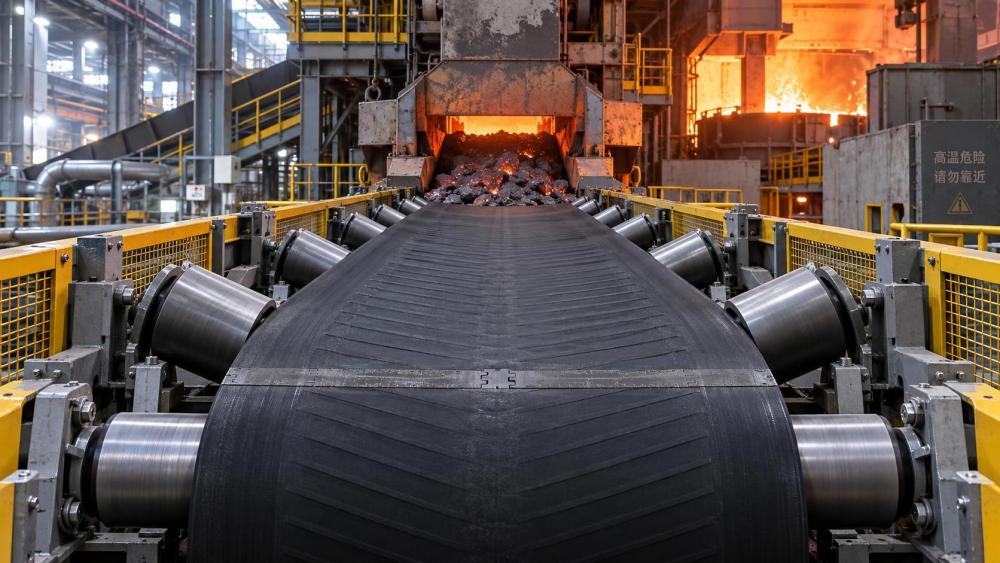
Heat damage is a replacement issue when the belt no longer behaves consistently
Heat resistant metallurgy belts are selected to tolerate elevated temperatures, but resistance is not immunity. The belt may be exposed to hot bulk material, radiant heat, steam, hot dust, localized furnace discharge, or brief contact with material above the intended operating range. A belt can survive an occasional event yet lose elasticity, cover adhesion, or splice integrity after repeated exposure.
Look beyond discoloration. A darkened or glazed surface can be a normal consequence of service, depending on the belt compound and conveyed material. More serious evidence includes stiff or brittle sections, a cover that cracks when flexed, blistering, a burnt odor during inspection, localized hard spots, softened patches, or deformation that remains after the belt cools. These conditions suggest that the elastomer system has changed rather than merely accumulated surface contamination.
Temperature damage is especially important near transfer points and discharge zones. The average operating temperature recorded for a conveyor may look acceptable while individual portions of the belt receive intermittent heat peaks. If damage repeatedly appears in the same belt section or at the same location along the conveyor, investigate the loading process, material cooling time, skirt-board contact, chute design, and any buildup that may be holding hot material against the belt.
Replacement should be scheduled when heat exposure has made the belt too stiff to flex smoothly over pulleys, when cracking is developing across multiple areas, or when the splice and cover show signs of thermal degradation. Continuing to run a thermally embrittled belt creates a higher risk of sudden rupture during startup, under a heavy burden, or when the conveyor experiences a jam.
A failing splice changes the decision from monitoring to intervention
The splice is often the most consequential inspection point on a high-temperature conveyor belt. It sees repeated flexing, tensile load, thermal cycling, and sometimes impact at loading zones. A belt body may still appear acceptable while the splice is approaching failure.
Warning signs include a raised or opening splice, damaged fasteners, missing fastener elements, separation at the splice edge, cracking across the splice line, abnormal thickness changes, material catching at cleaners, or a recurring bump every belt revolution. A splice that heats up excessively because of friction or poor alignment also needs immediate attention.
Whether the belt needs replacement depends on the splice design, the belt's remaining condition, and the cause of the defect. A single damaged mechanical fastener may be repaired if the surrounding belt remains sound and the fastening method suits the application. A failed vulcanized splice in an otherwise healthy belt may be re-spliced during a planned stop. However, re-splicing is a poor economy when the belt has widespread cover loss, thermal hardening, carcass exposure, or multiple previous repairs. In that situation, the splice failure is often the event that reveals the belt has reached the end of practical service life.
Tracking problems matter when adjustment no longer holds
Belts in metallurgy plants commonly encounter fine dust, scale, uneven loading, seized idlers, worn pulleys, and material buildup. Any of these can cause mistracking. It is important not to condemn the belt merely because it runs off-center. A new belt installed on a conveyor with poor pulley alignment or asymmetric loading will also track poorly.
Replacement becomes more likely when the belt has developed a permanent camber, distorted edges, or uneven stretch that prevents stable tracking after the conveyor structure has been checked. If a belt repeatedly moves to one side despite confirmed pulley alignment, functioning idlers, clean return paths, and centered loading, its geometry may no longer be recoverable.
Before deciding, maintenance personnel should inspect the system in the order most likely to reveal an external cause:
- Confirm that material enters near the centerline and in the direction of belt travel.
- Remove accumulated scale and fines from pulleys, idlers, scrapers, and return areas.
- Check idler rotation, bracket condition, pulley lagging, shaft alignment, and bearing condition.
- Inspect skirt-board clearance and look for constant rubbing on one belt edge.
- Measure belt width and compare edge condition across several locations, including the splice area.
- Observe tracking both empty and loaded, because some belts appear stable until burden distribution changes.
If the belt is replaced without correcting these conveyor conditions, the replacement belt can inherit the same failure pattern within a short period. The replacement decision and root-cause correction should be treated as one maintenance action.
Measure remaining thickness instead of relying on appearance
Visual inspection identifies obvious damage, but thickness measurement makes replacement planning more disciplined. The original cover thickness, carcass construction, acceptable minimum cover remaining, and wear pattern should be recorded for each belt type where possible. The purpose is not to force every belt into one universal threshold. Different conveyed materials, pulley diameters, cleaners, and heat exposures produce different failure modes.
Measurements are most useful when taken at repeatable locations: the center carrying zone, both edges, the loading zone, return side contact areas, and near repairs or splices. A belt with evenly reduced cover thickness may remain predictable. One with sharply worn strips, deep grooves, or a rapidly thinning area can fail much earlier because the wear has become concentrated.
Maintenance teams should also compare the rate of change, not simply the latest reading. A stable belt with visible wear may be suitable for continued service through the next planned shutdown. A belt that has lost a meaningful amount of cover between routine inspections needs a shorter inspection interval and a prepared replacement plan. Accelerating wear often points to an upstream change: hotter material, altered particle size, a damaged scraper, a blocked chute, an idler problem, or a new loading practice.
Do not wait for a complete belt break
A complete break is an unambiguous reason to replace a belt, but it is one of the most expensive ways to reach the decision. Emergency replacement can require unplanned production loss, urgent lifting arrangements, temporary handling measures, and rushed work in a hot, dusty area. It may also damage the conveyor frame, drive pulley lagging, skirt systems, guards, or nearby equipment.
Planned replacement is justified earlier when the consequences of failure are high. A belt carrying hot material over occupied access routes, feeding a critical furnace process, serving as the only transfer path in a production line, or operating where a spill is difficult to clean should have a more conservative replacement threshold. Conversely, a short, accessible conveyor with standby capacity and controlled material temperature may allow continued monitoring of limited damage while a replacement is prepared.
This is why belt condition cannot be evaluated separately from process criticality. The same crack can lead to different maintenance decisions on two conveyors. The belt condition tells you what may fail; the process role determines how much risk the plant can accept.
Decide whether repair still makes technical and economic sense
Repair is appropriate when it restores a localized defect without creating a weak point that will be repeatedly stressed by heat, bending, impact, or abrasive material. Small cover damage, minor edge repairs, and selected fastener issues can often be managed during scheduled maintenance. Repairs should be compatible with the belt compound, operating temperature, and conveyor duty. A repair material that performs well on a cool aggregate belt may not remain stable near a metallurgical discharge point.
Replacement is usually the stronger decision when repairs are becoming frequent, when several damaged areas are distributed around the belt, or when each repair requires another production interruption. Repeated patches can affect belt balance, cleaning efficiency, tracking, and passage over pulleys. They also make inspections more complex because a new defect can be hidden among older repaired areas.
A practical way to frame the decision is to ask four questions:
- Can the damage be repaired without reducing the belt's safe load-carrying capability?
- Will the repair tolerate the actual temperature, flexing, and abrasive exposure at that conveyor location?
- Has the source of damage been corrected, or will the same defect return?
- Does continued repair create more planned and unplanned downtime risk than a scheduled replacement?
When the answer to any of these questions is unfavorable, replacement planning should take priority over another temporary repair.
Use replacement planning to correct the original failure mechanism
Ordering a replacement belt should not be the last step of the diagnosis. Before installation, document why the outgoing belt was removed: heat cracking, abnormal cover wear, edge damage, splice failure, belt camber, impact cuts, contamination, or a combination of conditions. That record helps determine whether the replacement should match the previous construction or whether the conveyor duty calls for a different heat-resistant grade, cover thickness, carcass design, splice approach, or protection arrangement.
The review should stay focused on the actual operating conditions. Consider the temperature of material at loading, how long hot material stays in contact with the belt, particle size and sharpness, drop height, belt speed, belt tension, pulley diameter, cleaning system pressure, and the likelihood of hot fines accumulating under skirts or at pulleys. A belt that fails early because of off-center loading will not gain much life from a more expensive compound alone. A belt that repeatedly hardens from thermal overload needs a review of material temperature and residence time before the next belt is selected.
For maintenance teams, the most useful replacement trigger is therefore a combination of evidence: measurable wear, structural condition, splice integrity, tracking stability, thermal behavior, and the operational consequence of failure. Heat resistant metallurgy belts should be replaced before those factors converge into an uncontrolled stoppage. A planned changeout, supported by a clear diagnosis of the old belt, protects both the conveyor and the production schedule.
Want to dive deeper into these market dynamics, or need data-driven support for your next business move? Drop a line below and let the analysts at PCTS provide customized insights.
We respect your privacy. Your information is strictly confidential.
Related News
- 00
0000-00
How to check vibration analysis software for sensor compatibility - 00
0000-00
IndexBox Forecasts 3.8% Annual Growth for Global Radial Seals Market Through 2035 - 00
0000-00
How to assess the chemical compatibility of FFKM sealing sheets - 00
0000-00
IndexBox Forecasts 3.6% Annual Growth for Construction Bearings Market - 00
0000-00
When do hydraulic components require an export license?
Weekly Insights
Stay ahead with our curated technology reports delivered every Monday.