





What to check before choosing an electronics assembly pneumatics manufacturer
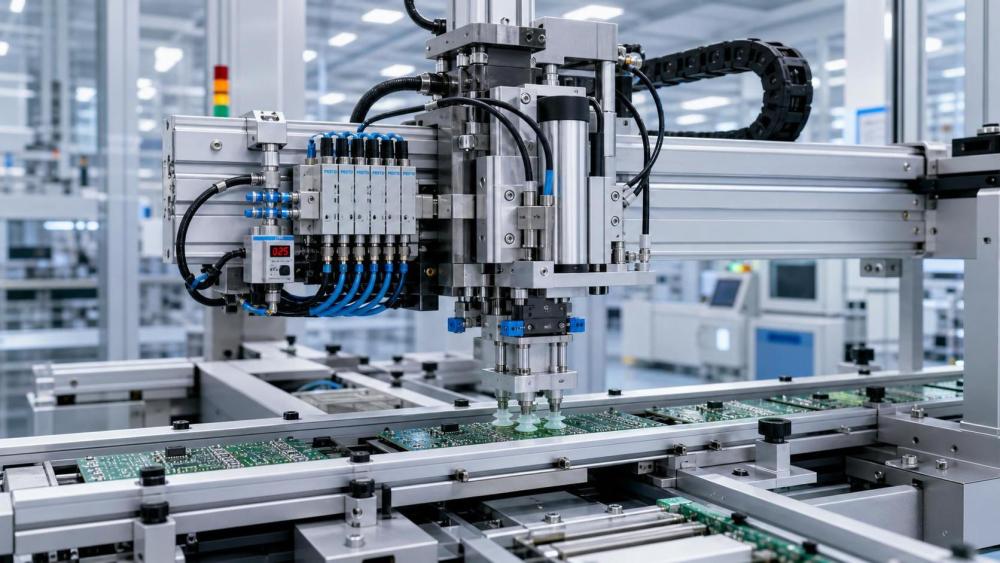
In electronics assembly, pneumatic components rarely get the same attention as vision systems, motion controllers, or placement heads. But when an air cylinder, vacuum generator, valve island, or gripper behaves inconsistently, the entire line starts showing symptoms elsewhere: pick-and-place errors, unstable clamping, poor solder fixture repeatability, higher reject rates, and maintenance teams chasing “random” downtime that is not random at all.
That is why choosing an Electronics Assembly Pneumatics manufacturer is not just a sourcing task. It is a reliability decision. Technical evaluators usually know this in theory, yet many reviews still stop at catalog force, bore size, and unit price. In practice, the better question is simpler: will this supplier’s pneumatic products behave predictably in a clean, fast, high-cycle electronics environment, and will they still be supportable two years from now?
For assembly lines handling PCB transport, precision gripping, micro-stroke actuation, screwdriving fixtures, test stations, or vacuum-assisted handling, the checks below tend to separate a usable supplier from a risky one.
Start with the application, not the catalog
A common mistake is evaluating manufacturers by their product range before defining the actual duty. Electronics assembly pneumatics are not one uniform category. A cylinder used for tray indexing has different priorities from a vacuum system picking delicate components, and both differ from an actuator inside an ESD-sensitive test fixture.
Before comparing suppliers, pin down a few practical conditions: cycle rate, stroke frequency, required repeatability, load characteristics, cleanroom or near-cleanroom expectations, ambient contamination, air quality available on site, and whether the assembly process is sensitive to particles, oil mist, or vibration. Without that context, even a technically good manufacturer can be a poor fit.
This is where cross-component thinking matters. Platforms such as PCTS are useful because electronics assembly reliability is rarely about one pneumatic part in isolation. Bearings in linear slides, seals in cylinders, tubing materials, vacuum elements, couplings, and maintenance intervals all interact. A manufacturer that understands only the actuator but ignores sealing wear, contamination control, or total cost of ownership is only seeing part of the system.
Check motion control quality, not just basic specifications
Most catalogs can tell you bore, stroke, operating pressure, and theoretical force. That is the easy part. What technical teams should probe is control behavior under real assembly conditions.
Ask how the manufacturer addresses low-speed stability, end-of-stroke impact, cushioning consistency, response time variation, and repeatability over long cycle counts. In electronics assembly, small inconsistencies can have outsized consequences. A gripper closing slightly too hard may crack a delicate component housing. A vacuum pick head with slow response may miss takt time. A stopper cylinder with poor repeatability may create alignment drift that gets blamed on tooling.
If the manufacturer cannot discuss valve response, pressure regulation stability, seal friction behavior, or how they manage micro-stroke precision, that is a warning sign. The product may still be acceptable for general industrial automation, but electronics assembly often demands tighter behavioral control than bulk material handling or simple clamping.
Material and cleanliness standards deserve a closer look
Electronics production is unforgiving when it comes to contamination. You do not always need a formal cleanroom-rated pneumatic system, but you do need to know what the manufacturer is doing to limit particle shedding, oil carryover sensitivity, seal debris, corrosion risk, and outgassing concerns where relevant.
This becomes especially important for vacuum handling, precision dispensing support, SMT support equipment, semiconductor-adjacent assembly, or any process where residue can affect soldering, optical inspection, or contact reliability. Questions worth asking include:
- What seal materials are used, and are alternatives available for chemical or temperature exposure?
- How are internal components cleaned before shipment?
- Is the lubrication strategy suitable for sensitive assembly zones?
- Can they provide guidance on filtration, dryers, and air preparation requirements?
- Are tubing and fittings selected with contamination and chemical compatibility in mind?
A capable supplier should not treat these as unusual questions. In fact, the better manufacturers often connect pneumatic performance with seals, O-rings, and air treatment quality because those are the parts that quietly determine field reliability. That broader view aligns with how industrial intelligence platforms like PCTS frame component decisions: not as isolated purchases, but as linked reliability variables.
Compatibility with your existing line architecture matters more than brand prestige
A well-known name does not automatically mean easy integration. The right Electronics Assembly Pneumatics manufacturer should fit into the controls, maintenance habits, and spare parts logic you already have.
Check port standards, tubing sizes, mounting dimensions, electrical interfaces on solenoid valves, manifold options, sensor compatibility, fieldbus availability if applicable, and replacement interchangeability. If your line already uses a certain PLC architecture or standard pneumatic footprint, introducing a supplier with proprietary interfaces may create more lifecycle friction than its initial performance advantage is worth.
This is also the stage where maintenance teams should be involved. Engineering may approve a technically elegant solution that becomes painful when spare sensors, seals, or valve coils are hard to source locally. In electronics assembly, downtime is usually more expensive than the price delta between component brands.
Look at reliability evidence in a practical way
Not every supplier will publish the same depth of endurance data, and not every claim is directly comparable. Still, a serious manufacturer should be able to discuss testing logic, expected wear points, maintenance recommendations, and failure modes without hiding behind marketing language.
Useful conversations usually sound like this: what typically limits service life in this model; how does air quality affect warranty or expected performance; what happens to repeatability as seals age; which components are field-replaceable; what stock should the user carry for preventive maintenance? Those answers often tell you more than a glossy brochure.
Be cautious with vague statements like “long life,” “high precision,” or “maintenance free” unless the supplier can tie them to operating conditions. Pneumatic life can vary significantly depending on pressure fluctuations, side loading, contaminants, and duty cycle. A manufacturer that speaks in conditions and trade-offs is usually more credible than one that promises universal performance.
Support quality is part of the product
In this segment, technical support is not an afterthought. It affects commissioning speed, troubleshooting quality, and how quickly a line recovers when something behaves unexpectedly.
Evaluate whether the manufacturer can help with actuator sizing, vacuum circuit design, air preparation recommendations, cushioning adjustment, and diagnostic logic. Can they review a motion sequence and point out a probable instability source? Can they explain when a pneumatic solution is being pushed beyond what it should do, and suggest a different approach instead of simply selling a bigger cylinder?
That kind of support is especially relevant for integrators and OEMs working across multiple component categories. PCTS has built much of its value around this exact reality: buyers and engineering teams do not just need parts lists; they need context linking fluid power, sealing, condition monitoring, wear behavior, and maintenance economics. A manufacturer with similar system awareness is easier to work with over the full equipment lifecycle.
Supply chain discipline can outweigh a small price advantage
For technical evaluators, supplier risk is not only about technical failure. It is also about lead time instability, inconsistent revision control, undocumented material changes, and replacement uncertainty.
Ask how the manufacturer handles part traceability, engineering change notification, packaging protection, and long-term availability for standard and semi-custom items. Electronics equipment often stays in service for years, and small pneumatic items become surprisingly troublesome when a once-standard valve or compact cylinder is quietly discontinued.
If the application serves export markets, also confirm whether documentation, labeling, and compliance-related declarations can be provided in the format your organization needs. The exact requirements depend on destination and machine category, so this usually needs project-specific verification rather than assumptions.
A short comparison table helps expose hidden risk
Two common evaluation mistakes
One is overvaluing nominal performance. A component that looks stronger or faster on paper may behave worse in a delicate assembly process if control finesse is poor. More force is not automatically better when handling light parts or precision fixtures.
The other is separating procurement from maintenance reality. A low-cost source may pass initial technical review, but if replacement seals, valve modules, or application support are slow to obtain, the real cost shows up later in downtime and operator workarounds.
That is why experienced teams often compare suppliers using a mix of engineering fit, contamination risk, maintainability, and total support quality. Unit price still matters, of course. It just should not be carrying more decision weight than the line itself can tolerate.
What a solid final review usually looks like
Before approving an Electronics Assembly Pneumatics manufacturer, it is worth running one last structured review: confirm the actual motion and cleanliness requirements, verify compatibility with the machine architecture, challenge reliability claims with application-specific questions, and check whether support and spare parts planning are realistic for the regions where the equipment will operate.
If a supplier can clearly discuss pneumatics together with sealing behavior, air quality, wear points, maintenance intervals, and system integration, that is usually a better sign than a long product list. In electronics assembly, dependable performance is rarely the result of a single impressive component. It comes from a manufacturer that understands how small pneumatic details influence the stability of the whole machine.
And if some answers remain vague, treat that as useful information, not a minor gap. In this category, ambiguity has a habit of turning into service calls later.
Related News
- 00
0000-00
How FFKM O-rings reduce seal failure in corrosive media - 00
0000-00
What global equipment manufacturing in the USA means for supply chain risk - 00
0000-00
How FFKM outgassing performance affects vacuum seal selection - 00
0000-00
When should heat resistant metallurgy belts be replaced? - 00
0000-00
When does a fluid power maintenance service reduce unplanned downtime?
Weekly Insights
Stay ahead with our curated technology reports delivered every Monday.