





For a procurement leader, a delayed bearing is rarely just a delayed bearing. It may hold up a gearbox rebuild, extend a shutdown window, leave a hydraulic press idle, or force an OEM to miss a promised delivery date. The same is true for seals, cylinders, chains, couplings, pneumatic valves, and the thousands of less visible parts that keep industrial equipment moving.
That is why global equipment manufacturing in the USA has become more than a location question. It is a supply chain risk question. As manufacturers build, assemble, engineer, or service equipment from U.S. facilities while selling into worldwide markets, they are changing the balance between speed, cost, control, and exposure. Domestic production can shorten certain supply lines and make quality issues easier to investigate. It does not, however, remove dependence on global materials, specialized tooling, electronic controls, or foreign sub-tier suppliers.
For business decision-makers, the important shift is not simply whether equipment carries a “Made in USA” label. The more useful question is: which risks have actually been reduced, which have merely moved, and where does hidden dependency remain?
U.S.-Based Manufacturing Is Becoming a Risk-Management Decision
For decades, global industrial sourcing was often designed around unit cost and scale. Components could be engineered in one region, forged or molded in another, machined elsewhere, and assembled close to end markets. That model remains viable for many product families, particularly where volumes are high and specifications are stable. Yet recent disruption has made the weak points more visible: port congestion, volatile freight rates, geopolitical restrictions, raw-material shortages, long lead times, and sudden demand swings.
In response, many equipment makers are reconsidering where critical operations belong. The USA is attractive not only as a large end market, but also as a base for engineering support, final assembly, aftermarket service, and selected component production. This is especially relevant for equipment with demanding reliability requirements: machine tools, mining systems, agricultural machinery, material-handling equipment, energy assets, food-processing lines, automation cells, and heavy mobile machinery.
The logic is practical. When a production site, engineering team, test laboratory, warehouse, and customer service organization are closer together, companies can often respond faster to design changes and field failures. A supplier can inspect a damaged spherical roller bearing, validate a revised seal material, or investigate premature chain wear without waiting weeks for samples to cross borders.
But proximity should not be confused with immunity. A U.S. plant may assemble a hydraulic power unit locally while relying on imported pumps, specialty elastomers, precision bearings, castings, steel alloys, sensors, and electronic drives. Supply chain resilience depends on the full bill of materials, not the final assembly address.
The Supply Chain Risk Map Has Changed, Not Disappeared
Global equipment manufacturing in the USA tends to reduce some risks while intensifying others. Leaders who recognize this trade-off early can make better sourcing and inventory decisions.
Risks that may become easier to control
Lead-time visibility. Shorter physical distance can improve communication between planners, suppliers, and production teams. If a hydraulic cylinder barrel is delayed or a bearing batch requires additional inspection, the manufacturer may have more time to adjust schedules, authorize alternatives, or prioritize critical orders.
Quality containment. Precision components are sensitive to process discipline. Raceway grinding variation, lubrication contamination, improper heat treatment, or seal compound inconsistency may not be obvious at receiving inspection. Local or regional access makes supplier audits, root-cause analysis, and corrective-action follow-up more practical. This matters when a component failure could create safety, warranty, or downtime exposure.
Aftermarket responsiveness. Equipment owners do not experience supply chain risk only when buying new machines. They experience it when an essential seal kit, air cylinder, pump cartridge, timing belt, or gearbox bearing is unavailable during an outage. U.S.-based manufacturing and service networks can support faster MRO replenishment when inventory is positioned intelligently.
Engineering collaboration. A local manufacturing footprint can bring product engineers closer to machinists, assemblers, and maintenance specialists. That feedback loop can improve manufacturability and serviceability. For example, a sealing arrangement may be redesigned for easier replacement, or a coupling selection may be adjusted after repeated field misalignment issues.
Risks that remain stubbornly global
Many industrial products contain dependencies that are difficult to relocate quickly. Specialty steels, high-performance polymers, rare-earth materials, advanced controls, high-precision grinding equipment, and certain bearing or seal geometries may still come from concentrated global supply bases. Even when a supplier has a U.S. warehouse, inventory may be replenished from overseas production on a long cycle.
Capacity is another concern. Moving final assembly into the United States does not automatically create enough domestic capacity for every forging, casting, or high-precision component. When demand rises sharply, local suppliers can become bottlenecks, particularly in product categories requiring skilled labor, specialized machinery, or lengthy qualification processes.
Cost exposure also changes rather than vanishes. Ocean freight risk may decline, but labor availability, energy costs, regional transportation constraints, and domestic material pricing can become more significant. An organization that treats reshoring as a simple cost-saving exercise may be disappointed. The better business case is often reduced disruption cost, improved customer service, and more predictable lifecycle economics.
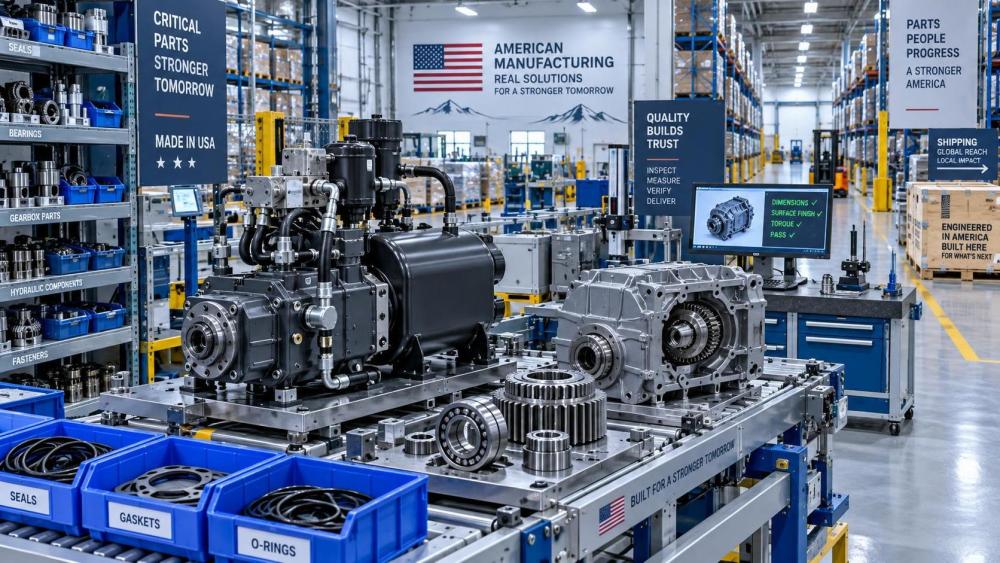
Critical Components Deserve a Different Sourcing Strategy
Not every item needs the same level of supply chain protection. A standard fastener and a custom spindle bearing should not be managed under identical rules. The strongest industrial organizations segment their supply base according to operational consequence, technical substitutability, replenishment time, and failure impact.
Consider the difference between a commonly available pneumatic fitting and a high-pressure hydraulic pump used in a production-critical system. The fitting may be sourced through multiple distributors with minimal qualification effort. The pump, by contrast, may require exact flow characteristics, pressure ratings, mounting dimensions, fluid compatibility, contamination-control requirements, and validation against the system’s duty cycle. A substitute that appears equivalent on paper can create heat, noise, energy loss, or premature failure in operation.
The same principle applies across mechanical transmission and sealing systems:
- Precision bearings may involve long qualification cycles, specific preload requirements, lubrication constraints, and demanding vibration performance.
- Mechanical seals and O-rings require material compatibility with temperature, pressure, chemicals, media cleanliness, and regulatory requirements.
- Chains, belts, sprockets, and couplings depend on alignment, load profiles, environmental exposure, and available maintenance practices.
- Hydraulic and pneumatic components must match system pressure, control architecture, filtration standards, and safety expectations.
For these categories, decision-makers should avoid the common mistake of buying purely on immediate purchase price. The more relevant measure is the cost of an unavailable or underperforming component: lost production, emergency freight, technician time, scrapped product, missed customer commitments, and potentially avoidable asset damage.
Domestic Production Does Not Eliminate the Need for Dual Sourcing
A frequent misunderstanding is that U.S.-based manufacturing makes supplier diversification less important. In reality, it can make diversification more targeted. A local primary source may offer speed and stronger collaboration, while an approved regional or international alternative protects against plant outages, capacity constraints, labor disruptions, or supplier financial stress.
Dual sourcing is not always appropriate. For highly engineered components, qualifying a second source can be expensive and technically demanding. In some cases, the better option is to retain a single qualified manufacturer while creating resilience through strategic stock, repair capability, shared forecasting, or contractual capacity commitments.
The decision should be made component by component. A useful framework asks four questions:
- How long can the operation run without this item?
- Can an alternative be used safely without redesign or revalidation?
- Where do the supplier’s own materials and subcomponents originate?
- What is the realistic recovery time after a disruption?
That last question is often overlooked. A supplier may quote a normal lead time of several weeks, but recovery after a tooling failure, material allocation, or transportation interruption can take much longer. Procurement teams need both numbers.
Inventory Is Returning as a Strategic Asset
Lean inventory remains valuable when it eliminates waste and obsolescence. Yet “lean” can become fragile when it ignores the replacement cycle of industrial assets. For a maintenance team, a low-cost inventory policy can feel expensive the moment a critical machine is stopped for lack of a specialized seal or bearing.
Global equipment manufacturing in the USA is encouraging a more nuanced view of inventory. Rather than carrying large quantities of everything, companies are building risk-based buffers around long-lead, single-source, high-failure-consequence parts. This may include bearing sets for critical motors, seal kits for process pumps, hydraulic cylinder repair packages, control valves, drive belts, chain links, and condition-monitoring sensors.
Inventory decisions should also account for shelf life and storage conditions. Elastomeric seals can degrade when exposed to heat, ozone, or unsuitable storage environments. Bearings can be damaged by poor handling, contamination, or corrosion. Hydraulic components require cleanliness discipline. Stocking a part without preserving its usability creates a false sense of security.
Traceability and Condition Data Are Now Part of Procurement Resilience
Supply chain risk is easier to manage when organizations know what they have, where it came from, and how it is performing. That sounds basic, but many companies still lack clean data connecting approved parts, installed assets, supplier lots, service histories, and replacement demand.
For industrial components, traceability has operational value beyond compliance. If abnormal vibration appears in a motor or gearbox, maintenance teams need to identify the bearing type, lubrication history, installation date, load conditions, and supplier batch quickly. If a seal fails in a chemical process, engineers need confidence in the compound, media exposure, and operating temperature. Without this record, failure analysis becomes slower, more expensive, and less conclusive.
Condition monitoring strengthens the picture. Vibration sensing, temperature tracking, oil analysis, pressure monitoring, and edge-based fault diagnostics can help businesses shift from emergency purchasing toward planned replacement. That reduces the chance that a component shortage will dictate a maintenance decision. It also helps procurement teams forecast demand using asset condition rather than historical consumption alone.
What Executives Should Ask Their Manufacturing and Procurement Teams
The conversation should move beyond “Are we sourcing domestically?” A more mature review examines the architecture of the supply network. Executives should ask whether critical suppliers disclose meaningful sub-tier risk; whether engineering specifications permit approved alternatives; whether inventory policies reflect downtime consequences; and whether MRO teams are involved before sourcing decisions are finalized.
It is also worth asking where flexibility truly exists. Can final assembly be shifted between facilities? Can a standard seal design be used across multiple equipment platforms? Are spare parts interchangeable across product generations? Can repair, remanufacturing, or component refurbishment reduce reliance on new supply during disruption?
These questions frequently reveal opportunities that are less dramatic than a full reshoring program but more immediately useful. Standardizing a family of hydraulic fittings, rationalizing bearing references, improving supplier forecasts, or redesigning a seal cartridge for field replacement can all reduce risk without sacrificing performance.
A More Balanced Meaning of Manufacturing “in the USA”
The rise of global equipment manufacturing in the USA signals a broader change in industrial strategy. Companies are placing greater value on response time, engineering proximity, supplier transparency, service capability, and control over critical operations. For machinery OEMs and industrial buyers, that can create meaningful resilience.
Still, the strongest supply chains will not be those that rely on one country, one supplier, or one inventory model. They will be built around clear visibility into component dependencies, realistic recovery plans, technically sound alternatives, and procurement decisions grounded in total cost of ownership.
For bearings, fluid power systems, power transmission parts, seals, and MRO inventory, resilience is not a slogan. It is the ability to keep equipment reliable when conditions are no longer predictable. U.S.-based manufacturing can be an important part of that capability—but only when leaders look beyond geography and manage the full chain of risk.
Want to dive deeper into these market dynamics, or need data-driven support for your next business move? Drop a line below and let the analysts at PCTS provide customized insights.
We respect your privacy. Your information is strictly confidential.
Related News
- 00
0000-00
IndexBox Forecasts 3.8% Annual Growth for Global Radial Seals Market Through 2035 - 00
0000-00
How to assess the chemical compatibility of FFKM sealing sheets - 00
0000-00
IndexBox Forecasts 3.6% Annual Growth for Construction Bearings Market - 00
0000-00
When do hydraulic components require an export license? - 00
0000-00
How to size modular pneumatic valve systems for adequate airflow
Weekly Insights
Stay ahead with our curated technology reports delivered every Monday.