





Spare Parts Lifecycle Assessment: When Repair Costs Exceed Value
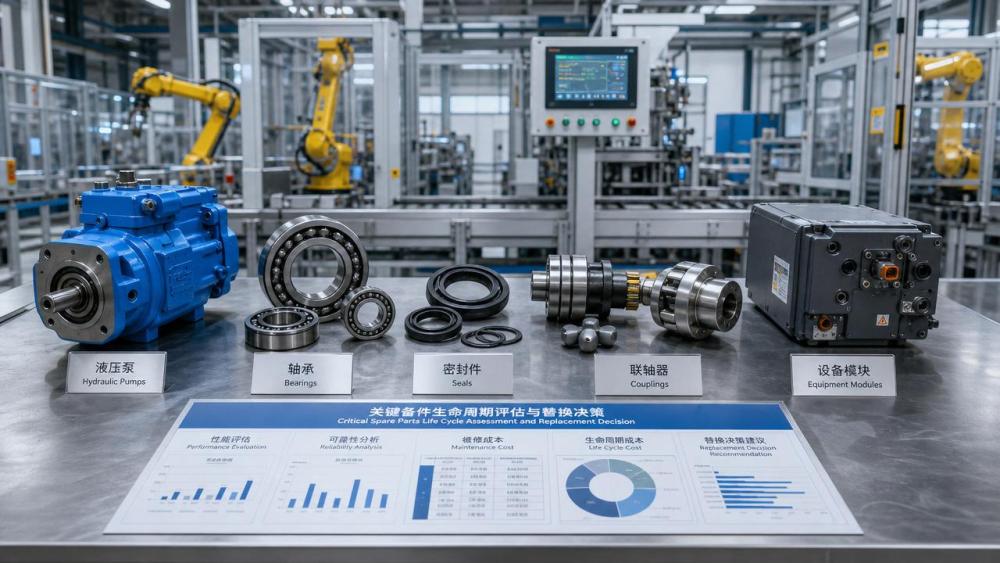
For finance leaders, spare parts lifecycle assessment is not a narrow maintenance exercise. It is a practical way to protect capital, control MRO spending, and avoid low-return repair decisions.
The core question is simple. At what point does another repair stop making economic sense, even if the machine can still run?
That tipping point is rarely caused by one invoice. It usually appears when parts cost, labor, downtime, quality loss, and procurement friction start rising together.
A disciplined spare parts lifecycle assessment helps teams see those signals earlier. It also turns maintenance data into clearer approval logic for replacement, rebuild, or deferred investment.
In industrial settings, this matters most for bearings, hydraulic pumps, seals, chains, couplings, pneumatic actuators, motors, and other wear-driven components with direct uptime impact.
Why spare parts lifecycle assessment matters more than unit price
A low purchase price can hide a high ownership cost. That is why spare parts lifecycle assessment must go beyond catalog price and compare the full cost of keeping an asset alive.
In many plants, repeated repairs look cheaper because spending is spread over time. But fragmented spending often escapes the same scrutiny applied to one-time replacement requests.
This creates a familiar pattern. Teams approve several small fixes, then absorb production loss, overtime labor, rush freight, and emergency sourcing without connecting the total financial picture.
A stronger spare parts lifecycle assessment corrects that bias. It compares repair economics against the remaining value, risk profile, and expected performance of the equipment.
From a financial view, the goal is not to minimize every immediate expense. The goal is to maximize useful output per dollar across the remaining service life.
The real cost layers behind a repair decision
A good spare parts lifecycle assessment separates visible costs from hidden ones. Visible costs are easy to capture. Hidden costs usually drive the final decision.
Visible costs
- Replacement part price, including bearings, seals, motors, valves, or chain assemblies.
- Internal labor for disassembly, inspection, repair, reassembly, and testing.
- Outside service fees for machining, balancing, rebuild work, or specialist support.
- Freight, expediting, and customs costs for urgent or imported components.
Hidden costs
- Downtime losses from stopped production or reduced line speed.
- Quality drift caused by worn transmission, sealing, or motion components.
- Energy waste from friction, leakage, poor alignment, or slipping belts.
- Safety exposure linked to unstable performance or repeated interventions.
- Procurement time spent chasing low-volume, obsolete, or hard-to-source parts.
When these hidden items are included, the spare parts lifecycle assessment often changes direction. What looked like a cheap repair can quickly become the costlier option.
How to identify the tipping point
The tipping point appears when expected repair cost exceeds the economic value of continued operation. In practice, that means using a simple but disciplined review structure.
Start with five decision tests
- Compare annual repair spend against the replacement cost of the part, module, or machine section.
- Measure failure frequency over the last twelve to twenty-four months.
- Estimate downtime cost per event, including lost throughput and restart losses.
- Assess whether spare part availability is getting worse because of lead time or obsolescence.
- Review whether the repaired asset still meets current output, energy, and quality requirements.
If three or more tests turn negative, the spare parts lifecycle assessment usually points toward replacement rather than another repair cycle.
Use practical threshold logic
Many companies set trigger rules to simplify approvals. For example, if repair cost reaches 50% of replacement value twice within one year, escalation becomes automatic.
Another useful rule is downtime risk concentration. If one worn component repeatedly threatens a critical line, financial tolerance should be lower than for noncritical equipment.
Where spare parts lifecycle assessment is most valuable
Not every spare item requires the same depth of review. The highest value comes from parts that combine high wear, high downtime impact, and variable sourcing conditions.
- Precision bearings in high-speed motors, spindles, conveyors, and rotating process equipment.
- Hydraulic pumps, cylinders, and motors in heavy-load or high-pressure duty cycles.
- Pneumatic actuators and air handling components in high-cycle automation lines.
- Chains, belts, sprockets, and couplings in power transmission systems.
- Mechanical seals, O-rings, and high-temperature sealing elements in leakage-sensitive processes.
In these categories, small failures can create large business consequences. That is exactly where spare parts lifecycle assessment improves procurement timing and capital discipline.
A finance-friendly framework for approval decisions
Maintenance teams often have the technical evidence. What they need is a decision structure that speaks clearly in financial terms.
A useful spare parts lifecycle assessment can be built around four approval questions.
1. What is the cost trend?
Look at repair spend by month, quarter, and failure event. Rising frequency matters as much as rising invoice size.
2. What is the avoided loss?
Estimate the downtime, scrap, labor, and rush purchasing that replacement would prevent over the next operating cycle.
3. What is the residual value?
If the asset is near obsolescence, its remaining value may be too low to justify recurring repair investment.
4. What is the strategic risk?
Single-source parts, export delays, and old designs increase risk. A solid spare parts lifecycle assessment brings those supply realities into the approval process.
Common mistakes that distort the decision
Several habits can make repair-heavy decisions look better than they are. These issues are common across industrial procurement and maintenance teams.
- Reviewing part cost without including downtime and quality loss.
- Treating each repair event separately instead of tracking cumulative lifecycle cost.
- Ignoring engineering time, planner effort, and emergency purchasing overhead.
- Assuming old spare parts are acceptable because the machine still operates.
- Overlooking performance decline, such as leakage, vibration, noise, heat, or lower line speed.
A balanced spare parts lifecycle assessment prevents these blind spots. It turns an emotional repair debate into a measurable business decision.
A simple scoring model for industrial teams
To make reviews faster, many organizations use a weighted scoring model. This helps standardize approvals across plants, asset classes, and supplier categories.
This kind of spare parts lifecycle assessment does not need to be complex. It only needs to be consistent, comparable, and tied to real operating data.
Turning analysis into better procurement action
The best outcome is not simply replacing more parts. It is making better-timed decisions with clearer budget logic and lower lifecycle risk.
In practical terms, spare parts lifecycle assessment supports three stronger actions.
- Shift recurring repair items into planned replacement programs.
- Prioritize critical spares with stable supply and verified performance history.
- Use lifecycle evidence during supplier negotiation, standardization, and capital request reviews.
That approach is especially useful in sectors relying on precision bearings, fluid power systems, transmission assemblies, and industrial sealing technologies.
When a spare parts lifecycle assessment becomes part of routine approval workflow, teams stop reacting to breakdowns and start managing asset value more deliberately.
Final takeaway
The smartest repair decision is not always the one with the lowest short-term invoice. It is the one that produces the best economic result over the remaining service life.
A disciplined spare parts lifecycle assessment helps reveal when repair costs exceed value, when replacement protects uptime, and when procurement strategy needs to change.
If your team is seeing repeated failures, growing downtime, harder sourcing, or unstable performance, that is the right moment to review lifecycle cost before approving the next repair.
Used well, spare parts lifecycle assessment becomes more than a maintenance tool. It becomes a practical filter for smarter spending, stronger asset decisions, and more reliable long-term industrial value.
Related News
- 00
0000-00
How FFKM O-rings reduce seal failure in corrosive media - 00
0000-00
What global equipment manufacturing in the USA means for supply chain risk - 00
0000-00
How FFKM outgassing performance affects vacuum seal selection - 00
0000-00
When should heat resistant metallurgy belts be replaced? - 00
0000-00
When does a fluid power maintenance service reduce unplanned downtime?
Weekly Insights
Stay ahead with our curated technology reports delivered every Monday.