





Why does lead time matter so much in OEM supplier evaluation?
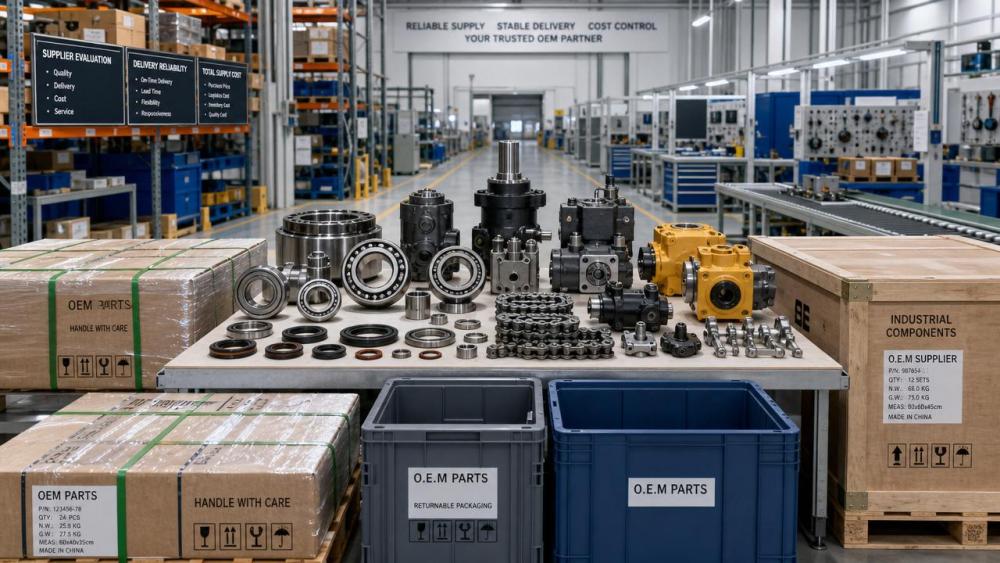
Lead time looks simple on paper, yet it changes cost structure far beyond delivery dates.
In OEM Supplier Evaluation, lead time influences inventory levels, emergency freight, line stoppage exposure, and planning confidence.
That is especially true in industrial categories where one delayed part can stop a larger assembly.
A late bearing, seal, coupling, chain, or hydraulic component may hold back commissioning, maintenance, or export schedules.
So the real question is not only, “How fast can a supplier ship?”
A better question is, “How does that lead time affect total supply cost across the full operating cycle?”
In practice, shorter and more stable lead times reduce the cash tied up in safety stock.
They also make demand changes easier to absorb when equipment orders move unexpectedly.
PCTS often frames this issue through total ownership logic rather than unit price alone.
That approach fits precision components well, because supply reliability and technical responsiveness usually move together.
When does a long lead time become a direct cost problem?
Not every long lead time is automatically bad.
For specialized spindle bearings, custom seals, or engineered hydraulic assemblies, longer production windows may be normal.
The cost problem starts when lead time is long, variable, and poorly communicated.
That mix creates planning gaps, and planning gaps quickly turn into money.
Typical cost pressure appears in several places:
- Higher safety stock for bearings, seals, belts, and MRO-critical spares.
- Premium freight when regular ocean or consolidated shipments no longer fit the schedule.
- Unplanned overtime during production recovery after material delays.
- Partial shipments that increase receiving, inspection, and coordination work.
- Lost flexibility when design changes happen after material commitments.
A common mistake in OEM Supplier Evaluation lead time analysis is counting only freight premiums.
The larger hidden cost is often schedule instability.
If one delivery date moves three times, planning teams create buffers everywhere else.
Those buffers raise stock, reserve capacity, and reduce purchasing leverage.
More importantly, unstable lead time makes demand forecasting look worse than it really is.
What should be measured instead of just quoted lead time?
Quoted lead time is only the first layer.
A stronger OEM Supplier Evaluation lead time review compares promise, consistency, and recovery capability.
This is where many sourcing decisions become more accurate.
The table below helps separate a fast quote from a dependable supply model.
A supplier with a 35-day stable cycle may be cheaper than one quoting 25 days but missing dates repeatedly.
That difference matters in bearings, fluid power parts, and sealing products where production windows are tightly linked.
PCTS content often highlights this wider performance view because industrial supply risk rarely comes from one metric alone.
How do short lead times compare with low prices in real sourcing decisions?
This is where OEM Supplier Evaluation lead time decisions become less theoretical.
A lower unit price can still create a higher total supply cost.
The gap usually appears when lead time forces extra stock or raises shortage risk.
Consider a standard industrial seal or bearing used across several machine platforms.
Supplier A offers a lower price, but ships in 14 to 18 weeks.
Supplier B is 4% higher, yet delivers reliably in six weeks with clear schedule updates.
If demand swings, Supplier B may lower overall cost through lower stock, fewer expedites, and less schedule exposure.
The calculation becomes even more important for these situations:
- Components with frequent design revisions.
- Mixed portfolios combining OEM production and MRO replenishment.
- Export projects with strict shipment milestones.
- Parts where downtime cost exceeds annual purchase value.
In other words, price wins only when timing risk stays manageable.
If timing risk is high, lead time becomes part of the price.
Which warning signs suggest a supplier’s lead time is more fragile than it looks?
A polished quotation can hide a weak execution model.
More useful signals usually appear in detail, not in brochures.
Watch for these patterns during OEM Supplier Evaluation lead time reviews:
- Lead times are quoted broadly, but not by SKU, process, or material dependency.
- Engineering changes trigger full schedule resets rather than controlled adjustments.
- Raw material sourcing is concentrated in one region without backup options.
- Urgent orders are accepted easily, but no clear priority rule exists.
- Delivery updates arrive only after the original promised date slips.
- Quality escapes rise when production is expedited.
This matters in precision mechanical components because lead time and process control are closely linked.
If heat treatment, grinding, seal compounding, or final inspection capacity is tight, schedules can look stable until demand spikes.
That is why technical visibility matters alongside logistics visibility.
Information platforms such as PCTS are useful here because they connect component technology, supplier capability, and lifecycle economics in one view.
What is a practical way to judge lead time before awarding business?
A practical review does not need to be complicated.
It needs to connect commercial terms with operational evidence.
A useful approach is to test lead time in stages rather than accept a single promise.
- Break items into standard, engineered, and critical spare categories.
- Request actual delivery history for comparable parts, not only target lead times.
- Check how schedule changes were communicated during the last disruption period.
- Model inventory cost under normal demand and surge demand.
- Define what qualifies for expedited recovery and who pays for it.
- Review whether quality and traceability remain intact under faster production.
This method helps compare suppliers that look similar on price sheets but behave very differently under pressure.
It also avoids the common trap of using one lead time assumption for all component families.
Bearings, pneumatic parts, seals, and transmission components often have different bottlenecks.
Treating them as one sourcing profile can distort total supply cost calculations.
So what should the final decision balance look like?
A sound decision balances price, lead time, consistency, technical fit, and recovery options.
Lead time should not dominate every sourcing decision, but it should never be treated as an administrative detail.
In OEM Supplier Evaluation, lead time often explains why a low quoted cost becomes a high operating cost later.
For industrial components, the best result usually comes from matching supply speed to application criticality.
Short, stable lead times matter most where downtime is expensive, engineering changes are frequent, or inventory space is limited.
Longer cycles can still work when demand is predictable and supplier execution is transparent.
The next useful step is to build a simple decision matrix by component category.
Include delivery consistency, expedite resilience, stock impact, and process visibility beside price.
That creates a more realistic sourcing picture, and it makes total supply cost easier to control over time.
Related News
- 00
0000-00
How FFKM O-rings reduce seal failure in corrosive media - 00
0000-00
What global equipment manufacturing in the USA means for supply chain risk - 00
0000-00
How FFKM outgassing performance affects vacuum seal selection - 00
0000-00
When should heat resistant metallurgy belts be replaced? - 00
0000-00
When does a fluid power maintenance service reduce unplanned downtime?
Weekly Insights
Stay ahead with our curated technology reports delivered every Monday.