





Global Sourcing Strategy Vietnam: Cost, Lead Time, and Supply Risk
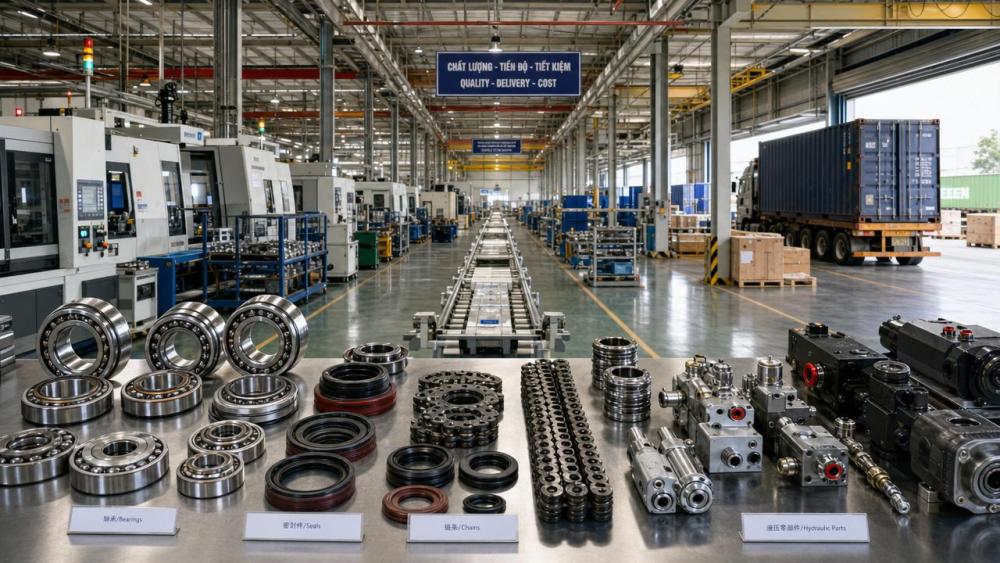
For procurement teams balancing cost pressure, delivery speed, and supplier resilience, a strong global sourcing strategy Vietnam can unlock major advantages.
The opportunity is real, but the decision only works with a clear view of landed cost, production timing, and disruption exposure.
In industrial components, price alone rarely decides the best source.
Buyers also need confidence in machining quality, supply continuity, packaging standards, export handling, and replacement part consistency.
That is why a practical global sourcing strategy Vietnam should compare three variables together: cost, lead time, and supply risk.
This matters even more for bearings, seals, chains, belts, hydraulic parts, pneumatic components, and other reliability-sensitive items.
A low quoted price means little if late delivery stops production or inconsistent quality drives high maintenance cost later.
From recent market shifts, the stronger signal is clear.
Vietnam is no longer just an alternative location. It is becoming a core node in many regional and global procurement networks.
Why Vietnam keeps gaining traction
A successful global sourcing strategy Vietnam starts with understanding why supplier migration continues.
Vietnam offers a competitive manufacturing base for labor-intensive assembly, metalworking, industrial packaging, and selected precision component categories.
Trade agreements also improve market access for many export routes.
That can support a better total cost structure, especially when tariff exposure is part of the sourcing equation.
In practice, buyers often see Vietnam as attractive for medium-volume programs that need flexibility without moving fully into a high-cost manufacturing environment.
The country also benefits from growing supplier clusters around industrial parks, ports, and export-oriented production zones.
- Competitive direct labor in many manufacturing categories
- Improving supplier capabilities in machining and assembly
- Stronger integration with regional logistics networks
- Better diversification compared with single-country dependence
- Growing interest from OEM and industrial MRO buyers
Still, a global sourcing strategy Vietnam should never assume that all product families benefit equally.
High-precision bearings, specialized seals, and hydraulic systems may still depend on imported materials, tooling, or testing resources.
That changes both cost expectations and lead time planning.
How to assess real cost, not just quoted price
The biggest mistake in a global sourcing strategy Vietnam is focusing on EXW or FOB price only.
A lower unit price can disappear after freight changes, customs handling, buffer stock, rework, and supplier management cost.
A better approach is to model total landed cost by product family.
For industrial components, the following cost layers usually matter most.
- Quoted unit price and tooling amortization
- Inbound material dependency and currency exposure
- Inspection, sampling, and quality audit cost
- Ocean or air freight, plus local logistics fees
- Duty, compliance, and documentation cost
- Inventory carrying cost from longer replenishment cycles
- Failure cost, including line stoppage and warranty risk
This is where the global sourcing strategy Vietnam becomes more strategic.
If a supplier offers strong process control, stable metallurgy, and clear quality records, slightly higher pricing may still create a lower total cost.
That is especially true for transmission parts and sealing components where small defects cause large downstream losses.
Lead time planning needs a wider lens
Lead time is often where a global sourcing strategy Vietnam either proves itself or breaks down.
Quoted lead time may look acceptable, but actual replenishment time includes more than factory production days.
Buyers should separate lead time into four parts: order confirmation, material readiness, production cycle, and export transit.
This makes delays easier to diagnose and easier to negotiate.
For example, a supplier may machine housings quickly but wait longer for imported seals, steel, or specialty coatings.
That means the real constraint is not factory labor. It is upstream supply alignment.
In actual operations, the most reliable sourcing decisions come from measuring lead time variability, not just lead time average.
- Track promised versus actual shipment dates
- Review raw material dependency by SKU
- Check port congestion patterns by season
- Test supplier response speed during engineering changes
- Compare standard orders with urgent replenishment cases
A solid global sourcing strategy Vietnam usually includes dual planning windows.
One window supports normal replenishment. The second covers exceptions such as quality holds, schedule pull-ins, or customer demand spikes.
This is especially useful for MRO buyers where downtime cost can outweigh any purchase price savings.
Supply risk is broader than factory risk
A resilient global sourcing strategy Vietnam should map risk beyond the supplier’s workshop.
The obvious risks are quality escape, labor shortage, and shipment delay.
The less obvious risks are often more damaging.
These include sub-tier material concentration, weak engineering documentation, limited testing depth, or compliance gaps in export paperwork.
For industrial parts, supply risk also includes performance instability.
A bearing that passes dimensional inspection but fails early in service still creates procurement risk.
The same goes for hydraulic seals with inconsistent compound behavior or chains with poor wear resistance.
A practical risk review for global sourcing strategy Vietnam should include the following checks.
- Validate sub-supplier visibility for steel, elastomers, coatings, and critical inserts.
- Confirm process capability for grinding, heat treatment, sealing, and finishing.
- Review traceability from lot number to shipment record.
- Audit corrective action discipline after defects or delays.
- Check business continuity plans for power, labor, and transport disruption.
This broader view turns supplier selection into risk-adjusted procurement instead of simple quote comparison.
A workable supplier evaluation framework
The best global sourcing strategy Vietnam is usually built with a scorecard, not a gut feeling.
A balanced scorecard keeps commercial, operational, and technical factors in one decision model.
For component sourcing, the weighting can vary by category.
Standard brackets may prioritize price and capacity, while precision bearings or sealing systems require stronger quality weighting.
- Commercial: unit price, payment terms, MOQ flexibility, currency exposure
- Operational: on-time delivery, capacity headroom, planning discipline
- Technical: tolerance control, material knowledge, validation capability
- Quality: rejection rate, traceability, CAPA speed, certification maturity
- Risk: sub-tier concentration, logistics sensitivity, business continuity
This kind of framework makes a global sourcing strategy Vietnam easier to defend internally.
It helps align sourcing, engineering, quality, and operations around the same facts.
It also reduces the common problem of choosing a supplier that looks cheap in procurement but expensive in operations.
How to make the strategy perform over time
A global sourcing strategy Vietnam should not end at supplier nomination.
The real value comes from ongoing control after the first shipment.
This means using simple but disciplined operating routines.
- Run quarterly business reviews with delivery and defect trends
- Create early-warning alerts for material or capacity constraints
- Keep approved second sources for critical SKUs
- Review safety stock levels using actual variability data
- Link supplier performance to future volume allocation
Over time, this turns a global sourcing strategy Vietnam into a living procurement system rather than a one-time cost project.
That also means buyers can respond faster when freight swings, demand changes, or technical requirements shift.
For companies sourcing mechanical power transmission, fluid power, sealing, and industrial MRO items, that flexibility is often where the margin improvement really appears.
The most effective global sourcing strategy Vietnam is not the one with the lowest opening quote.
It is the one that delivers stable quality, predictable replenishment, and lower disruption cost across the full supply cycle.
When cost analysis, lead time mapping, and risk screening work together, Vietnam becomes a stronger sourcing option and a more dependable part of long-term procurement planning.
Related News
- 00
0000-00
How precision transmission systems improve robot positioning accuracy - 00
0000-00
When welded hydraulic cylinder systems suit high-cycle equipment - 00
0000-00
Building a Conveyor Belt Predictive Maintenance Plan for Dusty Facilities - 00
0000-00
Which Chain Wear Indicators Enable Reliable Predictive Maintenance? - 00
0000-00
Predictive Maintenance for Conveyor Belts: Preventing Failures in High-Throughput Lines
Weekly Insights
Stay ahead with our curated technology reports delivered every Monday.