





It usually starts with a familiar conversation: a production line needs bearings, seals, hydraulic fittings, chain assemblies, or other replacement materials, and the first quote that lands on the buyer’s desk looks acceptable. Then a second supplier comes in much lower. A third promises faster lead time. Someone from maintenance says the previous batch wore out too soon, while engineering insists the material spec cannot change. Suddenly a straightforward purchase turns into a risk decision with operational consequences.
Many teams discover at this point that industrial material procurement is not really about finding the lowest unit price. It is about judging where cost will actually show up later: in machine downtime, emergency freight, failed inspections, unstable supply, rushed substitutions, or excess stock sitting on shelves because no one trusts future availability. If you are handling repeat buys, multi-site sourcing, or hard-to-replace mechanical components, understanding what drives both cost and supplier risk can prevent expensive surprises that do not appear on the quotation sheet.
When a cheaper quote is not really cheaper
A common mistake is to compare suppliers by unit price before confirming whether they are quoting the same thing in practice. On paper, two offers may describe the same bearing class, seal size, belt profile, or hydraulic component category. In reality, there can be meaningful differences in raw material grade, machining tolerance, heat treatment control, surface finish, packaging protection, shelf-life handling, traceability, or testing depth.
This is where hidden cost begins. The lower quote may still be valid for a less demanding application, but if your equipment runs under heat, contamination, shock load, chemical exposure, or continuous duty, minor quality variation can become a maintenance problem. Procurement teams often feel pressure to justify savings quickly, yet the cost of a part should be judged in the context of where it operates, how often it is replaced, and what failure interrupts.
That is especially true in categories where performance depends on consistency rather than just dimensions. A seal that fits but degrades early, a chain that matches pitch but wears unevenly, or a hydraulic part that meets nominal specification but varies batch to batch can turn a “good buy” into recurring trouble.
The risk signals that usually appear before supply problems
Supplier risk rarely arrives without warning. In many purchasing situations, the signs are visible early, but they get overlooked because teams are moving fast or focusing too narrowly on immediate price.
One sign is unstable communication. If technical questions are answered vaguely, or if the sales contact keeps changing material descriptions after quoting, that suggests weak internal coordination. Another sign is lead time that sounds too optimistic without a clear production or inventory explanation. A supplier may promise fast delivery to win the order, then revise dates later once actual capacity, subcontracting, or export handling catches up with reality.
Documentation quality is another clue. In industrial material procurement, suppliers that handle specifications carefully tend to reduce downstream confusion. That does not mean every supplier must provide excessive paperwork for every item. It means they should be able to clarify grade, application limits, interchangeability, packaging conditions, and revision control when it matters.
There is also the issue of concentration risk. A supplier may perform well in normal conditions but still create exposure if they are the only approved source for a critical material. This becomes a bigger issue when the item has a long manufacturing cycle, specialized tooling, proprietary geometry, or region-specific logistics constraints.
Where total cost usually increases without being noticed
Some cost drivers are obvious, such as raw material volatility, transport charges, import duties, and order quantity. Others build more quietly across the procurement cycle.
One of the biggest is specification ambiguity. If drawings, material standards, hardness requirements, lubricant type, sealing compound, or acceptable substitutes are not documented clearly, suppliers make assumptions. Assumptions lead to rework, disputes, or unsuitable deliveries. Even when the supplier is capable, unclear inputs from the buyer can distort cost and risk.
Another frequent driver is order fragmentation. Companies sometimes split demand across too many low-volume purchases, often because different departments source independently or because emergency orders keep interrupting normal planning. This increases transaction effort, makes freight less efficient, and weakens negotiating leverage. It can also make supplier performance look worse than it is, because every shipment becomes “urgent” by default.
Then there is the cost of poor substitution. In maintenance environments, teams may approve alternatives under time pressure. Some substitutions are sensible and technically equivalent. Others create misalignment in fit, lubrication behavior, wear pattern, chemical resistance, or expected service interval. The direct cost difference may be small; the operational cost can be much larger.
Finally, supplier onboarding itself has a cost. Every new source requires validation time from procurement, engineering, quality, and possibly operations. If a buyer changes suppliers too often in pursuit of short-term savings, the organization may spend more managing transitions than it saves through lower price.
Start with the application, not the catalog description
When a sourcing decision feels unclear, it helps to step away from catalog language and return to the actual use condition. Ask where the material sits in the equipment, what kind of stress it experiences, how difficult replacement is, and what happens if performance drifts.
For example, a consumable used in a low-risk, easily accessible area can often be sourced more flexibly than a component buried inside critical rotating equipment. A standard belt for non-essential conveying may justify a broader supplier pool than a precision bearing in a spindle environment. A general-purpose O-ring is not evaluated the same way as a seal exposed to aggressive media, temperature cycling, or contamination-sensitive operation.
This application-first view helps avoid two opposite mistakes: overbuying on low-risk items and underestimating the consequences of failure on critical ones. Both errors distort procurement cost.
In practice, many buyers create unnecessary friction because every item is treated with the same approval method. A more useful approach is to separate materials into practical sourcing groups: operationally critical, technically sensitive, standard repeat items, and emergency replacements. These groups do not need rigid labels in the system as long as the buying team understands that each one deserves a different level of supplier scrutiny.
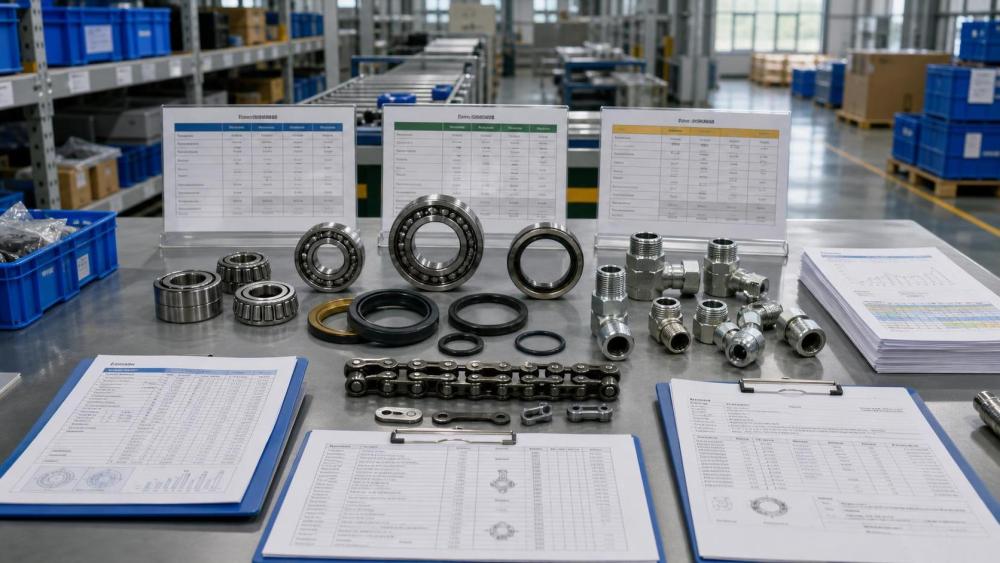
A more reliable way to compare suppliers
When buyers are under pressure, supplier evaluation often becomes overly simple: quote received, lead time listed, price compared, order placed. That may work for low-risk purchases. It is less reliable for industrial materials tied to maintenance continuity or equipment performance.
A stronger comparison method looks at a few practical dimensions together.
Technical alignment
Can the supplier explain the material, tolerance, coating, sealing compound, load capability, or environmental limitation in a way that matches your application? If your team has to keep correcting them, the low price is carrying technical uncertainty.
Consistency of supply
Do they show signs of stable production or sourcing control? This can include realistic lead times, clarity on stock versus made-to-order items, and a believable explanation of how they handle demand changes.
Quality predictability
The key is not perfection; it is repeatability. Procurement teams can work with normal variation if it is understood and managed. They struggle when the same part behaves differently every order.
Commercial discipline
Look for quote validity, revision control, shipping terms clarity, and responsiveness when questions become specific. These details indicate whether the supplier is likely to create confusion later.
Support after delivery
If a part arrives with a discrepancy, can the issue be discussed efficiently? In industrial buying, after-sales handling matters because disruptions often surface only during installation or operation.
None of this requires turning procurement into a theoretical scoring exercise. It simply means that a purchase decision should reflect the true risk profile of the material, not just the line-item price.
Why lead time risk often costs more than price risk
Buyers usually notice price movement immediately because it appears in every quotation. Lead time risk is easier to underestimate until the consequences become urgent. A delayed delivery on a planned stock item may be inconvenient. A delayed delivery on a shutdown-critical part can trigger premium freight, temporary workarounds, overtime coordination, or a rushed purchase from a less suitable source.
This is one reason dual sourcing is often discussed, though it is not always practical. For some specialized industrial materials, qualifying a second source takes time and internal agreement. Still, even where dual sourcing is not possible, procurement can reduce lead time exposure by mapping which items have long replenishment cycles, which ones depend on custom processing, and which ones are vulnerable to export or transit disruptions.
It also helps to separate “available now” from “available repeatedly.” Some suppliers can deliver quickly once, especially if they are clearing stock or reallocating inventory. That does not prove they can support regular demand. Buyers who ask one extra question — whether supply is coming from stock, current production, or external sourcing — often get a clearer picture of future risk.
Procurement problems that are really internal process problems
Not every supplier issue originates with the supplier. In many companies, cost inflation and sourcing instability are partly created by internal habits.
Engineering may update a specification without synchronizing procurement records. Maintenance may request a familiar item description that no longer matches the approved version. Different plants may buy equivalent materials under different naming conventions. Some teams place orders too late because consumption forecasting is weak; others buy too early because they lack confidence in replenishment timing. Both patterns increase cost in different ways.
If this sounds familiar, the most useful fix is usually not a dramatic supplier change. It is better item control: clearer descriptions, better cross-reference handling, cleaner historical purchase data, and early communication between maintenance, engineering, and purchasing. Even a modest improvement in part identification can reduce duplicate sourcing, substitution confusion, and argument over whether a delivered item is “the same as last time.”
Using market and technical information without overcomplicating the buy
One practical way to reduce uncertainty is to gather outside visibility before committing to a source, especially when buying unfamiliar categories or evaluating alternative suppliers. Buyers often need a place to compare technical context, market movement, application notes, and supplier positioning without relying only on sales claims. Used carefully, industry intelligence can help procurement teams ask better questions about bearing performance, sealing material suitability, hydraulic component reliability, transmission wear patterns, spare part planning, and lifecycle trade-offs.
The useful point is not to make the process academic. It is to shorten the gap between a quote and an informed decision. If your team has limited in-house time for deep component research, structured technical and market references can make supplier evaluation more grounded and less reactive.
What usually works better in daily purchasing practice
In routine operations, the most effective procurement improvement is often a small shift in sequence. Before negotiating price, confirm application fit. Before approving a substitute, check failure consequence. Before adding a new supplier, decide whether the category justifies another approval burden. Before accepting a short lead time promise, ask how that lead time is achieved. Before concluding that a supplier is expensive, review whether their consistency is already preventing unplanned costs elsewhere.
This approach does not eliminate trade-offs. Sometimes the lower-cost source is perfectly reasonable. Sometimes a premium supplier is unnecessary. The point is to make those choices deliberately rather than accidentally.
For industrial material procurement, cost and supplier risk are closely linked because the purchase does not end when the order is placed. It ends when the material performs as expected, arrives when needed, and does not force the business into avoidable disruption. Buyers who evaluate sourcing with that wider lens usually make steadier decisions, even in categories where technical detail and supply uncertainty are hard to separate.
Related News
- 00
0000-00
Which documents are essential for seal export compliance? - 00
0000-00
When do fluid power systems need closed-loop control? - 00
0000-00
How to vet an industrial sealing solutions supplier for critical equipment - 00
0000-00
When wireless intelligent condition monitoring justifies retrofit costs - 00
0000-00
When does an export compliance service reduce shipment delays?
Weekly Insights
Stay ahead with our curated technology reports delivered every Monday.