





As of August 12, 2026, the EU Packaging and Packaging Waste Regulation ((EU)2025/40, PPWR) is in full mandatory effect, replacing Directive 94/62/EC and directly raising the compliance threshold for packaging used in goods shipped to Europe. For exporters, manufacturers, packaging suppliers, and cross-border sellers, this matters because the rule reaches beyond outer cartons to materials such as tape, fillers, and inks, while non-compliance can lead to customs detention, product delisting, and fines tied to 4%–6% of global revenue.
What Is Now in Force
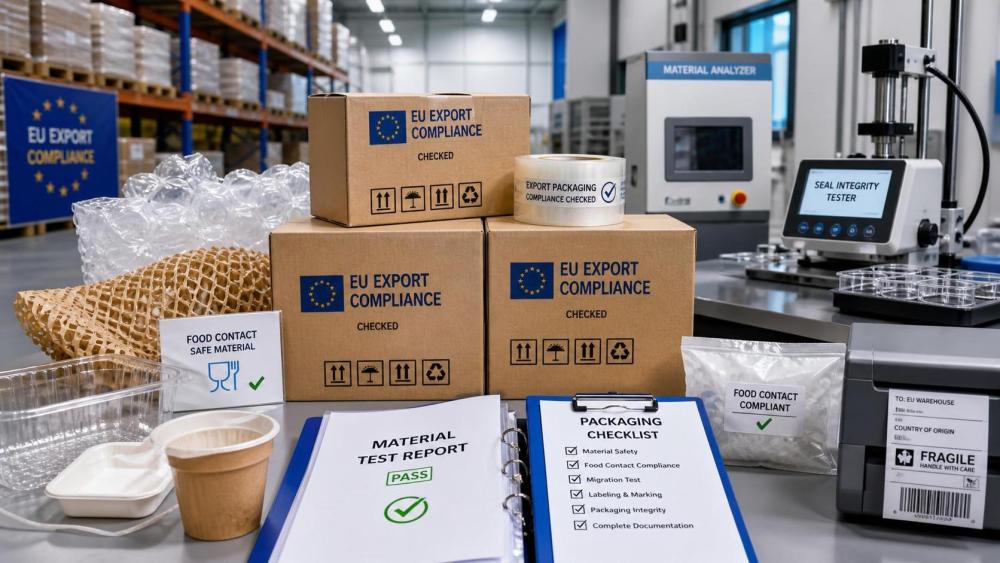
The confirmed change is that the PPWR under Regulation (EU)2025/40 became fully mandatory on August 12, 2026, and replaces the previous Directive 94/62/EC. The rule applies to packaging for products exported to the EU, including cartons, tape, filling materials, and inks.
Under the information provided, the regulation requires heavy metals in packaging to remain at or below 100 ppm. It also places strict control on PFAS in food-contact packaging and prohibits composite materials that are difficult to recycle. In documentation terms, affected businesses must provide a Declaration of Conformity (DoC), test reports, and technical documentation to be retained for 10 years.
The stated consequences for non-compliance include customs seizure or detention of goods, removal from platforms, and fines ranging from 4% to 6% of global revenue.
Where the Pressure Will Show Up First
Exporters now face packaging as a shipment-level compliance issue
From an industry perspective, exporters shipping to the EU are likely to feel the impact first because packaging is no longer a peripheral purchasing item but part of market access. The main business impact is likely to appear in shipment preparation, customs-facing documentation, and product listing continuity. What deserves closer attention is whether every packaging component used in export orders can be matched to the required declarations and test materials.
Manufacturers may need to review packaging specifications alongside product output
Analysis shows that manufacturers supplying EU-bound goods may be affected where packaging choices are embedded in production or final packing operations. The impact is likely to be concentrated in packaging design, material selection, and handoff to export teams. Businesses in this position should watch for gaps between existing production packaging and the materials that can actually meet the stated thresholds and documentation requirements.
Packaging and material suppliers move closer to the compliance chain
Observably, suppliers of cartons, adhesive tape, fillers, inks, and food-contact packaging may face greater scrutiny because their materials sit directly within the stated scope of the rule. The main impact is likely to appear in supplier qualification, test support, and document readiness. Buyers will likely pay closer attention to whether suppliers can support DoC preparation, testing evidence, and long-term technical file retention.
Platforms and channel operators may treat packaging risk as listing risk
For channel and platform-facing businesses, the stated risk of delisting makes packaging compliance relevant beyond customs clearance. The practical effect may appear in seller onboarding, listing maintenance, and dispute handling with marketplace operators or channel partners. What deserves closer attention is that packaging non-compliance may affect sales continuity even before broader commercial issues emerge.
What Companies Should Check Immediately
Map every packaging component, not only the box
Companies should focus on the full packaging bill of materials described in the summary, including cartons, tape, fillers, and inks. The practical issue is whether internal teams still treat these as separate purchasing items rather than one compliance package tied to the export product.
Prepare documentation as an operating requirement
The requirement for a DoC, test reports, and 10-year technical documentation means the issue is not limited to material choice. Businesses should pay close attention to document ownership, retention responsibility, and response timing when customs checks, platform reviews, or customer requests arise.
Identify exposure in food-contact packaging and composite materials
Where food-contact packaging is involved, the stricter PFAS control should be treated as a priority review point. For businesses using composite packaging structures, the stated prohibition on difficult-to-recycle composites makes material screening and supplier confirmation a near-term operational concern.
Align procurement, delivery, and customer communication
Analysis shows that procurement teams, packaging suppliers, compliance staff, and sales or account teams may need tighter coordination. The immediate concern is not abstract policy awareness but whether orders already moving to the EU are supported by compliant materials and complete files.
Why This Looks Like an Immediate Enforcement Signal
It is more appropriate to understand this as an active compliance threshold rather than a distant policy direction. The event is not simply a draft update or consultation stage; the information provided states that the regulation is now fully mandatory. Observably, that changes the discussion from future preparation to present execution.
At the same time, this should also be read as a longer-term signal for packaging governance in EU-bound trade. Analysis shows that the rule connects material restrictions, recyclability expectations, and document retention into one compliance framework. That combination suggests companies will need to treat packaging control as part of routine export readiness, not as a one-off regulatory check.
How the Industry Should Read This Moment
The industry significance of this development lies in the fact that packaging compliance is being enforced as a direct condition of access to the EU market. The immediate result is a higher operational burden for exporters and their supply chains, especially where packaging materials and supporting records are fragmented across vendors and internal teams.
From an editorial perspective, the most reasonable reading is that this is both a short-term operational change and a longer-term compliance signal. It should not be overstated beyond the facts provided, but it is also not a development that can be treated as routine background regulation.
Basis of This Article
This article is based on the user-provided news title, event date, and event summary concerning the mandatory implementation of the EU Packaging and Packaging Waste Regulation ((EU)2025/40, PPWR) on August 12, 2026. The analysis and observations above are interpretive and are intended to distinguish confirmed facts from industry reading.
For this type of development, source categories commonly worth checking include official regulatory notices, company disclosures, industry association updates, authoritative media coverage, and standard or regulatory documents. A specific official source link was not provided in the input, so the exact official reference remains subject to further verification. Follow-up attention should remain on any later official clarification, implementation guidance, and market-side enforcement practices connected to PPWR documentation and packaging material compliance.
Want to dive deeper into these market dynamics, or need data-driven support for your next business move? Drop a line below and let the analysts at PCTS provide customized insights.
We respect your privacy. Your information is strictly confidential.
Related News
- 00
0000-00
How sealing technology reduces contamination in semiconductor manufacturing - 00
0000-00
Where to install vibration sensors on rotating machinery - 00
0000-00
NTSB Probe Finds Boeing Warned of MD-11 Engine Bearing Risk Years Earlier - 00
0000-00
How to size pneumatic grippers for packaging system integration - 00
0000-00
How to size alloy steel power transmission chains for heavy loads
Weekly Insights
Stay ahead with our curated technology reports delivered every Monday.