





Hydrodynamic lubrication theory sits at the center of real machinery performance because it explains how a fluid film carries load between moving surfaces. When that film is stable, friction drops, wear slows, heat is managed, and component life becomes more predictable.
That matters across bearings, hydraulic pumps, shaft seals, couplings, and transmission assemblies. In industrial decision-making, this is not only a design topic. It also affects maintenance intervals, spare parts planning, energy use, and lifecycle cost.
Why the theory matters beyond the textbook
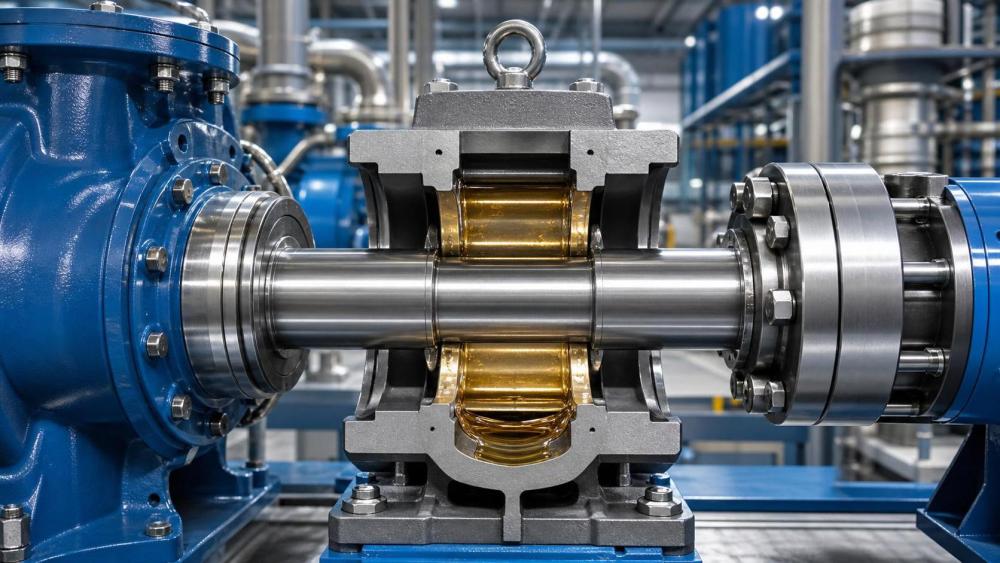
Hydrodynamic lubrication theory describes a condition where relative motion pulls lubricant into a converging gap. Pressure builds inside that film and separates the surfaces without direct metal-to-metal contact.
Simple in principle, the result is highly practical. Stable film formation supports quieter operation, lower scuffing risk, and better reliability under continuous industrial loads.
In PCTS coverage, this principle connects naturally with bearings, fluid power equipment, sealing systems, and industrial MRO decisions. It links tribology with operational questions that affect uptime and total cost of ownership.
The current industry focus is easy to understand. Machines are running faster, loads are becoming less forgiving, and shutdown costs are rising. Under those conditions, lubrication performance is no longer a background issue.
What creates a hydrodynamic film in real equipment
A hydrodynamic film does not appear by lubricant presence alone. It depends on motion, surface geometry, viscosity, load, clearance, and temperature working together in the right balance.
When a shaft rotates inside a bearing, or when moving machine elements slide in a controlled gap, the lubricant is dragged into a narrowing space. That wedge effect creates pressure inside the fluid.
If speed is too low, the film may not fully separate surfaces. If load is too high, the film can become too thin. If viscosity falls because of heat, protection may weaken at the exact point it is needed.
This is why hydrodynamic lubrication theory should always be read with operating conditions in mind. A design that works well in laboratory conditions may perform very differently in dusty, hot, high-load production environments.
The variables that change performance most
- Lubricant viscosity, especially under actual operating temperature
- Surface speed and whether startup conditions dominate runtime
- Load direction, shock loading, and transient pressure spikes
- Component clearance, finish quality, and alignment accuracy
- Contamination, aeration, and lubricant degradation over time
Where hydrodynamic lubrication theory shows up in industry
The concept is often associated with journal bearings, but its relevance is wider. It influences how many core industrial components manage load, motion, and durability.
From an industry intelligence perspective, this range is important. It means hydrodynamic lubrication theory is not a narrow academic subject. It is a shared performance language across rotating equipment and fluid power systems.
What the market is paying closer attention to
Three shifts are raising interest in lubrication behavior. The first is higher equipment efficiency targets. The second is reliability pressure in continuous production. The third is closer scrutiny of maintenance economics.
Under these pressures, users increasingly compare not only component price, but also lubrication tolerance. A part that survives contamination, temperature drift, or variable load may create stronger long-term value than a lower-cost alternative.
This is also where PCTS-style analysis becomes useful. Bearings, seals, pumps, and transmission parts cannot be judged only by catalog dimensions. Their lubrication behavior under application-specific conditions often decides actual field performance.
Signals worth checking during evaluation
- Operating speed range rather than nominal speed only
- Load profile, including shock and cyclic variation
- Lubricant compatibility with temperature and sealing materials
- Sensitivity to contamination and filtration quality
- Condition monitoring options for vibration, heat, or oil health
How to apply the theory in practical decisions
In practice, hydrodynamic lubrication theory is most valuable when it improves judgment. It helps explain why one machine runs cool and stable while another, using similar hardware, develops wear, noise, or leakage.
For example, a bearing may fail early not because the bearing was poorly made, but because viscosity dropped below the needed film level at operating temperature. The root cause may sit in lubricant choice, not in the component alone.
Likewise, a hydraulic pump can lose volumetric efficiency and surface integrity when lubrication regimes become unstable. What appears to be a pressure problem may begin as a film formation problem inside the rotating group.
The same logic applies to sealing systems. Mechanical seal faces often depend on controlled lubrication conditions. If fluid properties shift, dry contact risk and thermal damage can rise quickly.
A useful interpretation framework
When reviewing a component or system, it helps to ask four connected questions. Can a stable film form, can it remain stable, what disrupts it, and how visible are those disruptions before failure occurs?
That framework supports better comparison across suppliers, designs, and maintenance strategies. It also turns hydrodynamic lubrication theory into an applied filter for risk assessment.
Common misunderstandings that lead to poor outcomes
One common mistake is assuming more lubricant always means better lubrication. In reality, the wrong viscosity or unstable flow can increase drag, heat, and efficiency loss.
Another mistake is focusing only on steady-state operation. Many failures begin during startup, shutdown, or load transitions, when the full hydrodynamic film is not yet established.
A third issue is separating component choice from maintenance practice. Hydrodynamic lubrication theory depends on real conditions, so filtration, oil cleanliness, alignment, and monitoring are part of the same performance equation.
This is especially relevant in heavy-duty chains, industrial belts, power transmission assemblies, and mixed equipment fleets. Lubrication risk often spreads across connected components rather than staying isolated in one part.
What to examine next
A useful next step is to map lubrication conditions to actual operating scenarios, not just design assumptions. Check speed variation, load cycles, ambient temperature, contamination exposure, and shutdown frequency.
Then compare those conditions against component clearances, lubricant properties, seal compatibility, and monitoring capability. That process often reveals whether a performance issue is structural, operational, or maintenance-related.
For ongoing evaluation, hydrodynamic lubrication theory works best when combined with application data, supplier documentation, and field feedback. In that combined view, lubrication stops being an isolated technical detail and becomes a practical decision tool for reliability.
For anyone tracking bearings, hydraulic systems, seals, or transmission parts through the broader PCTS lens, the most productive move is to build a clear checklist: film formation conditions, lubricant stability, contamination control, and failure warning signals. That foundation supports better comparisons, smarter maintenance planning, and more confident equipment decisions.
- hydraulic pumps
- industrial MRO
- hydrodynamic lubrication
- hydraulic pumps and motors
- transmission systems
- hydraulic systems
- mechanical seals
- heavy-duty chains
- industrial belts
- maintenance strategies
- condition monitoring
- Total Cost of Ownership
- Fluid Power Systems
- Tribology
- hydrodynamic lubrication theory
Related News
- 00
0000-00
When does an export compliance service reduce shipment delays? - 00
0000-00
How to assess a mechanical seal solutions supplier’s quality control - 00
0000-00
How to use chain wear analysis to prevent mining conveyor failures - 00
0000-00
How to select PU timing belts for automation with high positioning accuracy - 00
0000-00
How to size power transmission systems for steel mill loads
Weekly Insights
Stay ahead with our curated technology reports delivered every Monday.