





A well-designed maintenance strategy service reduces downtime and cost when it shifts maintenance from reactive repairs to data-driven planning, asset criticality control, and smarter spare-parts decisions. For business decision-makers, the real value lies not only in preventing failures, but in improving equipment availability, extending component life, and lowering total operating risk across production, MRO, and supply chains.
For most industrial businesses, the question is not whether maintenance matters, but when a structured maintenance strategy service starts producing measurable financial results. The answer is practical: it works when maintenance is linked to asset risk, production priorities, failure patterns, and supply chain realities rather than treated as a basic repair function.
In sectors that depend on bearings, hydraulic systems, pneumatic assemblies, transmission parts, seals, chains, and belts, downtime rarely comes from a single dramatic breakdown alone. It often grows from poor planning, missed early warning signs, weak spare-parts policies, and maintenance routines that do not match actual operating conditions.
That is why many business leaders evaluate a maintenance strategy service as an operating model, not a technical add-on. They want to know whether it will lower unplanned stoppages, stabilize maintenance spending, improve asset life, and strengthen confidence across procurement, production, and engineering teams.
When does a maintenance strategy service actually start reducing downtime and cost?
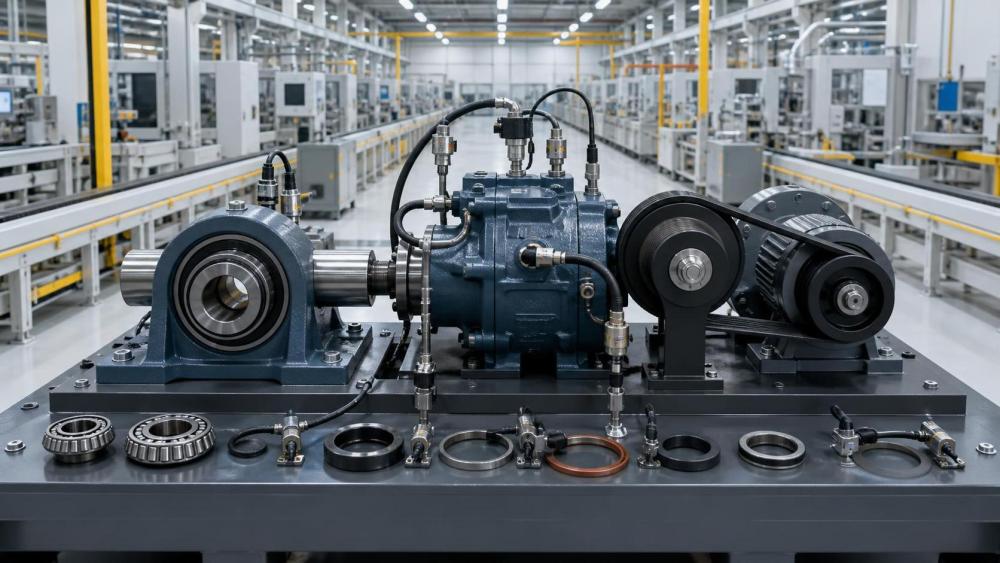
A maintenance strategy service starts creating real value when it changes decisions before failure happens. If the service only documents maintenance tasks, it may improve reporting, but it will not materially reduce downtime or cost.
The strongest results appear when three conditions are present. First, the operation has critical assets whose failure interrupts output, safety, quality, or delivery. Second, maintenance decisions are still partly reactive. Third, the business has enough operational data to prioritize action.
Under those conditions, a structured service can reduce avoidable shutdowns by identifying which components deserve predictive monitoring, which require preventive intervals, and which can safely remain in run-to-failure status. That distinction is where waste begins to disappear.
For executive teams, the cost benefit comes from better timing. Planned maintenance almost always costs less than emergency intervention because labor is organized, spare parts are available, collateral damage is limited, and production disruption is shorter and easier to schedule.
Consider rotating equipment supported by precision bearings and seals. If lubrication condition, vibration trend, contamination exposure, and load history are monitored properly, maintenance can intervene during a controlled window. That avoids secondary damage to shafts, housings, couplings, and adjacent transmission components.
The same principle applies to hydraulic pumps, motors, cylinders, pneumatic actuators, and conveyor drive systems. When maintenance strategy reflects actual wear mechanisms, the service helps companies replace parts based on condition and business impact instead of guesswork or calendar habit.
What problems are decision-makers really trying to solve?
Senior decision-makers rarely search for a maintenance strategy service because they want a new maintenance theory. They are usually trying to solve a business problem that already shows up in margin pressure, service failures, unstable output, or rising MRO spending.
One common concern is unplanned downtime that disrupts production commitments. This is especially serious in process industries, automated manufacturing lines, material handling systems, and export-oriented operations where delayed output can trigger penalties, missed shipments, and customer dissatisfaction.
A second concern is maintenance cost volatility. Emergency repairs tend to create a premium-cost environment because overtime labor, expedited freight, rush procurement, and emergency contractor support are all more expensive than planned intervention.
Another major issue is hidden asset-life loss. Bearings running with poor lubrication, seals exposed to incompatible chemicals, belts operating under misalignment, or chains running with improper tension may continue working for some time while steadily accumulating avoidable degradation.
Decision-makers also worry about spare-parts inefficiency. Many plants carry too much low-value stock and too little of the parts that actually determine uptime. Without a clear maintenance strategy, inventory often reflects historical habits rather than failure criticality.
There is also a governance issue. Leadership wants consistency across sites, teams, and contractors. If each maintenance team uses different rules for inspection intervals, lubrication standards, component replacement, and shutdown planning, performance becomes difficult to manage at scale.
How does a maintenance strategy service create measurable business value?
The value of a maintenance strategy service is not limited to fewer breakdowns. Its broader contribution is that it improves the economic quality of maintenance decisions across the full asset lifecycle.
First, it helps businesses match maintenance effort to asset criticality. Not every machine deserves the same level of monitoring, and not every component requires the same intervention frequency. That prevents both under-maintenance and over-maintenance.
Second, it improves equipment availability. When maintenance tasks are aligned with actual failure modes, machines spend more time in productive operation and less time waiting for diagnosis, approvals, or spare parts during emergency events.
Third, it supports longer component life. Precision bearings, hydraulic assemblies, sealing systems, power transmission parts, and pneumatic components perform best when maintenance addresses contamination, lubrication quality, heat, alignment, pressure fluctuations, and load instability early.
Fourth, it reduces total maintenance cost, not just direct repair cost. Better planning lowers emergency labor premiums, avoids repeat failures, reduces scrap risk, and limits the indirect losses tied to missed production, unstable quality, and inefficient line recovery.
Fifth, it improves procurement discipline. When maintenance strategy is linked to failure data and operating context, buyers can make more rational sourcing decisions on seals, O-rings, couplings, bearings, pumps, belts, chains, and condition monitoring components.
For B2B industrial companies, this matters because maintenance performance is deeply connected to total cost of ownership. A lower-priced component is not truly lower cost if it increases downtime probability, service complexity, or replacement frequency.
Which assets benefit most from a structured maintenance strategy service?
The best candidates are assets with high failure consequences, recurring wear patterns, or expensive downtime impact. These are usually the systems that directly influence throughput, safety, energy use, product quality, or delivery reliability.
Rotating machinery is a leading example. Pumps, motors, fans, gearboxes, compressors, conveyors, and spindle systems often depend on the health of bearings, lubrication systems, couplings, seals, and transmission elements. Small defects in these components can escalate quickly.
Hydraulic systems also benefit strongly because contamination, pressure instability, fluid degradation, and seal wear can create failures that spread across pumps, valves, cylinders, and motors. A maintenance strategy service helps prioritize fluid analysis, filtration control, and replacement planning.
Pneumatic systems deserve attention as well, especially in automated lines where actuator speed, air leakage, valve response, and positioning reliability affect takt time and repeatability. Small inefficiencies often become large operational losses over time.
Conveying and power transmission systems are another high-value category. Chains, belts, sprockets, pulleys, and couplings experience wear, misalignment, slippage, and shock loading. Without a structured approach, replacement may happen too late or far too early.
Sealing systems are often underestimated. Yet mechanical seals, O-rings, chemical-resistant seals, and high-temperature sealing materials are central to reliability in harsh environments. Leakage, contamination ingress, and fluid loss frequently trigger broader equipment and compliance problems.
What should decision-makers look for in a high-value service model?
Not every maintenance strategy service delivers the same outcome. Some providers focus mainly on documentation, while others combine reliability analysis, operating context, spare-parts logic, and implementation support. Decision-makers should be careful about that difference.
A high-value service should begin with asset criticality analysis. This establishes which failures matter most in terms of production, safety, quality, compliance, repair cost, and recovery time. Without this step, maintenance effort is often spread too evenly.
It should also include failure mode evaluation. For industrial components such as bearings, hydraulic pumps, seals, belts, and chains, the service must identify how failures actually develop under real loads, temperatures, contamination exposure, and duty cycles.
Condition monitoring logic is another important element. The service should clarify where vibration analysis, temperature tracking, oil analysis, pressure monitoring, leakage detection, or edge-based diagnostic sensors will generate decision-grade information.
Spare-parts strategy is equally important. A useful service helps determine which parts must be stocked locally, which can be sourced regionally, and which should be standardized across equipment groups to reduce purchasing complexity and downtime exposure.
Finally, the service should define performance metrics. Business leaders need visibility into mean time between failure, planned versus unplanned work ratio, schedule compliance, maintenance cost per asset class, and the downtime cost avoided through earlier intervention.
How can companies judge return on investment without overpromising results?
Leaders should assess ROI through avoided loss, not through vague expectations. The right calculation compares the cost of the service and related implementation against the measurable reduction in downtime, emergency labor, secondary damage, and excess spare-parts spending.
Start with the cost of one hour of downtime for critical assets. Include lost output, labor inefficiency, restart losses, late delivery exposure, quality fallout, and any energy or material waste caused by unstable operation.
Then review maintenance history. If a plant repeatedly suffers bearing failures, hydraulic leakage events, premature seal replacement, or conveyor stoppages, those patterns provide an evidence base for estimating preventable loss.
ROI also improves when maintenance strategy reduces unnecessary interventions. Many businesses replace components too early because they do not trust asset condition data. A better service can lengthen useful life without increasing operational risk.
However, decision-makers should avoid inflated assumptions. A maintenance strategy service will not fix poor installation practices, low-quality components, weak operator discipline, or chronic contamination by itself. Results depend on execution quality after the strategy is defined.
The most credible business case is phased. Focus first on the asset groups with the highest downtime cost and most visible failure patterns. Early wins build confidence and create the data needed to expand the program intelligently.
When does this approach fail to deliver expected savings?
A maintenance strategy service may underperform when the company treats it as a one-time report rather than an operating discipline. Strategy only works when inspection routines, planning practices, procurement rules, and shutdown decisions actually change.
Another common failure point is poor data quality. If asset records are incomplete, work orders are inconsistent, and failure causes are not captured accurately, the service may produce weak priorities or misleading conclusions.
Organizational separation can also limit value. When maintenance, production, and procurement work with conflicting targets, reliability decisions become compromised. For example, a cheaper seal or bearing choice may increase future downtime even if it reduces immediate purchase price.
Some companies also apply advanced monitoring where basic maintenance discipline is missing. If lubrication control, alignment, cleanliness, and installation standards are weak, sensors alone will not create sustainable savings.
Finally, savings may be delayed when the asset base is not segmented properly. Spreading the same maintenance model across all equipment can consume budget without addressing the few critical systems that actually drive business risk.
What is the practical conclusion for business leaders?
A maintenance strategy service reduces downtime and cost when it improves the timing, priority, and quality of maintenance decisions for the assets that matter most. Its value is highest where failure consequences are large and maintenance has been partly reactive.
For decision-makers, the right question is not simply whether to invest in maintenance strategy. The better question is whether current maintenance practices are producing stable availability, controlled MRO spending, disciplined spare-parts planning, and predictable asset life.
If the answer is no, then a structured maintenance strategy service can become a clear business lever. It connects engineering reality with financial performance by turning failure patterns, component behavior, and operating data into more reliable decisions.
In industrial environments built on bearings, hydraulic power, pneumatic motion, sealing integrity, and transmission reliability, that shift can be significant. It lowers operational risk, improves production resilience, and supports a stronger total cost position over time.
The companies that benefit most are usually those willing to prioritize critical assets, measure downtime economics honestly, and align maintenance, procurement, and operations around lifecycle value rather than short-term repair response.
In that sense, the real payoff of a maintenance strategy service is not just fewer failures. It is better control over the business consequences of failure, which is exactly where downtime and cost reduction become meaningful.
- pneumatic actuators
- hydraulic pumps
- O-rings
- vibration analysis
- transmission systems
- hydraulic systems
- pneumatic systems
- mechanical seals
- condition monitoring
- high-temperature sealing
- power transmission systems
- Total Cost of Ownership
- high-temperature sealing materials
- power transmission parts
- maintenance strategy service
Related News
- 00
0000-00
When do fluid power systems need closed-loop control? - 00
0000-00
How to vet an industrial sealing solutions supplier for critical equipment - 00
0000-00
When wireless intelligent condition monitoring justifies retrofit costs - 00
0000-00
When does an export compliance service reduce shipment delays? - 00
0000-00
How to assess a mechanical seal solutions supplier’s quality control
Weekly Insights
Stay ahead with our curated technology reports delivered every Monday.