





What usually goes wrong when industrial spare parts distributors are changed too quickly?
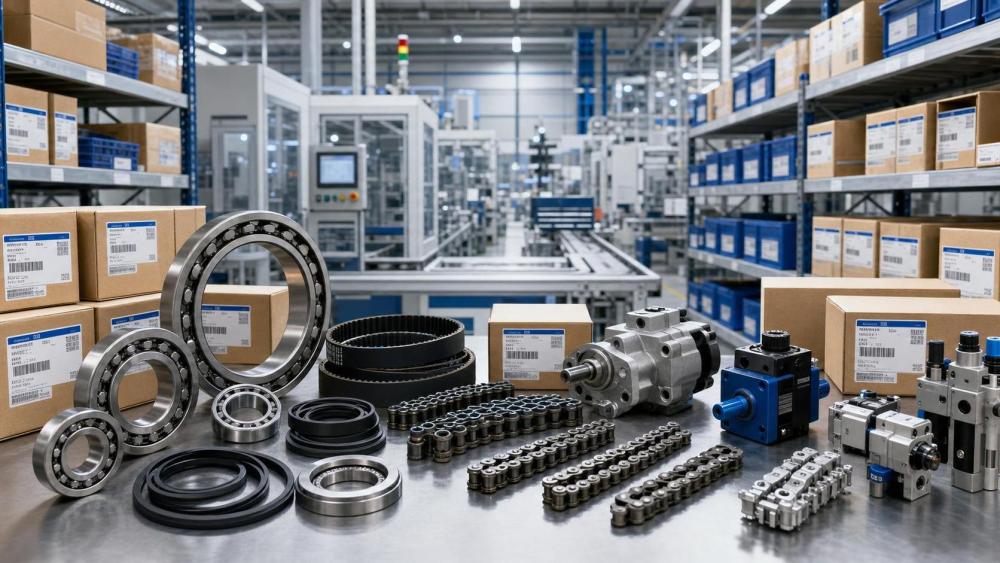
Changing industrial spare parts distributors is rarely just a purchasing event. It can reshape uptime, maintenance rhythm, and cost visibility across multiple equipment lines.
The biggest mistake is treating the switch as a simple price comparison. Lower unit cost can hide longer lead times, poor traceability, or weak technical support.
In actual operations, spare parts affect rotating systems, hydraulic assemblies, pneumatic motion, sealing reliability, and transmission efficiency at the same time.
That means one weak distributor can create several types of disruption. A bearing delay may stop a line. A wrong seal material may shorten service life. An unmatched chain may accelerate wear.
This is why industrial spare parts distributors should be reviewed through total operating impact, not only through the quoted catalog price.
A more reliable approach is to ask a simple question first: will the new source support the same or better reliability over the next replacement cycle?
That question becomes even more important when parts include bearings, hydraulic pumps, cylinders, couplings, belts, sprockets, seals, O-rings, or condition monitoring components.
How can you tell whether a new distributor is actually safer, not just cheaper?
A safer distributor usually proves value in documentation, inventory behavior, and application knowledge before the first emergency order ever happens.
Start with supplier control basics. Check quality certifications, batch traceability, packaging standards, and counterfeit prevention procedures.
Then move to operational discipline. Ask how stock is segmented between fast movers, long-tail parts, and special-order items.
Industrial spare parts distributors often look similar online, but the difference appears when part numbers are revised, legacy machines need support, or cross-brand substitutions are requested.
It helps to evaluate them across a short decision table before moving any volume.
A distributor that answers clearly, with evidence, usually brings less risk than one offering only broad claims and discount language.
Are compatibility and application support really that important?
Yes, especially when installed parts work inside demanding systems. Compatibility is not only about dimensions. It includes load, speed, lubrication, pressure, temperature, vibration, and media exposure.
For example, two seals may share the same size but fail very differently in chemical service. Two bearings may match geometry but differ in internal clearance or cage design.
The same applies to belts, chains, couplings, and pneumatic components. A substitute part that looks acceptable on paper may change noise, wear rate, or maintenance intervals.
This is where strong industrial spare parts distributors separate themselves. They should be able to discuss application limits, not merely catalog equivalence.
Useful verification usually includes the following:
- Cross-reference method for obsolete or revised part numbers.
- Material confirmation for seals, O-rings, and wear parts.
- Load, speed, and lubrication guidance for bearings and transmission parts.
- Pressure and duty-cycle review for hydraulic and pneumatic assemblies.
- Failure history feedback for similar applications.
Platforms such as PCTS are useful here because they connect component categories, maintenance economics, and application logic in one place.
That broader view helps when evaluating whether a new distributor understands not just the part, but the machine behavior around it.
What costs are often missed when comparing industrial spare parts distributors?
The hidden costs usually appear after the purchase order is closed. That is why total cost of ownership matters more than invoice price alone.
A lower-priced part can become more expensive if it causes rework, extra lubrication, frequent replacement, line stoppage, or higher energy use.
This is common in bearings, seals, hydraulic components, and power transmission items where small performance differences create large lifecycle effects.
When reviewing industrial spare parts distributors, cost questions should include more than purchase price:
- How often will expedited freight be required?
- Will the new source increase minimum order quantities?
- Are technical visits, failure analysis, or documentation charged separately?
- Will substitution risk increase scrap or restart time?
- Does the distributor support planned stocking for shutdown periods?
A practical way to compare options is to review one year of historical demand by category, then simulate cost under the new supply model.
That approach usually reveals whether the apparent savings are real, marginal, or negative once downtime exposure is included.
When does a distributor change become high risk?
Risk increases when the installed base is old, documentation is incomplete, or the site depends on hard-to-source components.
It also rises when the current distributor holds tribal knowledge about modified equipment, nonstandard kits, or recurring failure patterns.
In those cases, changing industrial spare parts distributors without a transition plan can create small errors that compound quickly.
A short risk screen helps before any changeover decision.
A staged transition is often smarter than a full transfer. It gives time to test service quality, packaging accuracy, and emergency response under real conditions.
What should be checked before the first purchase order goes to a new source?
Before moving business, confirm the practical details that usually cause friction later. This is where many distributor changes succeed or fail.
Review commercial terms, but also validate execution rules. Delivery promises mean little if packing labels, revision control, or return handling are unclear.
The pre-order checklist should cover:
- Approved manufacturer list and substitution policy.
- Part-number governance for old and new ERP records.
- Lot traceability documents and certificates where needed.
- Emergency order process outside normal business hours.
- Claims handling timeline for wrong, damaged, or failed parts.
- Stock commitments for critical MRO items.
It is also worth checking whether the distributor follows market signals, technical updates, and lifecycle issues across product families.
That type of visibility matters when sourcing precision components, fluid power products, transmission parts, and sealing materials that face changing availability or revised standards.
This is one reason industry intelligence resources like PCTS can support a better decision. They help connect supplier evaluation with reliability trends, replacement cycles, and operating context.
So what is the smartest next step before switching industrial spare parts distributors?
The best next step is not a full replacement. It is a controlled comparison built around your most important spare parts and your most expensive failure risks.
Start with a shortlist of categories such as bearings, hydraulic repair parts, pneumatic wear items, chains, belts, couplings, seals, and O-rings.
Then compare current and proposed industrial spare parts distributors on traceability, stock depth, lead-time consistency, technical review quality, and total delivered cost.
If the new source performs well in a pilot phase, expand gradually. If answers remain vague, the short-term discount is probably carrying long-term supply risk.
A distributor change is worth making when it improves reliability, not only when it changes the invoice. That is the standard that keeps maintenance planning and procurement decisions aligned.
Related News
- 00
0000-00
Which ISO standards apply to crane hydraulic systems? - 00
0000-00
How preload affects angular contact bearing stiffness and service life - 00
0000-00
Which documents are essential for seal export compliance? - 00
0000-00
When do fluid power systems need closed-loop control? - 00
0000-00
How to vet an industrial sealing solutions supplier for critical equipment
Weekly Insights
Stay ahead with our curated technology reports delivered every Monday.