





How global industrial components trade affects lead times and sourcing risk
In today’s global industrial components trade, lead time is rarely just a logistics question. For procurement teams, it is the end result of supplier capacity, raw material availability, customs flow, shipping schedules, quality control, and how many hands touch the part before it reaches a plant. The same is true for sourcing risk. A bearing, seal, hydraulic pump, chain, or pneumatic actuator may look interchangeable on paper, yet international trade conditions can make one source dependable and another highly exposed.
That is why industrial buyers increasingly look beyond unit price. A lower quote can be expensive if it comes with long replenishment cycles, inconsistent documentation, or a supplier that cannot ship full lots when demand changes. In bearings, transmission parts, hydraulic systems, seals, and other MRO items, the real sourcing question is usually: can this part arrive on time, fit the application, and stay available over the next replacement cycle?
Why lead times stretch in cross-border trade
Lead times often expand in layers. Manufacturing lead time comes first, and it can vary widely depending on whether the item is standard stock or a precision-made component with tighter tolerances. Then there is export processing, freight booking, transit time, import clearance, and local delivery. If any link is weak, the whole timeline shifts. This is especially visible in industrial components that sit inside a larger assembly line or maintenance schedule, where one delayed shipment can stop a machine from running.
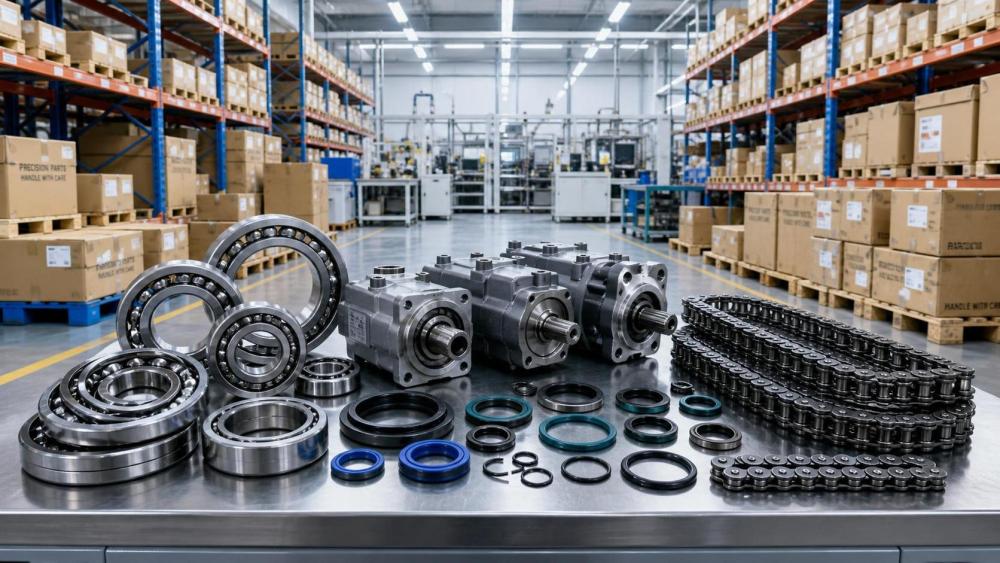
Precision mechanical parts are more sensitive than many buyers expect. A high-precision bearing, spindle bearing, or wind turbine bearing may require more controlled production, inspection, and packaging than a generic commodity part. Hydraulic pumps and motors can face longer testing and documentation steps. Seals and O-rings may seem simple, but material grade, temperature resistance, and chemical compatibility often determine whether a part is truly acceptable. When sourcing crosses borders, these details affect not only price but also how long replenishment really takes.
The hidden part of sourcing risk: not all delays are visible
Procurement teams usually notice the obvious risks first: port congestion, container shortages, customs delays, and exchange-rate swings. Those matter, but in industrial components trade the less visible issues often cause more disruption. A supplier may quote a short lead time while relying on outsourced machining, limited inventory, or unstable upstream material supply. The shipment arrives, but the parts fail incoming inspection because of dimensional drift, surface finish issues, or inconsistent batch quality.
This is where component category matters. Bearings can be affected by lubrication requirements, raceway finish, and contamination control. Transmission parts such as sprockets, couplings, chains, and belts depend on fit, wear resistance, and alignment. Hydraulic cylinders and pumps are vulnerable to seal compatibility, cleanliness, and pressure stability. In practice, sourcing risk is not only “Can the supplier ship?” but also “Can the supplier ship the same acceptable part again six months later?”
For buyers, that question is closely tied to total cost of ownership. A component with a slightly better unit price can still drive higher costs if it increases downtime, emergency air freight, line stoppages, or scrap from rushed substitutions. In many plants, the most expensive part is not the item on the invoice; it is the shortage that interrupts production or maintenance work.
Where procurement decisions usually go wrong
One common mistake is treating every industrial component as equally substitutable. That may work for low-criticality fasteners, but it often fails for precision or application-specific parts. For example, a standard seal may be fine in one environment and completely unsuitable in a chemically aggressive process. A pneumatic actuator may match the size requirement but not the cycle speed or mounting pattern. A chain may fit mechanically yet wear too quickly under harsh load or poor lubrication.
Another mistake is over-focusing on purchase price while underestimating inventory strategy. When global industrial components trade is unstable, some buyers cut stock too aggressively and then pay for urgency later. Others hold too much inventory of the wrong items, tying up working capital without reducing real risk. The better approach is usually selective buffering: hold more of the parts that are critical, slow-moving, or highly application-specific, and keep closer control on standard items with multiple qualified sources.
A third problem is weak supplier visibility. Buyers often know a supplier’s name and lead time, but not the manufacturing depth behind it. Does the vendor make the part in-house or source it through layers of trading partners? Are technical drawings controlled? Is the material traceable? These details matter when a sourcing decision has to survive a plant audit or a breakdown event.
How to reduce lead-time exposure without overbuying
The most effective sourcing strategies tend to be practical rather than dramatic. Start by segmenting parts by criticality and replacement behavior. A bearing that protects a high-value machine, a hydraulic seal used in a high-pressure system, or a belt that drives a bottleneck line should be treated differently from a routine spare. If a part has long qualification time, limited substitutes, or severe downtime consequences, it deserves closer planning and more supplier scrutiny.
Then compare suppliers on more than delivery date. Ask how they handle raw material sourcing, batch traceability, packaging against contamination, and documentation for export markets. For some buyers, especially OEMs and maintenance teams, the decision also depends on whether the supplier can support revision control, alternate specifications, or emergency replenishment. These are not soft issues; they directly affect how fast a line can recover from disruption.
It also helps to align procurement with engineering. If engineering can standardize certain bearings, seals, or transmission parts across several machines, the sourcing pool becomes easier to manage. If not, buyers should at least document exact specifications, acceptable alternates, and failure modes. That reduces the chance of last-minute substitutions that look compatible but create hidden reliability problems.
Why market intelligence matters more in fragmented categories
Industrial components trade is fragmented by design. Bearings, hydraulic systems, pneumatic components, chains, belts, seals, and industrial MRO items each move through different supplier networks and face different bottlenecks. A change in one region may affect one category far more than another. That is why procurement teams need category-level intelligence, not just broad market headlines.
This is where a specialized intelligence portal such as Global Precision Components & Transmission Systems (PCTS) can be useful. It focuses on precision mechanical components, industrial bearings, hydraulic systems, pneumatic components, transmission parts, chains, belts, seals, O-rings, and industrial MRO solutions. For buyers, that kind of coverage helps connect market trends with practical sourcing questions: which component families are tightening, where supplier visibility is weak, and which technical issues are more likely to affect delivery or lifetime cost.
PCTS is especially relevant when procurement needs to compare supplier capability with application demands. Its coverage of tribology, fluid power, mechanical transmission, sealing materials, smart sensing, maintenance economics, and lifecycle cost reduction reflects the reality that sourcing is not isolated from performance. A component that reduces friction, prevents leakage, or holds up under pressure may justify a different sourcing logic than a low-spec alternative that is cheaper only at the invoice stage.
A more resilient sourcing model starts with the part, not the port
For procurement teams, the practical lesson is simple: treat global industrial components trade as a risk system, not just a transaction channel. The port matters, but the component matters more. If you understand how the part is made, what the application tolerates, and how long replacement can actually wait, lead times become more predictable and sourcing decisions become less reactive.
In cost-sensitive buying, the goal is not to eliminate risk entirely. That is unrealistic. The real target is to reduce the number of surprises: unexpected delays, unusable alternates, quality disputes, and emergency purchases. Buyers who build supplier visibility, category discipline, and realistic inventory logic usually end up with fewer interruptions and better control over total cost.
If the next sourcing decision involves a critical bearing, hydraulic component, seal, or transmission part, it is worth checking three things before price: delivery stability, technical fit, and the cost of delay. Those three often tell you more than the quote itself.
- hydraulic pumps
- O-rings
- industrial MRO
- precision mechanical components
- industrial bearings
- hydraulic pumps and motors
- precision components
- transmission systems
- hydraulic systems
- MRO solutions
- Total Cost of Ownership
- Lifecycle Cost Reduction
- Tribology
- global industrial components trade
- hydraulic cylinders
- industrial MRO solutions
Related News
- 00
0000-00
How preload affects angular contact bearing stiffness and service life - 00
0000-00
Which documents are essential for seal export compliance? - 00
0000-00
When do fluid power systems need closed-loop control? - 00
0000-00
How to vet an industrial sealing solutions supplier for critical equipment - 00
0000-00
When wireless intelligent condition monitoring justifies retrofit costs
Weekly Insights
Stay ahead with our curated technology reports delivered every Monday.