





When Does an Export Compliance Service Reduce Shipment Delays?
An export compliance service reduces shipment delays when industrial suppliers must navigate complex customs rules, product classifications, export controls, and documentation requirements across multiple markets. For manufacturers of precision components, hydraulic systems, bearings, seals, and transmission parts, proactive compliance checks can prevent costly holds, rejected declarations, and last-minute logistics disruptions. The greatest value usually appears before freight is booked—not after a shipment has already been stopped at a border.
This matters because industrial exports are rarely as simple as moving standard catalog goods from one warehouse to another. A consignment may include spindle bearings for machine tools, high-pressure hydraulic pumps, pneumatic actuators, fluoropolymer seals, roller chains, couplings, or condition-monitoring components. Each product has a technical purpose, material profile, origin history, declared value, and potential regulatory sensitivity. When those facts do not align across the commercial invoice, packing list, customs declaration, product data, and shipping instructions, delays become much more likely.
An export compliance service is not a guarantee that customs will never inspect a shipment. It is a structured way to make sure the exporter can explain what is being shipped, where it is going, who will use it, and why the declaration is accurate. That preparation is especially useful when the commercial team, engineering team, freight forwarder, and overseas buyer all hold different pieces of the information.
The Delay Often Begins with an Incomplete Product Description
Many shipment problems begin with descriptions that are technically vague or commercially convenient but unsuitable for customs use. “Mechanical parts,” “industrial equipment,” or “bearing accessories” may be enough for an internal order entry system, yet they do not help a customs authority determine what the goods are. A description should normally identify the item in plain commercial language while remaining consistent with technical documentation: for example, a tapered roller bearing, a hydraulic cylinder assembly, a nitrile O-ring kit, or a steel roller chain for power transmission.
The issue is not simply wording. A product description affects tariff classification, valuation review, origin assessment, and sometimes export-control screening. A high-precision bearing may be used in ordinary industrial machinery, but its dimensions, speed capability, material, or destination could trigger questions that a general-purpose bearing would not. Similarly, a seal supplied for chemical processing equipment may require a different level of material and end-use documentation than a standard maintenance spare part.
Compliance support is most useful when it converts engineering information into consistent trade data. That includes product function, material composition where relevant, part number, model designation, quantity, unit value, country of origin, and the correct level of detail for the destination market. It prevents the common situation in which a buyer’s purchase order, a manufacturer’s datasheet, and a freight document each describe the same item differently.
Classification Uncertainty Is a Strong Signal to Involve Specialists
Commodity classification is one of the clearest points at which an export compliance service can reduce avoidable disruption. Classification is not a clerical afterthought. It determines the customs treatment of the goods and may influence duties, import permits, trade-remedy exposure, recordkeeping, and eligibility for preferential tariff treatment. The correct code depends on the actual product, not on the supplier’s preferred sales category.
Industrial component exporters face particular difficulty with assemblies and kits. A hydraulic power unit, for instance, may include a pump, motor, valves, filters, fittings, sensors, and controls. A repair kit may include seals, gaskets, fasteners, and metal components. Customs classification can depend on how the item is presented, whether the elements form a functional unit, and which component gives the set its essential character under the applicable rules. Those questions should be resolved from product evidence, not guessed from past invoices.
A reliable process creates a classification record that can be reused and reviewed when a design changes. It should capture supporting datasheets, drawings where appropriate, intended function, classification rationale, and the responsible reviewer. This makes future declarations faster and gives procurement, logistics, and sales teams one approved source of information. It also helps identify where country-specific tariff schedules or customs interpretations need separate confirmation.
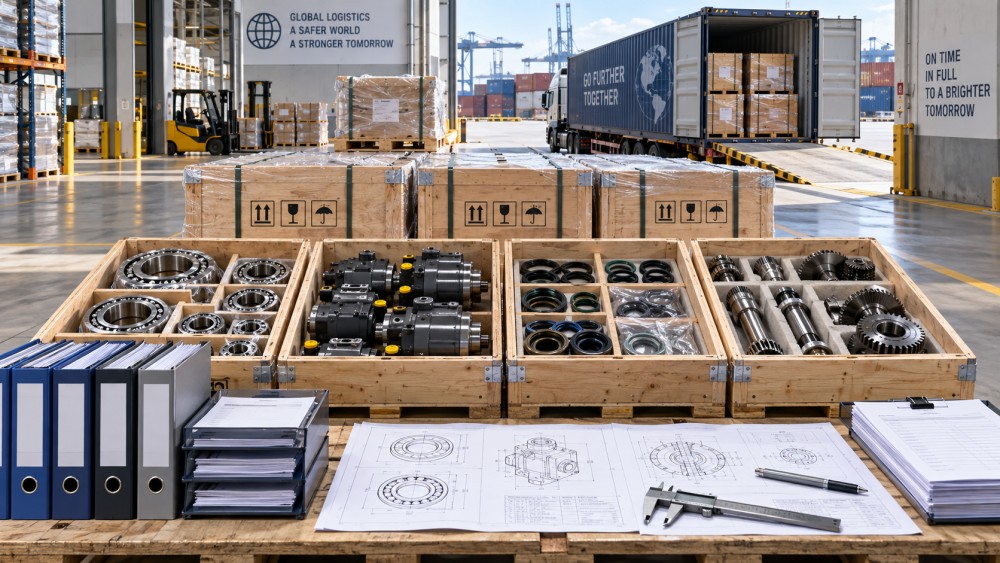
Multi-Market Sales Create More Than One Compliance Problem
An exporter may have a correct invoice for one destination and still face a delay in another. Markets differ in documentary expectations, import licensing practices, marking requirements, origin rules, valuation procedures, and the data required before cargo can be released. A declaration format that has worked repeatedly on one trade lane should not automatically be copied to a new one.
This is where an export compliance service becomes operational rather than administrative. It can map the requirements by destination and shipment type: routine MRO replenishment, project cargo, samples, warranty replacements, returns for repair, temporary exports, or emergency air freight. The same hydraulic motor may need a different document trail when it is sold to an OEM, sent to a distributor’s stock location, returned from a customer for analysis, or temporarily exported for field testing.
Country of origin deserves special attention. Origin is not always the same as the shipping country, the seller’s location, or the country shown on a supplier’s invoice. For industrial assemblies, determining origin may require a review of manufacturing steps and component sourcing. If preferential origin is claimed under a trade arrangement, the exporter should be able to substantiate that claim with records rather than relying on an informal supplier statement. When origin information is uncertain, resolving it before the shipment is tendered is far less disruptive than responding to a customs query after arrival.
Controlled End Uses and Restricted Parties Cannot Be Treated as Last-Minute Checks
Not every industrial component is subject to export controls, and technical sophistication alone does not determine whether controls apply. However, some components, software-enabled devices, design data, and equipment used in sensitive applications may require careful review. Controls can depend on technical characteristics, the destination, the end user, the intended end use, and the exporting jurisdiction’s rules.
A practical compliance workflow screens business parties early in the sales process and refreshes screening before shipment. It also establishes a route for escalation when an order involves an unfamiliar intermediary, an unusual delivery route, a request to remove technical detail from documents, or an end-use explanation that does not match the product. These circumstances do not prove misconduct, but they deserve review. The cost of pausing an order internally is generally lower than the cost of cargo being detained while questions are answered under time pressure.
For exporters of bearings, fluid-power equipment, seals, and transmission systems, the important discipline is to connect commercial data with application context. A standard industrial bearing may support a packaging line, a wind turbine drivetrain, a mining conveyor, or specialized equipment. The same is true of pneumatic and hydraulic components. A compliance team does not need to replace engineering judgment, but it does need access to enough product and end-use information to recognize when specialist review is needed.
The Best Time to Use Compliance Support Is Before the Order Becomes Urgent
Compliance work has the strongest effect on lead time when it is embedded in the order-to-shipment process. Waiting until the goods are packed limits the available options. A missing origin statement, an unresolved classification question, or a restricted-party screening issue can then hold production release, transport booking, export filing, and customer communication at the same time.
A useful operating model separates recurring products from exceptions. Frequently exported catalog items can be maintained in a controlled master-data file with approved descriptions, classifications, origin information, packaging conventions, and document requirements. Exceptions should be routed for review: new products, revised designs, mixed-origin assemblies, unusually high-value orders, new destinations, returns, samples, hazardous-material concerns, or customers whose end use is unclear.
Documents Must Tell One Coherent Story
Customs holds often arise because the documents tell conflicting stories. The invoice may identify a shipment as replacement parts, the packing list may say pump assemblies, and the export declaration may use a generic machinery code. Differences in quantity, weights, values, consignee names, incoterms, or origin can also invite questions. Some differences are legitimate, but they should be explainable and traceable.
An export compliance service can introduce a pre-shipment document review that focuses on consistency rather than merely checking whether all forms exist. For a precision-components exporter, that review may compare the order, product master, invoice, packing list, transport instructions, export declaration data, certificates requested by the customer, and any applicable license or authorization documentation. It should also confirm who is responsible for each decision. Freight forwarders can prepare or transmit information, but the exporter generally remains responsible for the accuracy of the data supplied.
The review should be proportionate. Applying a lengthy manual approval to every low-risk replenishment shipment can create its own bottleneck. The better approach is risk-based: automate stable, well-documented transactions where appropriate, then focus human attention on orders that differ from the established pattern.
Compliance Is Also a Supply-Chain Reliability Issue
For industrial buyers, shipment delay is not merely a logistics inconvenience. A delayed seal kit can extend a shutdown. A late bearing may postpone a planned maintenance intervention. Missing hydraulic components can interrupt assembly of a machine that is already committed to a delivery schedule. The practical value of compliance lies in protecting these downstream operations from preventable administrative uncertainty.
This perspective aligns closely with the work covered by Global Precision Components & Transmission Systems (PCTS). Across bearings, hydraulic and pneumatic equipment, power transmission, sealing technology, and industrial MRO, product reliability and delivery reliability are connected. A technically suitable component is of limited use if its supporting documents, sourcing records, or destination requirements prevent it from reaching the maintenance team or OEM on time.
PCTS helps place such questions in a wider operational context: component performance, maintenance economics, supplier evaluation, replacement cycles, and trade readiness should be considered together. Exporters can use this perspective to make compliance information part of product governance rather than a separate task handed to logistics at dispatch.
A Practical Decision Point for Management
An export compliance service is most justified when the business has recurring cross-border shipments, multiple product families, changing destinations, technically complex assemblies, or material exposure to urgent delivery commitments. It is also valuable when staff repeatedly spend time correcting invoices, answering broker questions, or reconciling inconsistent product data. Those are signs that the issue is systemic, not just a one-off paperwork error.
The first step does not need to be a large compliance project. Review the shipments that generated the most questions, identify which product data fields are missing or unreliable, and determine where approval decisions currently sit. Then build a controlled process around the highest-risk lanes and products. For industrial exporters, a defensible classification record, accurate origin data, consistent documentation, early screening, and clear exception handling will usually do more to reduce avoidable delay than expediting freight after a problem has surfaced.
Related News
- 00
0000-00
When wireless intelligent condition monitoring justifies retrofit costs - 00
0000-00
When does an export compliance service reduce shipment delays? - 00
0000-00
How to assess a mechanical seal solutions supplier’s quality control - 00
0000-00
How to use chain wear analysis to prevent mining conveyor failures - 00
0000-00
How to select PU timing belts for automation with high positioning accuracy
Weekly Insights
Stay ahead with our curated technology reports delivered every Monday.