





A wireless intelligent condition monitoring retrofit earns its cost when the equipment being observed has a credible path from an early fault signal to an avoided loss. The purchase is hard to justify when sensors are added simply because assets are important, connected, or expensive. It becomes defensible when a developing defect can be detected early enough to schedule work, reserve parts, coordinate access, and prevent a stoppage whose consequences exceed the installed cost and ongoing operating burden of the monitoring system.
That distinction matters because a sensor does not remove failure modes. It creates evidence about machine condition. The economic value depends on whether that evidence changes a maintenance decision before the fault becomes disruptive. A low-speed standby conveyor, for example, may show meaningful vibration changes but still offer little financial return if it can be repaired during a routine shift with readily available components. A critical pump train, high-speed spindle, fan, gearbox, hydraulic power unit, or production-line drive may justify the same hardware quickly when an unexpected bearing seizure, coupling failure, lubrication breakdown, or belt damage interrupts a constrained process.
Start with avoidable exposure, not the sensor catalogue
Retrofit costs should be compared with the portion of failure exposure that monitoring can realistically reduce. The relevant exposure is broader than the replacement price of a bearing or seal. It includes lost production opportunity, emergency labor, expedited freight, collateral damage, cleanup, quality loss, restart time, safety isolation, and disruption to scheduled work. Yet none of those costs should be counted automatically. If an early warning would not change the timing or scope of the repair, the loss remains largely unavoidable and the monitoring case weakens.
A useful first screen is to identify assets where a developing condition produces a recognizable interval between first indication and functional failure. Rolling-element bearing defects, imbalance, looseness, misalignment, gear mesh deterioration, cavitation-related vibration, inadequate lubrication, and progressive chain wear often provide such an interval. Sudden shaft fracture, instantaneous electrical faults, external impact, or a contaminant event that destroys a component within hours may not. Wireless monitoring is strongest where deterioration is progressive, accessible only during limited outages, and expensive to discover late.
The most suitable asset is rarely selected only by replacement cost. A moderate-cost bearing supporting a bottleneck machine can be more valuable to monitor than a much larger bearing on redundant equipment. Likewise, a gearbox may appear critical on an asset register but have a practical bypass route, installed spare, or ample repair window. The business case should reflect the actual production and maintenance configuration, including redundancy that works in normal operating conditions rather than redundancy assumed on a drawing.
The warning must be actionable
Condition data has value only when it supports a defined action. Before approving a retrofit, establish what will happen when a signal crosses a meaningful threshold. This does not require rigid alarm limits for every asset at the outset; a baseline and trend-based approach is often more reliable during the first operating period. It does require clarity about the response path. Will the alarm trigger a route inspection, lubrication review, thermal check, alignment verification, oil sample, planned shutdown request, or spare-parts reservation? Without that path, alerts accumulate without reducing risk.
The interval between detection and intervention needs careful scrutiny. A sensor that identifies a bearing outer-race defect several weeks before destructive damage can support planned work only if the machine can be stopped within that period. Where shutdown approval is available only during a quarterly outage, the detected condition must have sufficient remaining life, or the information may instead force an emergency decision. The same issue arises where a custom shaft, matched bearing set, mechanical seal cartridge, or specialized coupling element has a long replenishment lead time. Early detection has higher value when it creates enough time to secure the right parts without buying unnecessary stock for every possible fault.
Alert quality is equally important. A system that flags every normal load change, product changeover, or startup transient will consume attention and erode trust. Conversely, thresholds set so high that only severe damage is reported create little planning advantage. The retrofit scope should account for baseline collection, operating-state context, alarm ownership, and a route for confirming unusual readings. These implementation costs are often smaller than the hardware purchase but can determine whether the installation becomes a maintenance tool or an unused dashboard.
Choose measurements that fit the failure mechanism
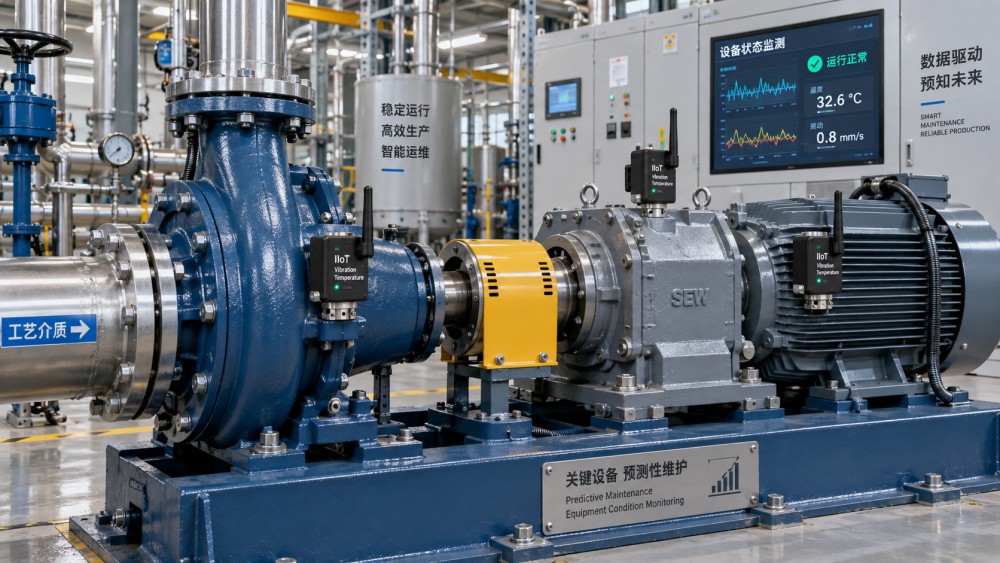
Wireless systems are often evaluated as a single category, although the suitability of vibration, temperature, ultrasound, pressure, motor current, speed, or lubrication-related data varies sharply by asset and fault mode. A general vibration sensor mounted on a bearing housing can reveal rising overall energy, changes in acceleration, or characteristic defect frequencies when the mounting point, rotational speed, and signal quality are appropriate. It is less decisive where the bearing is deeply enclosed, the housing is flexible, the machine runs at very low speed, or surrounding impacts dominate the signal.
Temperature is useful for detecting friction, lubrication distress, cooling loss, and some misalignment conditions, but it is commonly misread as a direct bearing-health measure. An increase may arise from ambient conditions, process temperature, housing geometry, seal drag, load, or changed duty cycle. A stable temperature does not confirm that an early rolling-element defect is absent. Temperature trends are most useful when compared against the asset's own operating pattern and paired with another condition indicator where the consequence of failure is high.
Hydraulic equipment illustrates why measurement selection matters. A rising bearing vibration signature on an electric motor and pump assembly can indicate mechanical deterioration, while fluctuating pressure, abnormal case-drain behavior, fluid contamination, air ingress, or suction restriction may point to hydraulic causes that vibration alone cannot separate. A wireless vibration retrofit on a hydraulic power unit can still be justified, but its scope should not be presented as complete pump health coverage unless the monitored signals correspond to the known failure mechanisms.
For belt and chain drives, a sensor on the driven bearing housing may detect looseness, pulley misalignment, sprocket wear, or bearing distress, but it will not reliably quantify belt tension or chain elongation in every arrangement. Visible wear, lubrication condition, alignment, guarding access, shock loads, and contamination remain relevant inspection factors. Monitoring should reduce uncertainty in the inspection schedule, not become a reason to abandon physical examination where it is the only dependable way to assess the component.
Installation detail changes data quality and lifetime cost
A low-priced sensor package can become expensive when installation requires repeated access work, custom brackets, network troubleshooting, battery replacement in difficult locations, or rework after poor mounting. The condition-monitoring specification should therefore include the physical environment, not merely the data sheet. Surface temperature, washdown, oil mist, dust, vibration severity, enclosure material, access clearance, hazardous-area requirements where applicable, and electromagnetic interference can all affect device selection and placement.
Mounting stiffness deserves particular attention for vibration sensing. A sensor placed on a thin guard, painted cover, loose bracket, or non-load-bearing panel may report the resonance of the mounting arrangement rather than the machine. Direct mounting near the load path to the bearing is generally more informative, provided the location is safe, repeatable, and protected from damage. Magnetic mounting can simplify surveys and pilot installations, but its response and retention should be assessed before it is treated as a permanent arrangement on high-frequency or high-vibration equipment.
Wireless coverage also needs a field survey under operating conditions. Metal structures, dense machinery, enclosed skids, rotating equipment, and process vessels can alter signal paths. A gateway that appears adequate during installation may perform poorly when doors are closed, equipment is running, or surrounding machinery is active. Network resilience, data buffering during communication loss, time synchronization, and the handling of missed transmissions should be examined as part of reliability, rather than left to the commissioning phase.
Battery life claims require similar discipline. Sampling frequency, waveform capture, transmission interval, local processing, ambient temperature, and communication quality all influence energy use. A sensor configured for occasional trend values has a different service demand from one collecting detailed vibration waveforms or transmitting frequently during alarm conditions. The replacement route, access permit requirements, and disposal process should be included in the maintenance plan from the start.
Do not price the retrofit as hardware alone
The full cost includes sensors, gateways, mounting materials, installation labor, engineering review, network integration, commissioning, baseline collection, software access, training for the people interpreting alerts, and recurring device maintenance. Some cost elements are visible in a quotation; others appear only after the first alarms arrive. Time spent resolving nuisance alerts, confirming suspect data, or investigating conditions without a clear response path is a genuine operating cost.
Against that cost, use conservative benefits that can be traced to a changed maintenance outcome. These may include avoided emergency work, reduced repeat inspection of inaccessible assets, lower likelihood of collateral damage after bearing failure, fewer expedited parts shipments, or improved ability to align replacements with planned outages. Avoid counting every detected anomaly as an avoided failure. A valid case should distinguish between information that confirms an already scheduled action and information that changes the timing, material availability, or repair scope.
It is also important to separate condition monitoring from a deferred-maintenance strategy. Sensors do not compensate for chronic lubrication errors, misalignment, improper fits, damaged housings, poor shaft finish at seal locations, inadequate filtration, or operation outside the component's load and speed limits. Where these conditions are known, correcting them may produce a stronger initial return than installing more instrumentation. Monitoring becomes more valuable after basic failure mechanisms are under control because trend changes are then easier to interpret and less likely to represent recurring installation defects.
A phased retrofit exposes weak assumptions early
A limited deployment on a coherent group of assets is often a better purchasing approach than a site-wide installation based solely on criticality rankings. Select equipment with known failure history, identifiable mechanical failure modes, reasonable wireless access, and a practical opportunity to act on warnings. Establish the baseline condition, normal operating states, expected alert review process, and existing inspection tasks before comparing results. The goal is not to prove that every sensor finds a defect quickly; it is to determine whether the information is dependable enough to alter maintenance planning.
The pilot should also reveal scope gaps. A recurring vibration alarm that corresponds to speed changes may indicate a need for tachometer or operating-state data. Repeated high-temperature readings may expose a poor mounting location or an unrecognized process heat source. An inability to schedule corrective work despite credible fault evidence points to an outage-planning constraint rather than a sensor problem. These findings shape a more accurate full-retrofit cost than an initial estimate based on sensor count.
Wireless intelligent condition monitoring justifies retrofit expenditure when it connects a detectable deterioration pattern to timely, practical intervention on equipment whose failure creates material operational disruption. The strongest proposals are narrow and evidence-based: they identify the assets, failure modes, warning interval, installation conditions, response responsibilities, and costs that determine whether a signal becomes an avoided event rather than another stream of data.
Want to dive deeper into these market dynamics, or need data-driven support for your next business move? Drop a line below and let the analysts at PCTS provide customized insights.
We respect your privacy. Your information is strictly confidential.
Related News
- 00
0000-00
How sealing technology reduces contamination in semiconductor manufacturing - 00
0000-00
Where to install vibration sensors on rotating machinery - 00
0000-00
NTSB Probe Finds Boeing Warned of MD-11 Engine Bearing Risk Years Earlier - 00
0000-00
How to size pneumatic grippers for packaging system integration - 00
0000-00
How to size alloy steel power transmission chains for heavy loads
Weekly Insights
Stay ahead with our curated technology reports delivered every Monday.