





Seal export compliance depends on more than product quality. Buyers and evaluators need documentation that proves the shipment is correctly identified, legally exportable, and acceptable in its destination market.
For sealing products, missing or inconsistent paperwork can stop a shipment even when the mechanical seal, O-ring, gasket, or lip seal meets the requested specification.
The practical objective is traceability. Each document should connect the commercial order, product configuration, material composition, customs classification, origin, and applicable regulatory requirements without contradiction.
Business evaluators should therefore assess documentation readiness as part of supplier qualification. A supplier that cannot prepare records consistently creates customs, warranty, delivery, and operational continuity risks.
What Business Evaluators Should Verify First
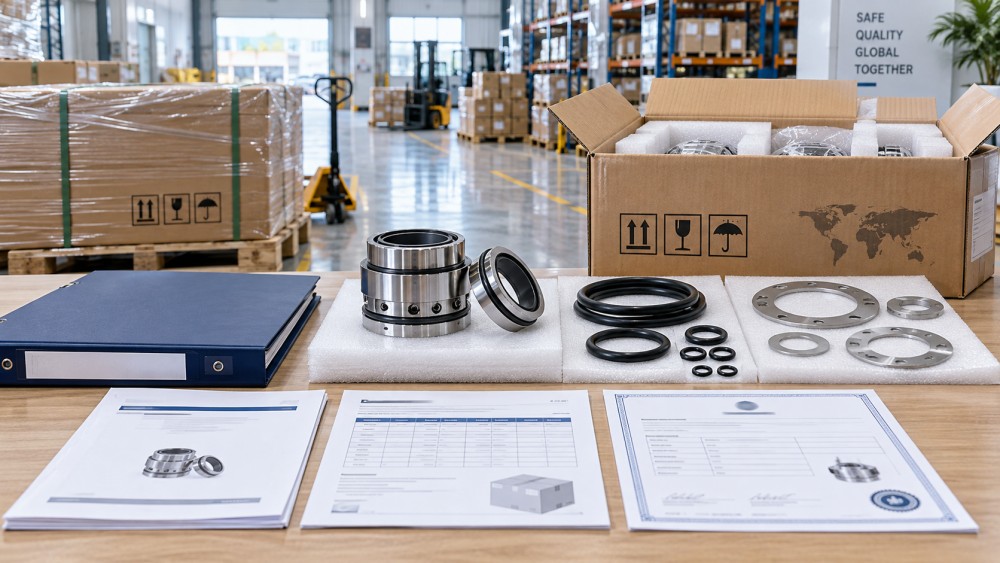
The core search intent behind seal export compliance is usually risk reduction. Evaluators want to know which records prevent border delays, restricted-material issues, incorrect duties, and rejected industrial shipments.
The first question is not whether every document applies to every shipment. It is whether the supplier can determine the correct documentation package for each product and destination.
Seals are not a single product category. A shipment may contain elastomer O-rings, PTFE backup rings, mechanical seal faces, metal-reinforced gaskets, bonded seals, or complete cartridge mechanical seals.
These variations affect tariff classification, material declarations, origin claims, controlled-technology screening, packaging requirements, and destination-market environmental obligations. Generic paperwork is rarely sufficient for complex industrial sealing assemblies.
Evaluators should request a document matrix before approving a supplier. The matrix should identify required documents by product family, Incoterm, destination country, end-use sector, and shipment value.
A strong supplier distinguishes between mandatory customs documents, customer-requested quality documents, destination-specific regulatory declarations, and supporting records retained for audit or post-entry verification.
This distinction matters commercially. Over-documenting can slow routine shipments, while under-documenting can create demurrage, customs inspections, re-export costs, and production downtime at the customer site.
Commercial Documents That Establish the Export Transaction
The commercial invoice is the central document in most seal export transactions. It establishes the seller, buyer, product value, currency, payment terms, Incoterm, country of origin, and item description.
For seal export compliance, invoice descriptions must be specific enough for customs review. “Rubber parts” or “machine components” can trigger questions, reclassification, or valuation challenges.
A better description identifies the product type, material, intended industrial use, and part number. For example, “FKM O-ring, 75 Shore A, industrial hydraulic cylinder service.”
The invoice should match the purchase order, packing list, transport document, customs declaration, and certificate of origin. Small discrepancies can become significant when authorities examine a shipment.
A packing list supports physical verification. It normally identifies carton or crate counts, gross and net weights, package dimensions, marks, part numbers, quantities, and packing configuration.
For mixed seal kits, the packing list should show whether components are packed separately or bundled. This helps customs officers and receiving teams reconcile individual product lines accurately.
Purchase orders, order acknowledgments, and sales contracts are not always filed with customs, but they are valuable evidence when price, origin, scope, or delivery responsibilities are questioned.
Evaluators should confirm that the supplier controls revisions. A revised drawing, changed elastomer compound, or substituted metal component can make older commercial descriptions technically inaccurate.
Where letters of credit, documentary collections, or government tenders apply, document wording may be mandatory. Compliance teams should review bank and contract conditions before goods are packed.
Correct HS Classification and Export Declarations
Accurate Harmonized System classification is one of the most important seal export compliance requirements. The HS code affects duty treatment, statistical reporting, licensing checks, and customs risk scoring.
Sealing products may be classified differently depending on their construction and function. Vulcanized rubber seals, plastic seals, metal gaskets, mechanical seals, and machinery-specific assemblies require careful analysis.
Suppliers should avoid assigning a code solely because similar products used it previously. Product composition, essential character, degree of assembly, and national tariff interpretations can change the result.
For high-value or recurring shipments, a binding tariff ruling or written classification opinion may reduce uncertainty. This is especially useful where a seal assembly includes metal, elastomer, springs, and precision faces.
The export declaration, sometimes called a customs export entry, must use the correct classification, declared value, quantity, exporter identity, consignee details, and destination information.
In many jurisdictions, declarations are submitted electronically through the national customs system or by an authorized freight forwarder. The exporter remains responsible for data accuracy.
Evaluators should ask who owns classification decisions. A mature supplier has documented internal responsibility, technical product data, review procedures, and records supporting the code used for each item.
They should also check whether the supplier monitors tariff changes. A classification process that is accurate today can become incomplete after tariff schedule revisions or new customs guidance.
Certificates of Origin and Preferential Trade Claims
A certificate of origin confirms where goods originate under applicable customs rules. It may be required by the importing country, a buyer, a bank, or a preferential trade agreement.
Origin is not always the same as shipping location. Seals exported from a distribution center may have been manufactured, molded, machined, assembled, or substantially transformed elsewhere.
For standard non-preferential origin claims, authorities generally examine where the product was wholly obtained or underwent its last substantial transformation. The applicable test differs by jurisdiction.
Preferential origin claims require additional care. Free trade agreements often impose product-specific rules based on tariff shifts, regional value content, processing requirements, or material origin.
A supplier should retain bills of materials, supplier origin declarations, manufacturing records, and cost calculations supporting any preferential claim. Unsupported claims can lead to back duties and penalties.
Business evaluators should identify whether preferential duty treatment materially affects landed cost. Where the savings are modest, an unsupported origin claim may create more risk than value.
Certificates should name the correct exporter, producer where required, consignee, goods description, tariff classification, origin country, and certification statement. Dates and signatures must meet destination rules.
For components assembled from global inputs, request an origin analysis rather than accepting a country label. This is particularly important for mechanical seals containing imported springs, faces, and elastomer elements.
Material Declarations for Seals and Elastomer Components
Material documentation is critical because seal performance and regulatory eligibility depend heavily on compound chemistry. Buyers need evidence beyond a general statement that a part is “rubber” or “plastic.”
A material declaration should identify the principal polymer or material family, such as NBR, HNBR, FKM, EPDM, silicone, PTFE, polyurethane, graphite, silicon carbide, or stainless steel.
For engineered sealing products, it should also identify relevant fillers, reinforcements, coatings, bonding agents, and metallic parts when these affect chemical restrictions, recycling rules, or end-use acceptance.
Many buyers request a certificate of conformance stating that supplied parts meet the specified drawing, material designation, revision level, and contractual quality requirements. This supports receiving inspection and traceability.
A certificate of analysis may be appropriate for controlled raw materials or critical compounds. It can include cure properties, hardness, tensile data, specific gravity, batch number, and test results.
Do not treat a certificate of conformance as proof of regulatory compliance. It confirms contractual conformity, while environmental declarations require evidence against specific chemical and legal requirements.
For high-temperature, semiconductor, food-contact, medical, aerospace, or chemical-processing seals, evaluators should request application-specific material evidence before placing the export order.
The preferred approach is a controlled material data package linked to the product part number and revision. This prevents an approved declaration from being incorrectly applied to a changed compound.
Environmental and Chemical Compliance Declarations
Environmental documentation is often the most destination-sensitive element of seal export compliance. Requirements differ by market, industry, customer policy, material composition, and intended application.
Common requests include REACH declarations, RoHS declarations, SCIP-related information where applicable, California Proposition 65 notices, and statements regarding persistent, bioaccumulative, or restricted substances.
For European Union shipments, suppliers should assess whether articles contain Substances of Very High Concern above relevant reporting thresholds. The analysis must consider each homogeneous material where required.
RoHS may apply where seals are supplied as parts of electrical or electronic equipment. It does not automatically apply to every industrial seal, but buyers may require declarations contractually.
PFAS scrutiny has become increasingly important for FKM, FFKM, fluoropolymer, and PTFE-related sealing applications. Suppliers should avoid broad compliance promises without compound-level regulatory review.
A reliable declaration identifies the regulation, product scope, part numbers, exemptions if relevant, issue date, authorized signatory, and basis of knowledge. Vague letters provide little audit value.
Evaluators should ask whether declarations are based on supplier surveys, laboratory testing, formulation data, or bill-of-material review. The evidence method should match the risk and application criticality.
For chemical-process or food-production markets, additional documentation may include food-contact declarations, FDA-related statements, EU food-contact references, or migration testing where the product use requires it.
Export Controls, Sanctions, and End-Use Screening
Most standard industrial seals are not controlled items, but export compliance still requires screening of destinations, customers, intermediaries, end users, and intended applications against applicable restrictions.
Export controls can apply to technical data, engineering drawings, production equipment, specially designed assemblies, or seals used in sensitive aerospace, defense, nuclear, semiconductor, and energy applications.
The supplier should perform denied-party and sanctions screening before shipment. Screening should cover the purchaser, consignee, end user, freight forwarder, financial parties, and relevant beneficial owners.
End-use statements may be necessary where goods could be diverted to restricted military, weapons, surveillance, nuclear, or sanctioned activities. A routine commercial invoice cannot replace proper diligence.
Business evaluators should determine whether the supplier has an escalation process for red flags. Examples include unusual routing, inconsistent end-user information, excessive technical secrecy, or cash payments outside normal practice.
Where export licensing is required, the license, license exception record, or authority determination must be available before shipment. Delivery promises should not be made before this review is complete.
Export-control records should be retained with the transaction file. This enables the supplier to demonstrate why the sale was permitted and which screening results supported release.
Transport, Packaging, and Dangerous Goods Records
Transport documentation connects customs compliance to physical delivery. Depending on the transport mode, this may include a bill of lading, air waybill, sea waybill, rail consignment note, or courier record.
The transport document should align with the commercial invoice and packing list. Differences in consignee name, package count, cargo description, or weight can delay cargo release.
Finished seals are usually not dangerous goods. However, shipments may include lubricants, adhesives, solvents, cleaning agents, preservation fluids, or sample chemicals requiring hazardous-material assessment.
Safety Data Sheets are relevant when regulated chemicals accompany the shipment or when customers require handling information. They should follow the destination language and format requirements where applicable.
Wooden pallets, crates, and dunnage may require ISPM 15 treatment marks for international movement. This is often overlooked when evaluating seal exporters focused only on product documentation.
Packaging should also protect seals from ultraviolet exposure, compression set, contamination, moisture, deformation, and damage to precision lapped faces. Packaging failures can create quality claims despite compliant paperwork.
For moisture-sensitive or cleanliness-critical seals, the packing specification should state barrier materials, desiccants, cleanroom controls, lot labels, shelf-life details, and handling restrictions.
Quality Records That Support Customs and Customer Acceptance
Quality records are not always customs-mandated, but they often determine whether an imported seal shipment can enter production. They are especially important for OEM, MRO, and critical-service procurement.
Typical documents include inspection reports, dimensional records, hardness results, pressure-test records, batch traceability certificates, material certificates, first article reports, and nonconformance approvals where applicable.
For mechanical seals, documentation may include face material certification, spring material data, assembly inspection, leakage testing, pressure rating confirmation, and rotation-direction verification where the design requires it.
For O-rings and molded seals, useful records include cavity identification, lot number, compound batch, cure date, visual inspection results, hardness, dimensions, and shelf-life control information.
Evaluators should align document depth with failure consequences. A standard static gasket for general maintenance requires less evidence than a seal used in a high-pressure hydraulic system or hazardous chemical process.
Traceability must remain usable after export. Labels, certificates, invoices, and packing lists should allow the importer to connect installed parts back to manufacturing lots and material declarations.
Suppliers that digitize this documentation can respond faster to audits, recalls, field failures, and customer requests. The value is operational resilience, not simply administrative convenience.
How to Build a Practical Seal Export Compliance Checklist
Business evaluators should use a tiered checklist rather than demanding the same documents for every purchase. The checklist should begin with product, destination, application, and commercial risk factors.
For most routine industrial seal exports, the baseline package includes a commercial invoice, packing list, correct HS classification, export declaration, transport document, and applicable origin evidence.
For regulated or customer-controlled applications, add certificates of conformance, material declarations, REACH or RoHS statements, inspection records, batch traceability, and application-specific compliance documentation.
For sensitive destinations or end uses, add denied-party screening evidence, end-use documentation, export classification review, licensing analysis, and internal approval records before goods are released.
Ask suppliers for sample documents using redacted historical shipments. This reveals whether part numbers, descriptions, origin information, material statements, and shipment data remain consistent across documents.
Also assess ownership. Sales teams may prepare invoices, logistics teams may arrange declarations, quality teams may issue certificates, and compliance staff may manage screening. Gaps between teams cause failures.
Review document lead times during supplier selection. A supplier that needs several weeks to obtain a basic material declaration may not support urgent maintenance replacements or unplanned shutdown recovery.
Finally, include document accuracy in supplier scorecards. Track customs holds, certificate corrections, late declarations, shipment discrepancies, regulatory exceptions, and buyer receiving rejections over time.
Conclusion: Documentation Is Part of Seal Supply Reliability
Essential seal export compliance documents begin with accurate commercial records, HS classification, origin support, export declarations, transport papers, and traceable product identification. These documents establish the basic legal shipment foundation.
Material, chemical, quality, and end-use records become increasingly important as sealing applications become more regulated, technically demanding, or commercially consequential. Their value lies in proving claims before a dispute occurs.
For business evaluators, the strongest signal is consistency. A capable sealing supplier can connect part numbers, material formulations, origin status, test evidence, customs data, and destination requirements in one controlled process.
That capability reduces customs uncertainty, protects landed-cost assumptions, improves receiving confidence, and supports continuity for equipment that depends on reliable leakage control, contamination resistance, and mechanical uptime.