





Why does sourcing roller bearings China deserve a closer look?
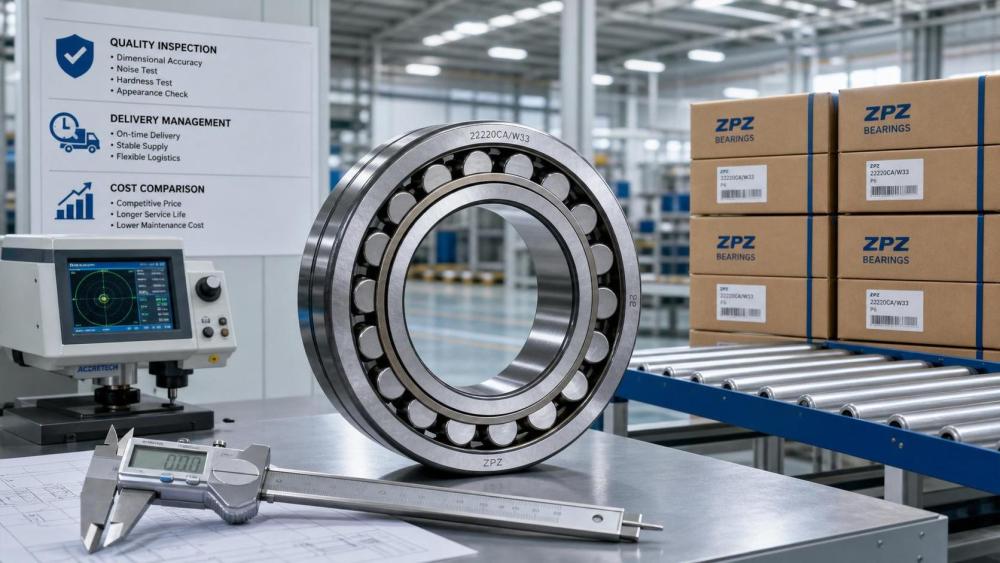
Sourcing roller bearings China often starts with a simple goal: reduce purchase cost without hurting machine reliability.
That goal is realistic, but the unit price alone rarely tells the full story.
In real industrial use, a bearing affects vibration, heat, lubrication life, shaft stability, and unplanned stoppage risk.
A low-cost bearing that fails early can raise maintenance labor, scrap rates, and spare parts pressure.
That is why roller bearings China is usually evaluated through three linked questions: quality, lead time, and total cost.
The more useful comparison is not cheapest versus most expensive. It is stable supply versus hidden operational risk.
Within broader industrial component sourcing, bearings sit beside seals, chains, couplings, hydraulic parts, and MRO items.
Because of that, evaluation methods used by PCTS across precision components also apply here: verify performance claims, check process control, and calculate lifecycle impact.
When does a low quotation on roller bearings China become a bad deal?
The warning sign is not just a cheap number. It is a cheap number with weak technical evidence behind it.
For roller bearings China, price gaps often come from steel grade, heat treatment consistency, grinding accuracy, cage material, and inspection depth.
A supplier may also reduce cost by limiting traceability, shortening test procedures, or outsourcing critical steps.
That does not always mean poor quality. It means the quotation needs context.
A practical way to compare offers is to ask what exactly is included.
- Bearing standard, tolerance class, clearance, and lubrication condition
- Raw material source and hardness range
- Noise, runout, and vibration inspection records
- Packaging method, corrosion protection, and export handling
- After-sales response for defective batches or field issues
If two quotes look similar on paper but only one includes these details, they are not truly equal.
This is especially important for applications with continuous loads, contaminated environments, or tight shaft alignment demands.
How can quality be compared without relying on marketing claims?
The strongest approach is to compare process evidence, not brochure language.
For roller bearings China, quality should be checked at three levels: product design, manufacturing control, and batch consistency.
What should be verified first?
Start with the bearing specification against the application duty.
Load direction, speed, shock level, lubrication method, sealing arrangement, and operating temperature all matter.
A supplier can deliver a dimensionally correct bearing that is still wrong for the working condition.
Which factory signals usually matter most?
More useful signals include stable grinding capability, heat treatment control, gauge calibration, and material traceability.
For demanding sectors, ask whether vibration testing, life testing, and metallographic checks are routine or only available on request.
PCTS often frames this kind of assessment around reliability economics.
That perspective helps because bearing quality is not abstract. It shows up later as uptime, maintenance intervals, and spare stock pressure.
This kind of table makes supplier comparison faster and keeps discussions anchored to evidence.
Lead time looks acceptable on paper, but will delivery stay reliable?
A quoted lead time is only a starting point.
For roller bearings China, delivery reliability depends on raw material availability, production scheduling, export packaging, and shipment coordination.
The more customized the bearing, the less useful a generic lead time promise becomes.
In practice, standard sizes may move quickly, while special tolerances, coatings, or branded packaging extend the cycle.
A better question is this: what part of the timeline is fixed, and what part is variable?
- Sample approval time
- Production queue time
- Inspection and documentation time
- Inland transport and port handling time
- Seasonal freight disruption risk
A supplier with a slightly longer quoted cycle can still be the safer choice if the schedule is transparent and repeatable.
That matters for plants balancing bearings with seals, belts, couplings, and hydraulic spares in one maintenance plan.
What is the right way to compare total cost, not just piece price?
This is where many sourcing decisions become clearer.
With roller bearings China, total cost should combine landed cost and operating cost.
Landed cost includes unit price, tooling, inspection, freight, duties, packaging, and payment terms.
Operating cost includes replacement frequency, downtime exposure, maintenance labor, lubrication demand, and failure-related damage.
A bearing that lasts 20 percent longer can be cheaper overall even if the purchase price is higher.
This is especially true in equipment where bearing failure can damage shafts, housings, seals, or connected transmission parts.
A simple comparison framework
Use a short scorecard before final approval.
This approach keeps roller bearings China comparisons tied to operational outcomes, not only invoice totals.
Which mistakes cause the most trouble after the order is placed?
The first mistake is approving a bearing only by drawing and price.
Dimensional fit matters, but running conditions matter more over time.
Another common issue is skipping pilot validation for new roller bearings China suppliers.
A small first batch can reveal packaging problems, documentation gaps, or consistency issues before a larger commitment.
It is also risky to ignore related component interactions.
Bearings do not work alone. Lubricants, seals, housings, alignment methods, and load transfer parts all influence performance.
That wider system view is one reason industrial intelligence platforms such as PCTS remain useful during supplier screening.
They place bearings inside the larger reliability chain, where downtime economics become easier to judge.
- Do not treat every standard bearing as equal.
- Do not accept vague claims about lifespan without test context.
- Do not overlook export packing, rust prevention, and document accuracy.
- Do not wait until failure to define warranty and replacement terms.
What should the next sourcing step look like?
A strong next step is to narrow evaluation to a short, evidence-based checklist.
For roller bearings China, define the application load, speed, environment, and maintenance interval before requesting final quotations.
Then compare suppliers on documented quality controls, realistic lead time structure, and total cost exposure.
If a bearing supports critical uptime, request sample validation and batch traceability before scale-up.
If the application is less critical, landed cost and replenishment speed may deserve more weight.
The key is staying consistent. Use the same comparison logic across every shortlisted source.
That turns roller bearings China from a price search into a controlled sourcing decision with fewer surprises later.
A practical final check is to align bearing choice with the wider spare parts strategy, especially where seals, transmission elements, and MRO planning intersect.
Related News
- 00
0000-00
How FFKM O-rings reduce seal failure in corrosive media - 00
0000-00
What global equipment manufacturing in the USA means for supply chain risk - 00
0000-00
How FFKM outgassing performance affects vacuum seal selection - 00
0000-00
When should heat resistant metallurgy belts be replaced? - 00
0000-00
When does a fluid power maintenance service reduce unplanned downtime?
Weekly Insights
Stay ahead with our curated technology reports delivered every Monday.