





Industrial sealing failures rarely begin with dramatic breakdowns. More often, they start with a small material mismatch, an incomplete test record, or a supplier document that looks acceptable until operating pressure, media exposure, or temperature cycling reveals the gap.
That is why seal quality certification has become a practical control tool rather than a paperwork exercise. In sectors tied to hydraulics, pneumatics, transmission systems, rotating equipment, and MRO planning, certification supports leak prevention, compliance confidence, and stable service life.
For platforms such as PCTS, where seals, O-rings, chemical-resistant materials, and reliability-driven components sit alongside bearings, pumps, belts, and couplings, the subject connects directly to uptime, maintenance economics, and procurement risk.
What seal quality certification really covers
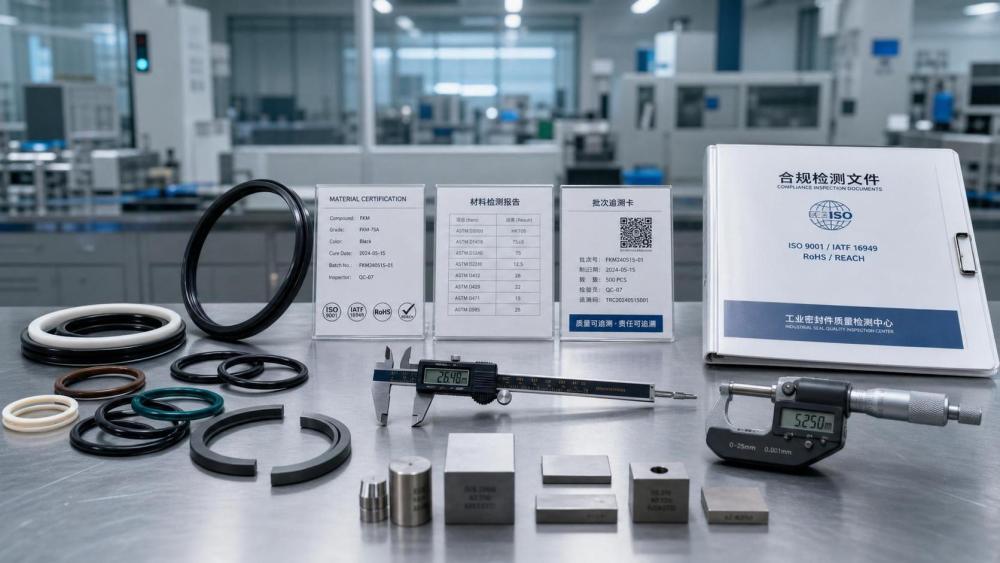
A useful seal quality certification process verifies more than product identity. It checks whether a seal can meet stated performance under defined operating conditions, and whether that claim is supported by traceable evidence.
In practice, certification can involve material conformity, dimensional inspection, physical testing, chemical resistance verification, batch traceability, process consistency, and regulatory alignment. The exact scope depends on application severity and industry rules.
A standard elastomer seal for general industrial service does not need the same evidence package as a high-purity chamber seal, a hydraulic cylinder seal, or a component exposed to aggressive solvents.
This distinction matters because many certification failures come from assuming one approval framework fits every sealing task. It does not. Industrial compliance starts with application definition.
Why the checklist matters now
Several pressures have raised expectations around seal quality certification. Equipment is running longer between planned shutdowns. Process media are becoming more specialized. Export markets also demand cleaner documentation and clearer compliance records.
At the same time, seal sourcing has become more global. A component may be designed in one region, molded in another, finished elsewhere, and installed in equipment shipped worldwide. Without a checklist, verification breaks down quickly.
There is also a wider reliability issue. In many machines, a low-cost seal protects far more expensive assets, including bearings, pumps, motors, gearboxes, valves, and contamination-sensitive assemblies. When the seal fails, the downstream cost is rarely small.
So the question is not whether certification exists, but whether the seal quality certification evidence actually matches the service environment, failure mode, and compliance obligation.
Core items in a practical certification checklist
A workable checklist should stay close to decision points. It needs to help confirm suitability before approval, not simply organize files after purchase.
1. Material identity and formulation control
Start with the base polymer or compound family. NBR, FKM, EPDM, PTFE, HNBR, FFKM, and silicone behave very differently under heat, pressure, oil exposure, steam, solvents, and cleaning chemicals.
A proper seal quality certification file should show compound designation, hardness range, cure system where relevant, and any restricted-substance declarations required by the target market.
2. Dimensional conformity
Check nominal dimensions, tolerances, flash condition, surface defects, and cross-section consistency. Even a high-grade material will underperform if groove fit, compression set behavior, or lip geometry is out of control.
3. Performance testing
Testing should reflect the application. Useful data may include tensile strength, elongation, compression set, abrasion resistance, low-temperature flexibility, swell behavior, and leakage performance under pressure.
For dynamic seals, friction, wear, shaft compatibility, and thermal cycling often deserve more attention than static bench results alone.
4. Process and batch traceability
Traceability is a compliance control, but it is also a failure investigation tool. Batch code structure, production date, cure lot, inspection records, and nonconformance handling should be clear and retrievable.
5. Supporting documents
A seal quality certification package typically includes certificates of conformity, material data sheets, test reports, declarations for specific regulations, and where relevant, application-specific approval records.
Standards are useful, but context decides relevance
A recurring mistake in seal quality certification is collecting standard references without linking them to the operating context. The result looks complete, but the decision quality is weak.
For example, a seal used in a hydraulic power unit may need strong pressure and fluid compatibility evidence. A semiconductor seal may prioritize purity, outgassing control, and chemical resistance. A food-contact seal faces different approval logic.
The same applies across industrial systems tracked on PCTS. Bearings need lubrication control, chains need wear management, belts need slip resistance, and seals need validated barrier performance. Compliance is always component-specific.
Usually, the most reliable approach is to map each seal to service temperature, pressure range, motion type, media exposure, cleaning cycle, expected life, and consequence of failure before setting certification requirements.
Where certification failures usually appear
Many issues are not caused by missing certificates. They come from weak interpretation.
- A certificate refers to a generic material family, not the actual production compound.
- Test data were generated on samples that do not match final geometry or cure conditions.
- Chemical compatibility was assumed from past use, not confirmed for the exact media blend.
- Traceability stops at shipment, making internal failure review difficult.
- Supplier changes in tooling, filler content, or post-processing were not requalified.
These gaps are especially costly in exported equipment, regulated process lines, and maintenance programs that depend on approved spare part lists. A seal quality certification checklist should be built to catch such gaps early.
How to use the checklist in daily decisions
Certification becomes valuable when it is tied to approval workflow. That means linking technical review, incoming inspection, supplier qualification, and replacement part control.
A practical review sequence often works like this:
- Define the sealing duty and failure consequence.
- Match material and geometry to operating conditions.
- Request targeted test evidence, not generic brochures.
- Confirm document traceability to the delivered lot.
- Set requalification triggers for design, supplier, or process changes.
In actual use, this approach shortens audit preparation and strengthens supplier comparisons. It also supports total cost decisions, since seal replacement intervals, leakage cleanup, contamination risk, and downtime all affect lifecycle economics.
A stronger basis for compliance and reliability
Seal quality certification should be treated as part of system reliability, not as an isolated quality file. In fluid power assemblies, rotating equipment, transmission systems, and industrial MRO programs, seal performance influences far more than leak tightness.
It affects contamination control, maintenance intervals, equipment safety, spare parts planning, and supplier accountability. That is why the best checklist is specific, traceable, and tied to real operating stress.
The next useful step is to review existing seal approval records against actual service conditions. Where evidence is generic, outdated, or incomplete, tighten the seal quality certification checklist before the next sourcing cycle or maintenance release.
Want to dive deeper into these market dynamics, or need data-driven support for your next business move? Drop a line below and let the analysts at PCTS provide customized insights.
We respect your privacy. Your information is strictly confidential.
Related News
- 00
0000-00
How to check vibration analysis software for sensor compatibility - 00
0000-00
IndexBox Forecasts 3.8% Annual Growth for Global Radial Seals Market Through 2035 - 00
0000-00
How to assess the chemical compatibility of FFKM sealing sheets - 00
0000-00
IndexBox Forecasts 3.6% Annual Growth for Construction Bearings Market - 00
0000-00
When do hydraulic components require an export license?
Weekly Insights
Stay ahead with our curated technology reports delivered every Monday.