





Reliability engineering decisions often fail at the point where a technically sound component is compared with a lower-priced alternative. The purchase price is visible, easy to approve, and easy to place in a budget. The consequences of a bearing change, a seal material choice, or a hydraulic pump specification may not appear until the machine is operating under load, exposed to contamination, or stopped during an unplanned maintenance window.
Lifecycle cost analysis gives technical evaluators a way to make that comparison on operational terms. It asks what a component will cost from specification through disposal, including installation, energy consumption, inspection, lubrication, spares, repair labor, production losses, and the consequences of failure. Used well, lifecycle cost reliability engineering does not simply justify buying a more expensive part. It identifies where additional spending improves availability and where it merely adds cost without reducing meaningful risk.
The method is most valuable when the component sits in a critical failure path: a spindle bearing that stops a precision process, a mechanical seal whose leakage contaminates a product stream, a chain drive that halts conveying, or a hydraulic cylinder whose loss of motion interrupts a production sequence. In these cases, reliability is not an abstract quality attribute. It has an economic effect that can be modeled and compared.
Start with the decision, not the cost template
A lifecycle model should be built around a specific engineering decision. “Which bearing is cheapest?” is too narrow to be useful. A better question is whether a higher-specification bearing and lubrication arrangement will reduce enough failure exposure to justify its installed cost over the equipment's planned operating period. The same approach applies to choosing a seal elastomer for chemical service, comparing belt and chain transmission options, or deciding whether condition monitoring should be added to a hydraulic power unit.
Defining the decision first prevents a common failure of lifecycle costing: collecting many cost categories without establishing which operating outcome matters. For one asset, the concern may be production availability. For another, it may be leakage compliance, energy use, safety exposure, product quality, or the ability to maintain a remote installation with limited spare-parts access.
The analysis boundary should also match the decision. Evaluating a rolling bearing only as an individual part can hide the real cost drivers. Its performance depends on housing geometry, shaft fit, alignment, preload or clearance, lubricant cleanliness, sealing, mounting practice, operating load, speed, and thermal conditions. A low-cost bearing installed into a poor contamination-control system may have little chance of achieving its nominal life. Conversely, a premium bearing may create limited value if the surrounding design already imposes an unavoidable short replacement interval.
Costs that belong in the model
Initial acquisition cost is one line item, but it is rarely the entire decision. A practical model normally considers the following cost groups:
- Component price, qualification work, inbound handling, and inventory carrying cost.
- Installation labor, commissioning time, tooling, alignment, flushing, or system cleaning required before startup.
- Routine maintenance requirements, including lubrication, filter changes, inspection labor, calibration, and planned shutdown time.
- Energy losses caused by friction, leakage, pressure drop, belt slip, poor transmission efficiency, or declining component condition.
- Corrective maintenance, including diagnosis, access time, removal, reinstallation, rework, and collateral damage.
- Spare-parts demand, lead-time exposure, storage constraints, shelf-life limits, and the need for emergency sourcing.
- Failure consequences: lost production, scrapped material, missed delivery commitments, environmental cleanup, safety controls, or damage to connected equipment.
- Residual value, refurbishment potential, and disposal requirements where they materially affect the result.
Not every category deserves the same level of precision. A critical compressor seal may require detailed modeling of product loss and cleanup exposure, while a noncritical conveyor idler bearing may be evaluated using simpler assumptions. Precision should follow the size and uncertainty of the decision. A complicated spreadsheet built on weak inputs gives an appearance of rigor without improving the choice.
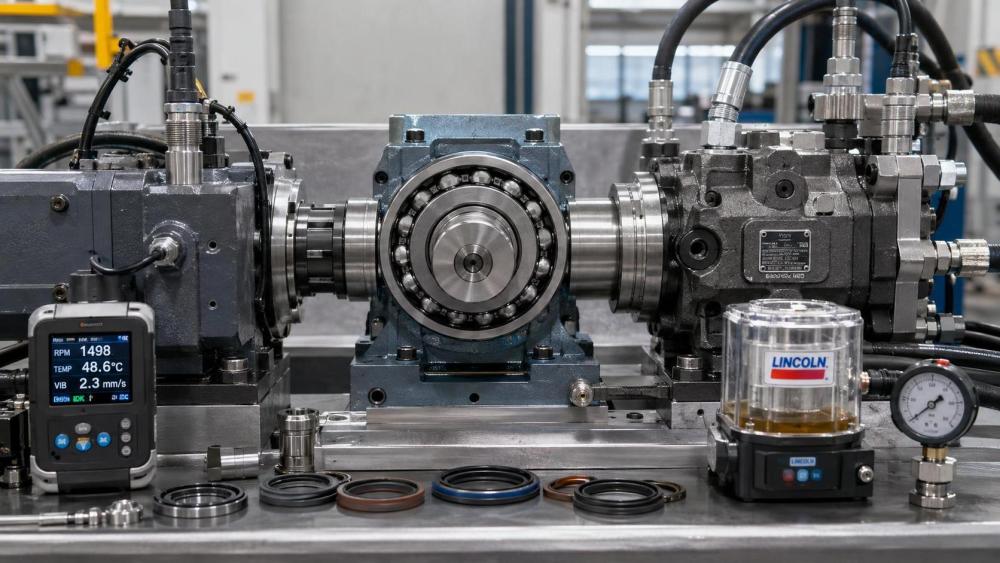
Reliability data must be translated into operating consequences
Reliability engineering contributes more than a predicted service interval. Its purpose in lifecycle analysis is to describe the probability, timing, and consequence of performance loss. A component can meet its basic fatigue-life calculation and still create costly maintenance if contamination, lubricant degradation, misalignment, thermal cycling, pressure spikes, or incorrect assembly cause earlier functional failure.
For this reason, evaluators should separate several concepts that are often blended together:
A useful reliability model does not assume every failure is identical. Consider two hydraulic pump options. One may have a lower expected failure frequency but require a long replacement lead time and specialized commissioning. The other may need more frequent service but be stocked locally and changed quickly. The preferred option depends on the equipment's duty, available redundancy, shutdown tolerance, and ability to carry a strategic spare. Reliability and maintainability must be assessed together.
The same distinction matters for seals. A seal that lasts longer in laboratory immersion testing may not lower lifecycle cost in a dynamic application if it is sensitive to shaft finish, extrusion gap, pressure cycling, or installation damage. For high-temperature or chemically aggressive duties, material compatibility remains necessary, but it is not sufficient. The analysis should include the actual motion, pressure profile, thermal behavior, media contamination, and consequences of a small leak becoming a process interruption.
Downtime should be valued by asset criticality
Downtime is usually the largest and least disciplined input in a lifecycle cost model. It should not be assigned as a generic hourly rate across all equipment. An unplanned stop on a redundant utility pump may be manageable. A stop on a bottleneck machine, a continuous process line, or a system with a tightly controlled restart sequence can have a much larger cost than the failed component itself.
Technical evaluators can make the estimate more defensible by breaking downtime into events. How long does fault detection take? Is access immediate or does the machine require isolation, cooling, draining, cleaning, or permit work? Is the correct spare on site? Does replacement require alignment, flushing, leak testing, run-in, or quality verification? Can production continue at reduced capacity, or is the failure a complete stop?
This approach also reveals when preventive replacement is economically unsound. Replacing components too early may reduce the chance of in-service failure, yet it consumes usable life, increases installation-related risk, and may introduce variation through repeated assembly. Age-based replacement is appropriate when the failure pattern is reasonably predictable and the consequence of failure is high. When degradation can be detected reliably through vibration, temperature, particle monitoring, leakage trends, pressure behavior, or belt tracking, condition-based action may preserve more service life without accepting the full risk of run-to-failure.
Component cost cannot be isolated from the maintenance strategy
A lifecycle cost decision should compare whole strategies, not only parts. For a gearbox bearing, the alternatives may include a standard bearing with frequent oil checks, an upgraded bearing with improved sealing, or a standard bearing combined with better filtration and online condition monitoring. Any of these may be the preferred choice depending on contamination risk, load stability, maintenance access, and the cost of a lost production hour.
In fluid power systems, a similar issue appears when teams focus on pump replacement intervals while overlooking fluid cleanliness and suction conditions. Abrasive particles, water contamination, aeration, overheating, and unstable inlet pressure can shorten pump and valve life together. A lifecycle model that attributes all cost to pump quality may select the wrong remedy. Improving filtration, reservoir maintenance, hose routing, or commissioning discipline can offer a higher reliability return than changing pump supplier or displacement design.
Transmission components require the same system view. Chain wear is influenced by lubrication, sprocket condition, alignment, tension, load variation, and environmental contamination. Belt failures can reflect pulley geometry, tension setting, heat exposure, oil contact, or recurring overload. The direct replacement cost may be modest, while access difficulty and line stoppage are expensive. In such cases, the decision may favor a design that simplifies inspection and replacement rather than one that only maximizes nominal component life.
Use scenarios where uncertainty is high
Inputs such as service life, lost-output cost, energy price, and repair duration are rarely fixed. A single assumed value can make a lifecycle comparison look more certain than it is. Scenario analysis is more useful for technical decisions: compare a normal-duty case, a severe-duty case, and a constrained-maintenance case. Then identify which assumptions change the ranking between options.
If a choice remains favorable across reasonable scenarios, it is robust. If the result reverses whenever the failure interval changes slightly, the decision should not be presented as a settled economic conclusion. It may need better condition data, a supplier clarification on operating limits, a trial under representative duty, or a less irreversible procurement commitment.
Sensitivity analysis also helps teams focus on the right engineering work. If downtime cost drives the result, effort should go into redundancy, repair preparation, and recovery time. If lubricant consumption dominates, the priority may be sealing, filtration, or lubricant selection. If inventory cost and lead time dominate, standardization and strategic spares may matter more than a small difference in component efficiency.
Common mistakes that distort lifecycle decisions
The first mistake is treating supplier warranty periods as service-life predictions. A warranty defines a commercial obligation under stated conditions; it does not establish the failure distribution of a component in a specific machine.
The second is using catalog ratings without confirming the duty cycle. Bearings, seals, pumps, couplings, and belts are all affected by transient loads, starts and stops, shock events, contamination, temperature, and installation conditions. A rating derived from stable conditions may be a weak basis for an intermittent or harsh-service application.
Another problem is double-counting reliability benefits. For example, a model may include fewer failures, lower maintenance labor, and lower downtime, then add a separate broad “reliability value” amount. Each benefit should be linked to a physical change in failure frequency, repair duration, energy use, or consequence. If it cannot be traced to an operational mechanism, it should be challenged.
Teams also sometimes treat monitoring as an automatic cost saver. Sensors and diagnostic systems create value only when the organization can interpret the signal, define an intervention threshold, schedule the work, and have parts and labor available. A vibration alarm that identifies a bearing defect but cannot trigger a planned repair before failure provides warning, not necessarily economic benefit.
A decision record that can survive review
For technical evaluation, the most useful output is not a single lifecycle cost number. It is a decision record that states the operating assumptions, failure modes considered, maintenance strategy, cost categories included, uncertainty range, and conditions under which the recommendation no longer holds. This allows engineering, maintenance, procurement, and operations to examine the same trade-offs without reducing the discussion to initial price.
The recommendation should be written in conditional terms. A higher-cost component may be justified for a critical, difficult-to-access asset with costly unplanned downtime and a credible path to achieving its expected life. The same component may be difficult to justify in a noncritical application where replacement is quick, spares are available, and process interruption is limited. Lifecycle cost analysis supports reliability engineering decisions when it makes those conditions explicit and keeps the system around the component in view.
Related News
- 00
0000-00
How FFKM O-rings reduce seal failure in corrosive media - 00
0000-00
What global equipment manufacturing in the USA means for supply chain risk - 00
0000-00
How FFKM outgassing performance affects vacuum seal selection - 00
0000-00
When should heat resistant metallurgy belts be replaced? - 00
0000-00
When does a fluid power maintenance service reduce unplanned downtime?
Weekly Insights
Stay ahead with our curated technology reports delivered every Monday.