





Introduction: Component sourcing in Thailand can offer competitive costs, flexible manufacturing capacity, and access to regional supply chains, but supplier quality must be verified before production begins.
For procurement teams buying precision components, transmission parts, seals, bearings, or fluid-power products, structured checks of capability, traceability, testing, and delivery performance are essential.
The central procurement question is not whether a supplier can provide a competitive quotation. It is whether that supplier can repeatedly produce conforming parts under controlled conditions.
Reliable component sourcing in Thailand requires evidence, not broad assurances. Buyers should validate processes, controls, documentation, capacity, and response practices before approving production orders.
Start With the Risk Profile of the Component
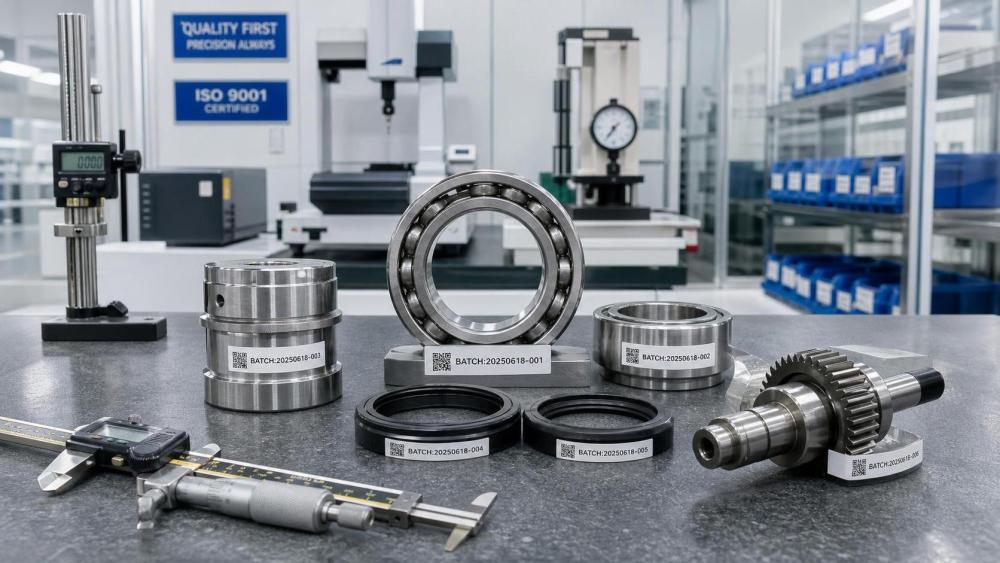
Supplier verification should begin with the component's operational risk. A standard bracket and a high-speed spindle bearing cannot be assessed with the same qualification process.
Procurement teams should classify each purchased item by safety impact, downtime exposure, performance tolerance, replacement difficulty, and cost of field failure before contacting suppliers.
For low-risk fabricated parts, dimensional conformity and reliable delivery may be sufficient. For seals, hydraulic parts, bearings, or transmission components, deeper process validation is necessary.
Consider the consequences of a defect inside the final machine. Leakage, excessive vibration, torque loss, contamination, or premature wear can create warranty costs far beyond unit-price savings.
Critical components should receive enhanced supplier qualification, including factory audits, sample testing, material verification, and first-article approval before any production release.
Define measurable acceptance criteria before requesting quotations. Suppliers cannot be evaluated consistently when requirements remain limited to drawings without performance, material, or inspection expectations.
A procurement specification should state dimensions, tolerances, material grades, surface finish, hardness, plating, cleanliness, packaging, test methods, and required certification documents.
When sourcing replacement parts, clarify whether interchangeability means physical fit only or identical functional performance under actual temperature, pressure, speed, load, and chemical conditions.
Verify Manufacturing Capability Beyond the Supplier Presentation
A polished website, factory photographs, and an ISO certificate do not prove that a supplier can manufacture your specific component consistently at the required quality level.
Ask suppliers to explain the full manufacturing route for the quoted part. Their answer should identify incoming material controls, machining steps, heat treatment, finishing, inspection, and packing.
For precision mechanical components, request details about machine types, spindle capability, tooling control, fixture design, coolant management, and dimensional measurement equipment.
For bearings, investigate grinding, raceway finishing, assembly cleanliness, lubrication methods, internal clearance control, noise testing, and vibration measurement capability.
For hydraulic and pneumatic components, assess machining precision, bore finishing, seal installation practices, pressure-test equipment, leak-test procedures, and contamination management.
For seals and O-rings, verify compound formulation control, batch mixing, molding parameters, curing methods, post-curing capability, visual inspection, and physical-property testing.
Transmission component suppliers should demonstrate how they control tooth geometry, chain pitch, belt construction, heat treatment, balancing, concentricity, and torque-related performance requirements.
Do not accept vague statements such as “advanced equipment” or “strict quality control.” Request equipment lists, process flow charts, calibration records, and representative inspection reports.
Where a supplier relies on subcontractors for plating, heat treatment, rubber compounding, or testing, identify those subcontractors and assess how quality responsibility is managed.
Assess Quality Systems Through Practical Evidence
Quality certification can be useful, but it should be treated as an entry point rather than final proof. The important issue is whether the system operates daily.
ISO 9001 may indicate that documented quality processes exist, while IATF 16949, ISO 13485, AS9100, or sector-specific approvals may matter for specialized applications.
Ask for recent examples of corrective action reports, nonconformance records, customer complaints, and process-improvement activities. Sensitive information may be redacted without eliminating useful evidence.
A capable supplier should show how it identifies root causes, assigns responsibilities, verifies corrective actions, and prevents repeated defects across related product families.
Review calibration management carefully. Micrometers, gauges, pressure sensors, hardness testers, coordinate measuring machines, and torque testers must have traceable calibration status.
Sampling plans also reveal quality maturity. Suppliers should explain when they use 100 percent inspection, statistical sampling, first-piece approval, in-process checks, and final inspection.
For critical dimensions, ask whether process capability data is available. Cp and Cpk values are especially valuable when consistent tolerance performance affects assembly or reliability.
Examine how rejected material is segregated. Clear labeling, physical quarantine areas, and documented disposition prevent nonconforming components from returning to production or shipment.
Confirm Material Traceability and Product Documentation
Material substitution is a common sourcing risk because visually similar components can perform very differently in fatigue, corrosion resistance, pressure containment, or thermal stability.
Require material certificates for metals, polymers, elastomers, and coatings whenever material properties affect safety, service life, regulatory compliance, or machine performance.
Certificates should connect the finished component to a material heat number, compound batch, or production lot. Generic certificates provide limited protection during failure investigations.
For stainless steel components, confirm the specific grade rather than accepting “stainless steel” as a sufficient description. Chemical composition and heat treatment can change corrosion performance substantially.
For elastomer seals, define the polymer family, hardness range, color requirements, curing standard, compression-set limits, media resistance, and temperature range where relevant.
For bearings and transmission parts, ensure that metallurgy, hardness, surface treatment, and lubricant specifications align with the actual application rather than a catalog-level description.
Request certificates of conformity, inspection reports, test records, and packing lists that reference purchase-order numbers, drawing revisions, part numbers, quantities, and lot identifiers.
Traceability should remain intact through receiving, production, inspection, packing, and shipment. This enables targeted containment if one lot later shows abnormal failure behavior.
Use Samples and First-Article Inspection to Test Reality
Samples are valuable only when they represent the intended production process. Hand-finished prototypes or engineering samples may not reflect normal output quality or cycle capability.
Ask whether sample parts were made using production tooling, production materials, normal operators, and planned inspection methods. Record any deviations before approving the samples.
A first-article inspection should compare every relevant drawing characteristic with actual results. This includes dimensions, threads, geometry, surface finish, material properties, and functional checks.
For assemblies, evaluate fit, torque, leakage, rotation, actuation speed, noise, vibration, and operating stability under conditions that resemble the final application.
Independent laboratory testing is appropriate when the part has high failure consequences or when supplier reports cannot independently validate material, hardness, coating, or pressure performance.
For hydraulic products, conduct pressure, endurance, leakage, and contamination tests. For seals, test compression set, tensile strength, media compatibility, and thermal resistance where applicable.
For bearings, consider dimensional verification, radial clearance, runout, vibration, noise, grease performance, and fatigue-life testing according to the component's operating duty.
Document sample approval conditions clearly. Production cannot be assumed equivalent to the approved sample unless materials, tooling, processes, suppliers, and control plans remain unchanged.
Audit the Thai Supplier's Factory and Production Controls
A factory audit provides information that documents alone cannot reveal. It shows whether actual working conditions match the supplier's stated quality procedures and production claims.
During an on-site audit, follow the component's route from receiving inspection through manufacturing, final inspection, storage, packaging, and dispatch rather than reviewing only meeting-room presentations.
Look for clear work instructions at machines, controlled drawing revisions, identified inspection points, trained operators, tool-maintenance records, and visible handling rules for sensitive products.
Assess housekeeping because poor organization can affect component quality. Metal chips, mixed lots, dust, uncontrolled humidity, and damaged containers create preventable contamination and traceability risks.
Observe whether gauges are accessible and used by operators. A quality department cannot inspect quality into a process after critical machining, assembly, or molding errors have occurred.
Review production planning as well. A supplier may produce excellent samples but struggle with capacity, maintenance, staffing, or material availability during high-volume production periods.
For component sourcing in Thailand, local audits can be performed by internal teams, qualified third-party inspectors, or regional quality representatives familiar with industrial manufacturing processes.
Audit findings should be scored by severity and linked to an action plan. Approval should depend on closure of critical findings, not simply on a supplier's willingness to improve.
Evaluate Delivery Reliability, Communication, and Commercial Control
Quality includes delivery performance because an in-specification component delivered after an equipment shutdown or production delay still creates a serious commercial problem.
Ask suppliers for on-time delivery data, production lead times, capacity utilization, minimum order quantities, inventory policies, and contingency plans for equipment or material disruptions.
Confirm whether quoted lead times include raw-material procurement, subcontracted operations, testing, export documentation, and inland transportation to the chosen shipping point.
Thai suppliers may serve both domestic and export customers, so buyers should verify English-language technical communication, document control, response time, and escalation availability.
Clarify Incoterms, packing specifications, labeling requirements, export classification, origin documentation, and responsibility for damage or shortages discovered during international transport.
A supplier's response to technical questions is often revealing. Specific, timely answers supported by drawings or records are more credible than immediate but generalized assurances.
Establish change-control requirements in the purchase agreement. Suppliers must obtain written approval before changing material sources, tooling, processes, inspection methods, or subcontractors.
Include remedies for quality failures, such as replacement parts, sorting costs, expedited shipment, root-cause analysis, and reimbursement rules when defects interrupt production or customer delivery.
Create a Supplier Approval Plan Instead of Making a One-Time Decision
Supplier qualification should not end with the first successful shipment. Quality performance must be monitored because process drift, staffing changes, cost pressure, and subcontracting can affect output.
Use a supplier scorecard that tracks defect rates, incoming inspection failures, on-time delivery, response time, corrective-action closure, documentation accuracy, and recurring quality issues.
Segment suppliers by business criticality. Strategic suppliers of high-risk bearings, precision seals, hydraulic assemblies, or transmission components require closer review than noncritical commodity vendors.
New suppliers should begin with controlled trial orders. Limit quantities, increase incoming inspection, and confirm packaging, documentation, and delivery processes before moving to full production volumes.
For established suppliers, periodic audits and performance reviews help identify issues before they become line stoppages, field failures, or costly warranty events.
Maintain approved samples, inspection records, drawings, certificates, and corrective-action history in a centralized supplier file. This protects organizational knowledge when procurement personnel change.
Procurement, engineering, quality, and maintenance teams should share supplier feedback. Each group sees different risks, from dimensional variation and installation difficulty to operational reliability.
The strongest sourcing decisions balance price with verified capability, predictable lead time, evidence-based quality controls, and the supplier's ability to support problems after shipment.
Conclusion: Make Supplier Quality Verifiable Before Committing Volume
Successful component sourcing in Thailand is achievable when procurement teams assess suppliers through documented proof, production evidence, samples, audits, and ongoing performance data.
Begin by defining the component's failure risk and acceptance criteria. Then verify manufacturing capability, quality systems, traceability, testing, factory controls, and delivery readiness.
For precision components and industrial MRO products, the lowest quoted unit price should never be the deciding factor without evidence that the supplier can maintain repeatable quality.
A disciplined qualification process reduces defective shipments, emergency freight, unplanned downtime, warranty exposure, and expensive supplier changes after production has already started.
Buyers that treat supplier verification as a structured engineering and procurement activity can use Thailand's manufacturing base while protecting reliability, lifecycle cost, and customer commitments.