





Preload changes an angular contact bearing before external service load is applied. By imposing an axial displacement or axial force between opposed bearing rings, it removes internal clearance and establishes a defined contact condition between balls and raceways. The immediate result is higher axial and radial stiffness. The longer-term result is more conditional: a preload level that stabilizes contact under the intended load spectrum can improve running accuracy and reduce damaging motion, while excessive preload raises contact stress, friction, and operating temperature enough to shorten service life.
The correct preload therefore cannot be selected from stiffness alone. It has to remain appropriate after speed, thermal growth, fits, housing behavior, lubrication condition, and externally applied loads have changed the original assembly condition.
What preload changes inside the bearing
An angular contact bearing carries axial load through a contact angle between the ball and raceway. In a duplex arrangement, axial movement of one ring relative to the other increases the load carried by some ball contacts and creates an internal axial force even when the shaft is unloaded externally. This is preload.
As preload rises, the ball-raceway contact areas deform more elastically. Their incremental resistance to further displacement increases, so the bearing pair becomes stiffer. A spindle nose then deflects less under a changing cutting force; a ballscrew support maintains position more consistently during reversal; and a pump shaft is less prone to axial movement that could disturb adjacent running clearances.
That same elastic deformation also produces a higher baseline contact load. The loaded zone does not begin at zero when the machine starts. Rolling friction, sliding at ball contacts, cage drag, and lubricant shear are all affected by this initial load. Heat is generated before process load is considered. At high speed, the heat balance can become the limiting factor well before static stiffness is.
Stiffness is nonlinear, not a fixed bearing property
A common comparison error is to treat the catalog stiffness associated with a preload class as a constant machine value. Bearing stiffness changes with load because Hertzian contact deformation is nonlinear. It also changes as the distribution of load among the balls changes. A preloaded pair usually has greater stiffness near its unloaded operating position than a clearance-bearing pair, but the difference between preload classes narrows or shifts once substantial external axial force acts in one direction.
System stiffness is lower than bearing stiffness alone. Shaft bending, housing wall deflection, shoulder geometry, spacer compression, and interfaces between mounted components all add compliance. Raising bearing preload may produce little useful positional improvement when a thin housing or a long overhung shaft governs the deflection. It can still add heat and reduce fatigue margin. The bearing calculation and the surrounding structure must therefore be considered together.
Why service life does not always increase with preload
Preload can extend useful life when it prevents harmful low-load behavior. A lightly loaded high-speed bearing may experience ball skidding, where rolling elements do not follow the expected kinematic path because traction is insufficient. Repeated skidding damages lubricant films and may leave smearing or discolored raceway tracks. A controlled preload supplies contact traction, keeps the ball set more stable, and can improve running behavior.
Preload also suppresses small alternating displacements at interfaces. In precision assemblies, minute motion between rings and seats can lead to fretting corrosion, loss of fit, or changing runout. In an opposed pair, adequate preload helps preserve ring location as the axial force direction changes.
However, bearing fatigue life is strongly affected by contact load. Higher preload increases the internal load borne by every rolling element cycle. If external loading is modest, that internal force can become the dominant life driver. The bearing may meet a stiffness target yet accumulate fatigue damage faster than a lighter-preloaded arrangement.
Service life also includes failure mechanisms outside classical rolling-contact fatigue. Grease oxidizes more rapidly at elevated temperature. Oil viscosity falls as temperature rises, reducing film thickness unless the lubrication system and lubricant selection compensate. High contact stress increases sensitivity to contamination particles and surface defects. The relevant question is not simply whether the bearing has sufficient calculated rating life; it is whether the chosen preload preserves a stable lubrication and thermal condition across the machine's real duty cycle.
A warm-running bearing does not automatically indicate excessive preload. Seal drag, overfilled grease, poor oil drainage, jet direction, churning losses, or an external source heating the housing can produce a similar temperature trend. Conversely, excessive preload can be hidden by a well-cooled housing while contact stresses remain undesirable. Temperature, torque, vibration, and axial displacement need to be interpreted together.
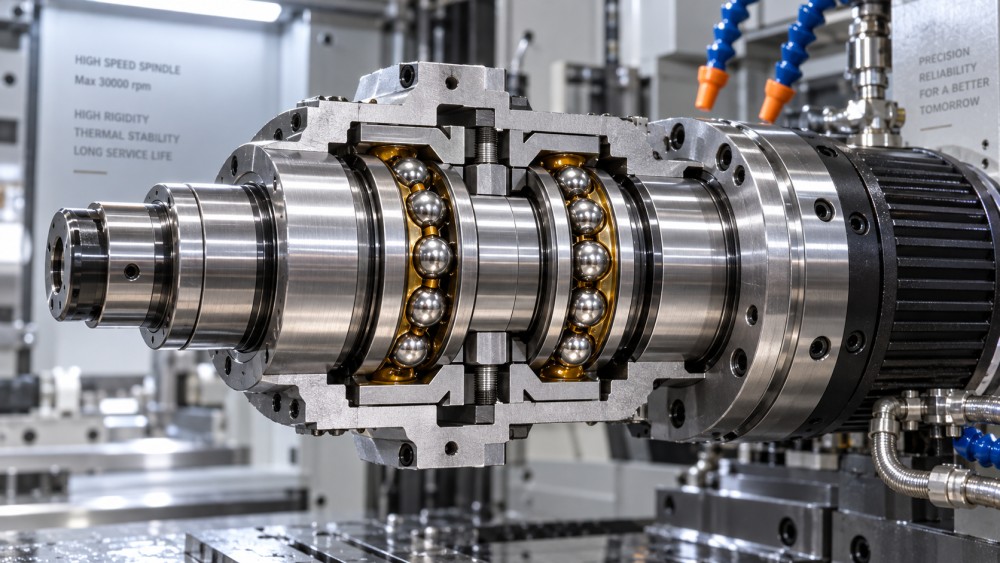
Preload methods and the conditions they create
Constant-position preload is created by fixing the relative axial position of the rings. Ground spacers, selective assembly dimensions, or direct clamping establish a displacement. The resulting preload changes when the shaft and housing expand differently. This method often delivers high rigidity, but its thermal sensitivity must be understood before it is used in a high-speed or wide-temperature application.
Constant-pressure preload uses springs or a similar compliant mechanism to apply an approximately controlled axial force. It is more tolerant of differential thermal expansion and can maintain contact during axial movement, but it offers less stiffness than a rigidly positioned pair at comparable force. It is useful where temperature variation, shaft growth, or lower required rigidity would make fixed preload unstable.
Duplex bearings are commonly arranged back-to-back, face-to-face, or in tandem. Back-to-back mounting provides a wide effective support span and strong resistance to overturning moments. Face-to-face arrangements are more tolerant of minor angular misalignment but have a narrower support base. Tandem pairs share axial load in one direction and normally require another bearing or pair to locate load in the opposite direction. These arrangements do not merely alter load direction; they change how preload interacts with moment load, housing flexibility, and thermal expansion.
Preload class labels supplied by a bearing producer are useful only within the specified matched set, mounting orientation, and dimensional assumptions. Combining individual bearings from separate packages on the assumption that identical part numbers create identical preload can introduce a large variation. Matched sets are ground so that clamping the indicated faces develops the intended internal condition. Spacer-ground arrangements need equivalent control of face runout, thickness variation, parallelism, and surface finish.
Thermal growth can reverse the original intent
At speed, the inner ring is often warmer than the outer ring because it is connected to the shaft and receives heat from the rolling contacts. A hotter shaft expands axially and radially. Housing temperature may lag because of greater mass, cooling, or distance from the heat source. In a fixed-position assembly, differential axial expansion can materially increase preload.
The result can be a feedback loop: preload increases friction, friction raises ring temperature, thermal growth further increases preload, and the bearing reaches a high stabilized temperature or, in a severe case, rapid distress. This risk is especially important for close-mounted pairs on high-speed spindles, where the inner-ring temperature and centrifugal effects are significant.
Thermal behavior is not determined by rotational speed alone. A short shaft between bearings can grow differently from a long shaft. A cartridge housing may conduct heat away far more effectively than a thin aluminum structure. A motor-driven pump can deliver heat through the shaft from a source outside the bearing cavity. Spacer material and geometry also affect the axial thermal path. Design review should use the actual distance between locating shoulders, expected heat sources, cooling arrangement, and assembly sequence rather than an assumed uniform temperature.
Fit selection affects effective preload
Interference fits change ring dimensions. An inner ring expanded by a tight shaft fit loses some internal radial clearance; an outer ring compressed by a tight housing fit changes it in the opposite direction. In an angular contact bearing pair, these dimensional changes alter contact geometry and effective preload. The effect becomes more important with thin rings, thin-section bearings, large interference, or housings that are not sufficiently rigid and round.
Out-of-round seats are particularly damaging because preload then varies around the circumference. Instead of a predictable loaded zone, the bearing sees localized high contact forces each revolution. The assembly may show elevated vibration or a periodic temperature pattern even when the nominal axial clamp force appears correct. Seat cylindricity, shoulder squareness, and abutment runout are functional preload controls, not cosmetic machining requirements.
Interpreting preload against the load spectrum
An axial force in one direction does not simply add to the preload of every bearing in an opposed pair. It increases load in one bearing and reduces it in the other. If the external force is large enough, the relieved bearing can unload. Whether that is acceptable depends on the required rigidity, reversal frequency, cage behavior, and moment loading. A design intended to maintain contact in both bearings through rapid direction changes needs a different preload than one carrying a sustained axial thrust in one direction.
Moment load deserves separate attention. A pair can retain its nominal axial preload while one side of the bearing set becomes heavily loaded by an overhung tool, pulley, or gear force. The apparent stiffness at the shaft centerline may be acceptable, yet localized ball loads rise sharply. Increasing preload may reduce small motion under the moment, but it also increases baseline load in the already stressed contacts. Increasing bearing span, changing support geometry, or reducing overhang can be more effective than selecting a heavier preload class.
- High-speed spindle service: preload must be evaluated with speed-related heat, lubricant delivery, centrifugal load effects, and the expected cutting-force envelope. A cold assembly setting is only the starting condition.
- Precision linear or rotary positioning: reversal accuracy often requires enough preload to avoid an unloaded transition, but shaft compliance and mounting-face errors can dominate measured lost motion.
- Pumps and compact gear drives: hydraulic thrust, helical gear thrust, pressure pulsation, and shaft deflection can change direction and magnitude over a cycle. The relevant preload is the one that remains valid during those transients.
Assembly details that alter the result
Axial clamping force is not a reliable direct measure of bearing preload after a nut has been tightened. Thread friction, nut face friction, spacer seating, and elastic deflection consume much of the applied tightening torque. A torque value may control fastener loading, but it does not prove the internal bearing condition unless the assembly method has been qualified for that geometry.
Cleanliness is equally important. A particle trapped between a spacer and ring face creates local tilt or axial error. A burr on a shoulder can prevent full seating. Either defect may resemble a preload problem through higher temperature, elevated vibration, or inconsistent runout. Pressing force must be applied to the ring being fitted; transmitting installation force through the balls can indent raceways and create damage that later appears as noise or early fatigue.
For grease-lubricated units, the selected grease quantity should match speed and free volume. Excess grease causes churning and masks preload diagnosis by raising temperature during run-in. For oil-air, oil mist, or circulating-oil systems, the supply rate and delivery point determine whether increased preload still has adequate film formation. Switching lubricant viscosity or lubrication method after preload validation invalidates part of the original assessment.
Verification should use more than one signal
When direct axial displacement or preload measurement is available during build, it provides the clearest evidence of assembly condition. In completed equipment, a controlled run-in combined with temperature rise, running torque, vibration spectrum, and runout measurement gives a more reliable picture than any one observation. The baseline should be captured at known ambient temperature and speed, then compared under repeatable conditions.
A gradual, stable temperature increase followed by equilibrium is different from continuing escalation. A sudden torque increase after warm-up points toward thermal preload growth, lubrication distress, or a seating change. High-frequency vibration may indicate surface damage or inadequate film thickness, whereas a once-per-revolution component is more consistent with runout, eccentricity, or localized seat distortion. These signatures overlap, so disassembly should not be prescribed from a single symptom alone.
Preload is best treated as an operating condition with a tolerance band, not an isolated assembly number. The selected setting has succeeded when the bearing pair maintains the required stiffness and running accuracy while heat, lubrication, contact stress, and load distribution remain within the limits established for the actual machine configuration.
Related News
- 00
0000-00
Where are axial piston pumps used in mining equipment? - 00
0000-00
Embodied AI Robotics and Drive Control Forum Held in Shanghai - 00
0000-00
How does seal service life affect the total cost of ownership? - 00
0000-00
Schaeffler to Cut 3,460 Jobs and Close Five European Plants - 00
0000-00
How does system size affect the price of a belt drive system?
Weekly Insights
Stay ahead with our curated technology reports delivered every Monday.