





Electronics Assembly Pneumatics cost is rarely determined by the purchase price of cylinders, valves, and fittings alone. For financial approvers, the bigger picture includes compressed air consumption, production speed, unplanned downtime, maintenance frequency, quality losses, and supplier stability across the full operating life.
In electronics assembly, pneumatic systems often look inexpensive at the sourcing stage because many components are standardized and individually affordable. However, total spend rises quickly when air leaks, oversized actuators, poor filtration, inconsistent cycle timing, or frequent replacement parts create hidden operating costs.
For budget owners, the practical question is not whether pneumatics are cheap or expensive in isolation. The real decision is whether a given pneumatic setup delivers stable throughput, predictable maintenance, and acceptable energy efficiency compared with its lifecycle cost.
This is why Electronics Assembly Pneumatics cost should be evaluated as a total cost of ownership issue. A sound approval decision depends on how well the system supports production continuity, quality control, and cost predictability over time.
What financial approvers should look at before approving Electronics Assembly Pneumatics cost
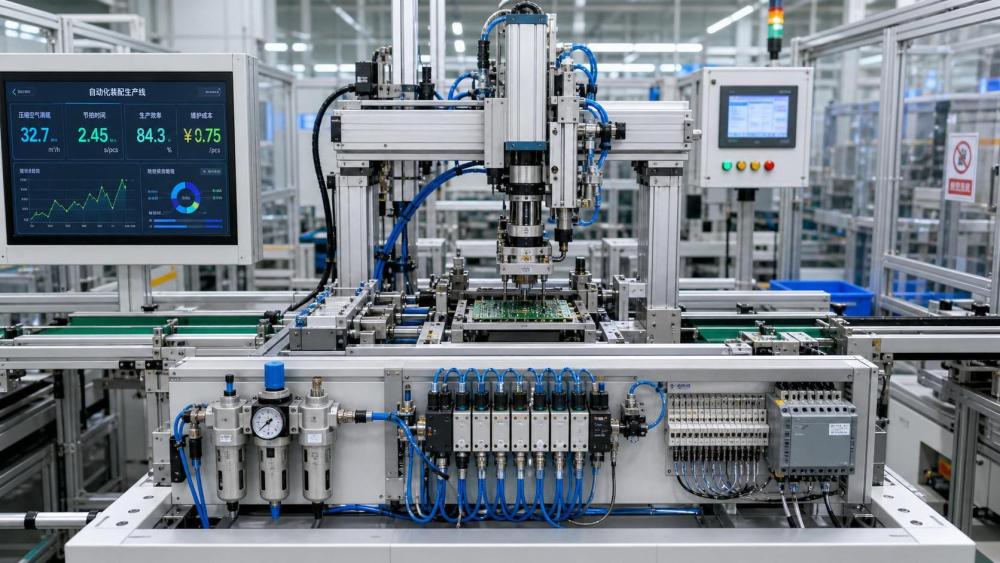
When finance teams review pneumatic spending in electronics assembly, the first risk is focusing too heavily on line-item prices. Lower component quotes can appear attractive, yet they may hide larger expenses in utilities, maintenance labor, scrap, and lost output.
The most useful evaluation framework starts with five categories: capital expenditure, energy consumption, maintenance cost, downtime exposure, and productivity impact. Together, these categories show whether the pneumatic system supports efficient assembly or quietly drains margin over time.
In electronics manufacturing, this matters because pneumatic devices often support pick-and-place actions, clamping, gripping, indexing, ejecting, testing, and packaging. Small inefficiencies repeated across thousands of cycles per shift can create meaningful cost escalation across the year.
Financial approvers should therefore ask a broader question: how much does this pneumatic architecture cost per accepted unit produced, not just per purchased component. That single shift in perspective often changes which supplier and design option makes the most financial sense.
Why compressed air consumption is often the biggest hidden cost
Compressed air is one of the most expensive utilities in many factories, yet it is still underestimated during investment review. In electronics assembly, even modest pneumatic motion can generate large annual energy costs when cycle counts are high and operations run continuously.
Air consumption depends on actuator bore size, stroke length, operating pressure, valve timing, leakage rate, and duty cycle. If a system is oversized for the application, the business pays for unnecessary compressed air every minute the line runs.
This is particularly important for financial reviewers because energy cost does not always appear in the pneumatic equipment budget. It may sit under plant utilities, making the true Electronics Assembly Pneumatics cost look artificially low during initial approval.
A lower-cost actuator package can therefore become more expensive over its service life than a better-engineered alternative. Components that reduce pressure requirements, shorten unnecessary stroke, or improve valve control can produce measurable savings in total operating spend.
For finance teams, the practical takeaway is simple: request estimated annual air consumption for each proposal. If the supplier cannot provide reasonable usage assumptions, the quote likely does not reflect the full economic impact.
How cycle efficiency changes cost per unit
In electronics assembly, pneumatic performance affects not only utility expense but also throughput. If cylinders extend too slowly, grippers require repeated correction, or valves create inconsistent motion, the result can be lower line speed and poorer labor productivity.
For a financial approver, this matters because even small cycle losses multiply quickly. A fraction of a second added to a repetitive assembly task may seem negligible, but across high-volume production it can reduce daily output and increase unit cost.
Cycle efficiency also influences machine balancing. If one pneumatic station becomes the bottleneck, upstream and downstream equipment may idle, causing underutilized capital and hidden efficiency losses that never appear in the component purchasing spreadsheet.
Well-matched pneumatics help maintain repeatable takt time. They support stable part handling, fast response, and smooth sequencing, which improves production predictability. In finance terms, better cycle efficiency can protect revenue capacity without requiring additional headcount or new equipment.
This is why approval decisions should include expected impact on line output. A slightly higher pneumatic investment may be justified if it improves throughput enough to lower cost per unit or reduce overtime requirements.
Maintenance intervals and spare parts planning directly affect budget control
Another major driver of Electronics Assembly Pneumatics cost is how frequently the system needs service. Seals, valves, tubing, filters, regulators, and actuators all have maintenance implications, especially in fast-cycle electronics environments where reliability is critical.
Cheap components may reduce upfront procurement cost but increase replacement frequency. If maintenance teams must repeatedly troubleshoot leaks, sticky valves, or inconsistent motion, the business absorbs extra labor cost, spare parts spend, and disruption to production planning.
For financial approvers, predictable maintenance is often more valuable than the lowest initial quote. Budget control improves when service intervals are known, spare parts are standardized, and failure rates are low enough to avoid repeated emergency purchases.
Standardization is especially useful in multisite or multi-line operations. If the organization can reduce the number of pneumatic variants, it lowers inventory complexity, simplifies technician training, and improves negotiating leverage with suppliers.
A strong approval process should therefore examine expected replacement cycles, maintenance documentation, local parts availability, and whether critical consumables are easy to stock. These factors strongly influence annual operating expense and working capital efficiency.
Air quality control has a direct cost impact in electronics assembly
Electronics assembly requires consistency and cleanliness. Poor compressed air quality can introduce oil, moisture, or particulates that affect valve life, actuator reliability, sensor performance, and in some cases even product quality or workstation cleanliness.
When air preparation is underspecified, costs appear in indirect forms. Components wear faster, pneumatic response becomes inconsistent, and quality-related disruptions become more frequent. Financial approvers may then see rising maintenance invoices without realizing the root cause began in air treatment design.
Filters, dryers, regulators, and monitoring devices add visible cost at the beginning of the project. Yet in many cases they reduce total spend by extending component life and lowering the risk of unstable operation in sensitive assembly processes.
This is a classic case where finance should avoid false economy. Underinvesting in air quality support may save money during procurement while increasing the long-term cost of failures, line interruptions, and shortened component life.
When reviewing proposals, approvers should ask whether the specified air preparation level matches the sensitivity of the assembly process. If not, the quoted system may be cheaper only because essential protection has been omitted.
Downtime risk usually outweighs small purchase savings
For many electronics producers, the biggest financial exposure is not component price but production stoppage. If a pneumatic failure halts an assembly cell, the cost can include lost output, operator idle time, schedule recovery expense, and delivery risk.
This is especially relevant where customer commitments are strict, margins depend on line utilization, or products have short market windows. In such conditions, one avoidable stoppage can eliminate the savings achieved by choosing a lower-cost pneumatic package.
Finance teams should treat reliability as an economic variable, not only an engineering preference. Mean time between failure, response consistency, and supplier quality discipline all affect whether the system supports stable revenue generation.
Downtime risk also increases when suppliers lack local service support or cannot deliver urgent replacements quickly. A low initial quote becomes expensive if the plant must wait for parts, source incompatible substitutes, or rework equipment under schedule pressure.
For approval purposes, it is wise to compare not only component prices but also the probable cost of interruption. In high-volume electronics assembly, resilience often deserves greater weight than small purchase-price differences.
Supplier consistency influences total spend more than many buyers expect
Many financial approvers focus on unit price and overlook supplier consistency. Yet in pneumatic applications, unstable quality between batches can create variation in fit, response time, sealing performance, and lifespan, all of which increase operating uncertainty.
A supplier that provides reliable documentation, repeatable manufacturing quality, stable lead times, and technical support can lower total spend even if the quoted price is not the lowest. The value comes from reduced disruption and stronger planning accuracy.
In electronics assembly, where process windows can be tight, quality inconsistency may trigger nuisance faults, recalibration needs, or micro-stoppages that are difficult to trace but expensive over time. Finance may only see these as scattered maintenance or productivity losses.
That is why supplier evaluation should include more than price comparison. Warranty terms, field support, application engineering capability, and performance history in similar assembly environments all matter when assessing real lifecycle cost.
A financially sound sourcing decision balances competitive pricing with confidence in continuity, quality assurance, and replacement support. This reduces both direct expenditure and the hidden cost of uncertainty.
How to evaluate Electronics Assembly Pneumatics cost with a total-spend model
For financial approvers, the best decision tool is a structured total-spend model. This does not need to be complicated, but it should include all major cost drivers rather than relying on purchase price alone.
Start with initial system cost: actuators, valves, fittings, tubing, air preparation units, installation, and controls integration. Then estimate annual compressed air usage based on pressure, cycle rate, and operating hours.
Next, add planned maintenance expense, expected spare parts consumption, and labor required for routine service. After that, estimate downtime exposure by using historical failure data or reasonable assumptions from similar lines.
Finally, include productivity impact, such as cycle time improvement, scrap reduction, or output stability. These factors are essential because a system that costs more upfront may still deliver better financial results if it protects throughput and reduces operational volatility.
With this approach, Electronics Assembly Pneumatics cost becomes easier to compare across vendors and designs. Finance gains a clearer basis for approval, and engineering gains a framework that aligns technical choices with business value.
Questions finance teams should ask vendors before approval
Strong cost control starts with better questions. Financial approvers do not need to evaluate pneumatics as design engineers, but they should ask suppliers for the information that reveals lifecycle economics.
Useful questions include: what is the estimated annual compressed air consumption, what service intervals are expected, what parts typically fail first, what is the average lead time for replacements, and what support is available during line stoppages.
It is also helpful to ask whether the proposed system is sized specifically for the application or based on standard assumptions. Overspecification is common, and it often increases both energy usage and unnecessary capital cost.
Another smart question concerns reference cases. Suppliers that have supported similar electronics assembly operations should be able to explain performance outcomes, maintenance patterns, and cost-saving opportunities from prior deployments.
These questions help finance teams move beyond quote comparison. They reveal whether a vendor is offering a genuinely economical solution or simply a lower visible price with higher hidden operating costs.
Conclusion: the lowest quoted price rarely reflects the real cost
Electronics Assembly Pneumatics cost is best understood as a total-spend issue that combines equipment price with energy use, cycle performance, maintenance burden, air quality protection, downtime risk, and supplier reliability.
For financial approvers, the most effective decisions come from asking how the pneumatic system affects cost per accepted unit, line stability, and budget predictability over time. That perspective is far more useful than comparing component prices in isolation.
In practical terms, a well-selected pneumatic solution can reduce hidden utility waste, support higher throughput, minimize disruptions, and improve maintenance planning. A poorly selected one can look inexpensive at purchase and expensive in operation.
The right approval standard, then, is not lowest initial cost but strongest lifecycle value. When Electronics Assembly Pneumatics cost is evaluated through that lens, finance can make decisions that protect both operational performance and long-term profitability.
Related News
- 00
0000-00
How precision transmission systems improve robot positioning accuracy - 00
0000-00
When welded hydraulic cylinder systems suit high-cycle equipment - 00
0000-00
Building a Conveyor Belt Predictive Maintenance Plan for Dusty Facilities - 00
0000-00
Which Chain Wear Indicators Enable Reliable Predictive Maintenance? - 00
0000-00
Predictive Maintenance for Conveyor Belts: Preventing Failures in High-Throughput Lines
Weekly Insights
Stay ahead with our curated technology reports delivered every Monday.