





How to Choose Pneumatic Grippers for Automation Lines
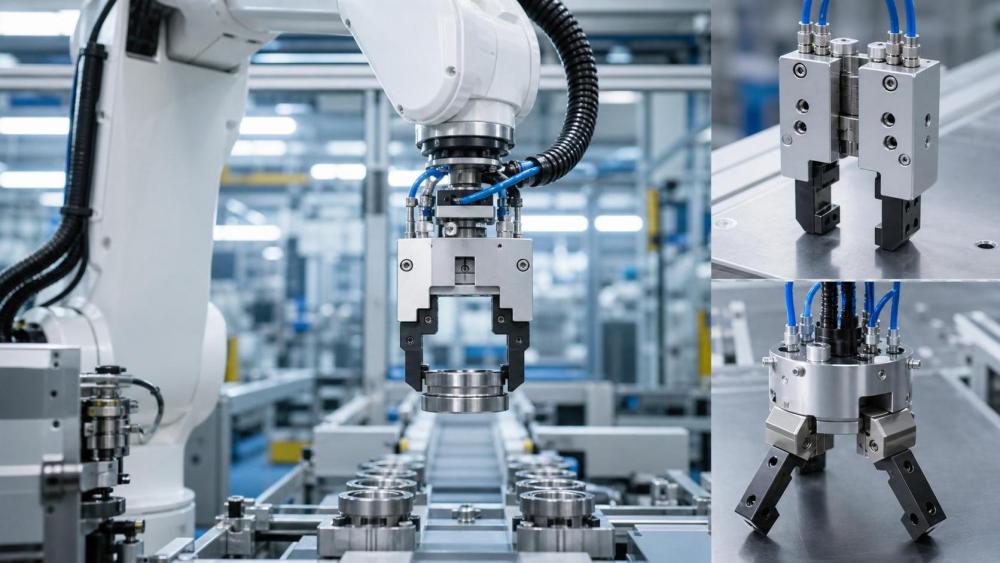
Choosing pneumatic grippers for automation lines is rarely a simple force calculation.
In real projects, gripper selection affects uptime, cycle time, part quality, and integration cost.
That is why technical reviews should look beyond catalog ratings.
The best pneumatic grippers for automation balance gripping force, jaw travel, speed, air efficiency, and installation fit.
They also need to match the product surface, machine layout, and expected duty cycle.
For automation lines handling varied parts, the wrong design can create slip, mis-picks, or frequent maintenance stops.
A more practical evaluation starts with the application itself.
What part is being handled, how fast the line runs, and what happens if grip stability drops.
From a PCTS perspective, pneumatic grippers for automation should be judged as reliability components, not just end effectors.
Start with Part Geometry and Payload Reality
The first step is defining the real gripping task, not the ideal one.
Many selection problems come from using nominal part weight without dynamic conditions.
Acceleration, deceleration, robot motion, and vibration can raise effective gripping demand sharply.
For that reason, pneumatic grippers for automation should be sized with motion loads in mind.
A light metal part in a high-speed pick-and-place cell may need more holding margin than a heavier part on a slow transfer station.
Part geometry matters just as much.
Round parts, oily surfaces, thin walls, and sharp edges all change how the gripper should contact the workpiece.
In practice, review these points before comparing models:
- Part weight, including maximum variation across batches
- Center of gravity location during lifting and transfer
- Surface condition, such as oil, dust, burrs, or coatings
- Grip points available without damaging the part
- Required orientation control during movement
This is where many successful automation projects separate themselves.
They treat gripping as an application engineering problem, not a catalog shortcut.
Choose the Right Gripper Type and Jaw Motion
Not all pneumatic grippers for automation work the same way.
Parallel grippers are common for precise, repeatable holding.
Angular grippers can be useful when access is tight or opening clearance matters.
Three-jaw designs often support round parts more evenly.
Long-stroke models help when part size variation is large.
The right choice depends on access, repeatability, and available space around the work zone.
Jaw motion should support the process, not interfere with it.
For example, wide opening travel may look attractive, but it can increase cycle time and air use.
Meanwhile, a compact stroke can improve speed if part positioning is consistent.
A quick comparison helps narrow options:
If the line handles multiple SKUs, jaw flexibility becomes even more important.
Check Gripping Force, Safety Margin, and Air Supply
Force values in catalogs can be misleading if read without context.
Actual force at the jaw tip changes with finger length, friction coefficient, and operating pressure.
This means pneumatic grippers for automation should always be evaluated with custom jaw tooling included.
Long fingers create leverage that reduces effective gripping force.
That tradeoff is common in deep-reach applications.
A realistic safety factor is essential, especially for vertical lifts or fragile parts.
Air supply quality also matters more than many teams expect.
Pressure fluctuation, poor filtration, or moisture can reduce repeatability and shorten seal life.
That creates hidden cost across high-volume automation lines.
When reviewing pneumatic grippers for automation, confirm these air-side conditions:
- Stable operating pressure under peak line demand
- Clean, dry air matched to supplier requirements
- Valve response time and tubing layout
- Expected air consumption per cycle
- Need for grip confirmation sensors or pressure monitoring
From a total cost viewpoint, air efficiency is not a minor detail.
Across large lines, it can shape operating expense for years.
Evaluate Mounting, Sensors, and Line Integration
A gripper may perform well on paper and still fail during installation.
Integration details often decide whether pneumatic grippers for automation are easy to scale or expensive to adapt.
Mounting orientation affects tubing, cable routing, service access, and collision risk.
A compact body can simplify tooling design on dense robot end-of-arm setups.
Sensor compatibility is another practical checkpoint.
Open and closed detection helps reduce mis-picks and supports faster troubleshooting.
In more demanding cells, part-presence confirmation may be worth the extra investment.
This is especially true where a dropped part can stop a downstream station.
A sound evaluation usually includes:
- Mounting pattern compatibility with existing tooling plates
- Sensor slot design and switch availability
- Ease of jaw replacement during maintenance
- Clearance during full open and full close movement
- Spare parts availability across operating regions
These points are easy to overlook early.
Later, they become the source of avoidable retrofits.
Consider Environment, Duty Cycle, and Maintenance Risk
Pneumatic grippers for automation do not operate in clean lab conditions by default.
Dust, coolant mist, welding spatter, washdown exposure, and temperature swings can change service life fast.
That is why environmental fit should be part of the selection matrix from the start.
A sealed or corrosion-resistant design may cost more upfront.
Even so, it may lower downtime risk dramatically in harsh applications.
Duty cycle is equally important.
A gripper running continuously on a packaging or assembly line needs proven endurance, not just acceptable initial performance.
Look at bearing surfaces, internal guides, seal design, and manufacturer life data.
At PCTS, this wider reliability view often exposes the real procurement difference between similar-looking models.
Ask practical questions such as:
- How often will the gripper cycle each shift?
- What contamination can reach the jaw guides?
- Are replacement seals or jaws easy to source?
- Can maintenance crews service it without full disassembly?
- What is the consequence of failure at this station?
These questions turn selection into risk control, which is exactly what modern automation decisions require.
Build a Better Selection Process for Pneumatic Grippers for Automation
The strongest selection process combines application data, supplier validation, and real operating assumptions.
In other words, do not choose pneumatic grippers for automation by price or force rating alone.
Compare total fit across mechanics, controls, air quality, maintenance, and future line changes.
A simple evaluation checklist can keep reviews focused:
- Confirm part data, motion loads, and grip orientation
- Match gripper type to geometry and access limits
- Calculate effective jaw force with tooling included
- Review air consumption and pressure stability
- Check sensor options, mounting, and maintenance access
- Validate environmental resistance and service life expectations
This approach supports better decisions and lowers integration surprises.
For companies comparing suppliers, it also creates a fairer basis for technical review.
Ultimately, the right pneumatic grippers for automation are the ones that keep production stable, efficient, and easy to support over time.
If the selection method reflects real line conditions, better performance usually follows.
Want to dive deeper into these market dynamics, or need data-driven support for your next business move? Drop a line below and let the analysts at PCTS provide customized insights.
We respect your privacy. Your information is strictly confidential.
Related News
- 00
0000-00
How to check vibration analysis software for sensor compatibility - 00
0000-00
IndexBox Forecasts 3.8% Annual Growth for Global Radial Seals Market Through 2035 - 00
0000-00
How to assess the chemical compatibility of FFKM sealing sheets - 00
0000-00
IndexBox Forecasts 3.6% Annual Growth for Construction Bearings Market - 00
0000-00
When do hydraulic components require an export license?
Weekly Insights
Stay ahead with our curated technology reports delivered every Monday.