





How Preventive Maintenance Supports Equipment Lifespan Extension
Preventive maintenance is one of the most practical routes to equipment lifespan extension in industrial operations. It is not simply a calendar of lubrication tasks or a checklist completed during a shutdown. Done well, it is a disciplined way to control the conditions that cause components to wear: contamination, inadequate lubrication, misalignment, overload, vibration, heat, corrosion, pressure instability, and delayed replacement of consumable parts.
For maintenance teams responsible for equipment after commissioning, the challenge is rarely identifying a machine that has already failed. The more difficult task is recognizing the small change that precedes failure: a bearing temperature that slowly trends upward, a hydraulic cylinder that begins to drift, a belt that requires repeated tension adjustment, or a seal that shows minor leakage only under peak pressure. These signals are easy to postpone when production is running. They are also where service life is usually won or lost.
A preventive approach protects more than the component being inspected. A worn bearing can load a shaft and coupling. A contaminated hydraulic fluid circuit can affect pumps, valves, cylinders, and actuators. A damaged seal can allow process media or abrasive particles into areas that were designed to remain clean. Equipment lifespan extension therefore depends on maintaining the system around each critical part, not merely replacing the part that becomes visibly defective.
Failure Usually Begins as a Manageable Condition
Most industrial components do not move directly from normal operation to catastrophic failure. They pass through a period in which operating conditions deteriorate. Friction rises, clearances change, particles circulate, lubrication films weaken, or mechanical loads become uneven. The duration of that period varies widely by application, duty cycle, environment, and component design, but it creates an opportunity for intervention.
Consider a rotating assembly. Incorrect mounting, shaft runout, unbalanced loads, or unsuitable lubricant selection may all shorten bearing life. Replacing the bearing without correcting the underlying condition can restart the same failure cycle. The maintenance action that supports lifespan is not just “install a new bearing”; it may include inspecting the housing fit, checking shaft condition, verifying lubrication compatibility, reviewing sealing effectiveness, and confirming that the machine is not operating outside its intended load or speed range.
The same logic applies to fluid-power systems. A pump that becomes noisy or loses volumetric stability may be affected by fluid cleanliness, air ingress, suction restrictions, inappropriate viscosity at operating temperature, or a relief setting that requires engineering review. Replacing the pump without examining the circuit can leave the replacement exposed to the same contaminant or pressure problem. Preventive maintenance turns such events into a root-cause investigation rather than an endless spare-parts transaction.
Build Maintenance Around Failure Modes, Not Generic Intervals
Fixed maintenance intervals are useful as a starting point, particularly when OEM instructions, safety requirements, or warranty conditions apply. Yet a calendar alone is not enough. Two identical machines can age differently when one operates in humidity, dust, washdown conditions, high temperatures, frequent starts, variable loads, or continuous duty. Preventive schedules should therefore be adjusted using the actual failure modes and operating exposure of the equipment.
A useful maintenance plan separates tasks into three layers. Basic operator observations identify visible leaks, unusual noise, loose guards, belt tracking problems, pressure fluctuations, and abnormal heat. Scheduled inspections examine alignment, fastener condition, lubrication points, fluid condition, filter status, chain elongation, seal wear, and actuator motion. Condition monitoring adds trend information through vibration, temperature, ultrasound, oil analysis, pressure data, or electrical indicators where these methods are appropriate and economically justified.
The important distinction is that monitoring does not replace physical inspection. A vibration reading may indicate a developing issue in a bearing arrangement, but it cannot confirm whether a grease fitting is blocked, whether the wrong lubricant was introduced, or whether the housing has been damaged during an earlier repair. Reliable decisions combine instrument trends, visual evidence, operating history, and the knowledge of personnel familiar with the machine.
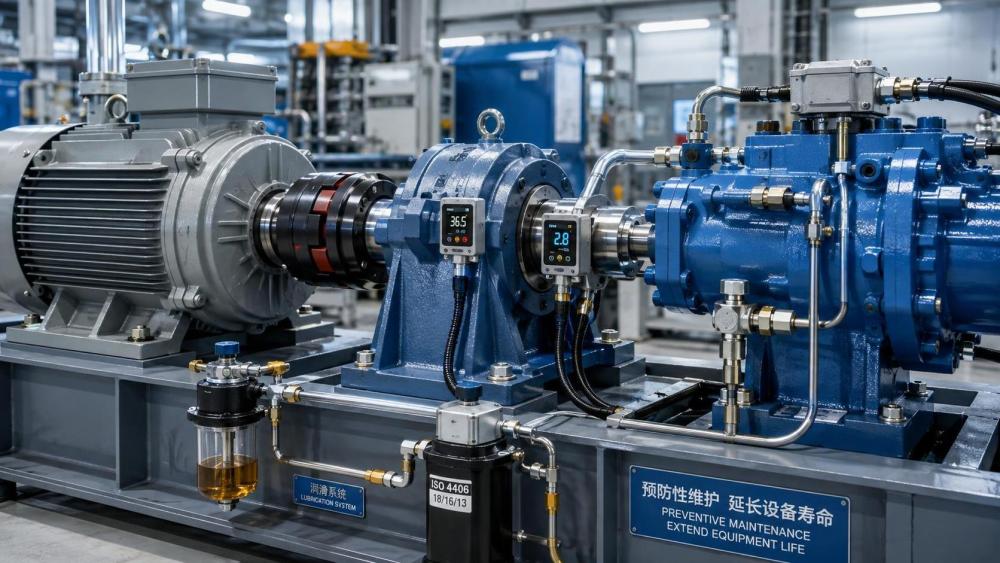
Maintenance focus by component group
Lubrication Is a Control Process, Not a Routine Addition
Lubrication is often described as a basic maintenance activity, but it can be one of the most consequential. Both insufficient lubrication and excess lubrication can create problems. Too little lubricant may allow metal-to-metal contact or an inadequate film under load. Too much grease can raise operating temperature, damage seals, or cause churning losses in certain arrangements. Mixing lubricants without checking compatibility can also create unpredictable consistency or performance changes.
A sound lubrication program identifies the correct lubricant type, the intended replenishment method, the application point, and the environmental risks. Storage matters as much as application. Open containers, poorly labeled transfer tools, and shared grease guns create opportunities for contamination and accidental mixing. In dusty plants, food-processing areas, mining operations, marine environments, or high-temperature processes, the maintenance method must account for conditions that are not visible in a generic lubrication chart.
Fluid analysis can be useful for hydraulic systems, gearboxes, and other circulating-lubricant applications, particularly when equipment is costly to stop or when internal wear cannot be inspected easily. The interpretation should be connected to machine history. A sample result alone is not a verdict; sampling location, procedure, fluid age, filtration performance, and recent maintenance work all affect what the result means.
Alignment, Sealing, and Cleanliness Protect the Whole Machine
Misalignment is frequently underestimated because equipment may continue operating while the problem develops. In belt and chain drives, alignment affects tracking, load distribution, and wear of pulleys, sprockets, and bearings. In coupled rotating equipment, angular or parallel misalignment can contribute to vibration, flexible element wear, shaft loading, and premature bearing damage. Alignment checks should follow any event that can alter machine position: foundation work, motor replacement, bearing housing repair, impact damage, or repeated thermal cycling.
Seals deserve equal attention. They are often inexpensive relative to the machinery they protect, but they control leakage and contamination at critical interfaces. An O-ring or mechanical seal must be selected for the actual medium, temperature, pressure behavior, movement, and installation geometry. A material that performs well in one fluid may be unsuitable in another. High-temperature, aggressive chemical, vacuum, or abrasive applications require especially careful review of elastomer or seal-face compatibility. “Same size” is not a sufficient replacement criterion.
Cleanliness is the connecting discipline. Dirt entering a bearing housing, hydraulic reservoir, pneumatic line, or enclosed transmission can accelerate wear far beyond the original point of entry. Maintenance teams should look beyond the failed component to determine how contamination entered and whether protective measures are still working. Damaged breathers, cracked hose covers, ineffective wipers, poorly fitted guards, and careless assembly practices are recurring weaknesses in many industrial environments.
Use Condition Monitoring to Make Shutdowns More Intelligent
Condition monitoring helps maintenance teams decide what deserves attention before the next planned shutdown. Vibration monitoring is commonly used for rotating equipment because developing imbalance, looseness, bearing-related defects, and some alignment issues can influence vibration patterns. Temperature monitoring can reveal friction, overload, poor cooling, or electrical problems. Pressure and flow trends may be valuable in hydraulic circuits, while air consumption and cycle irregularity can reveal pneumatic leakage or actuator issues.
Smart sensors and edge-based diagnostic tools can make these observations easier to collect, but technology should be matched to the asset. A simple conveyor drive may benefit more from disciplined inspection and correct belt tension than from an elaborate sensor package. Conversely, critical spindles, high-duty pumps, wind turbine bearing systems, or inaccessible machinery may justify more continuous monitoring. The right question is not whether a system is “smart,” but whether the information changes maintenance decisions in time to avoid avoidable damage.
Trend history is usually more useful than isolated readings. A measurement should be compared with the machine’s normal baseline, operating state, load, and ambient condition. Maintenance records that capture this context become valuable over time, especially when personnel change or a recurring problem returns after several months.
Spare Parts Planning Prevents a Small Defect From Becoming a Long Outage
Equipment lifespan extension is closely tied to the availability of the correct replacement part. A delayed repair may force temporary substitutions, repeated operation in a degraded state, or rushed installation under production pressure. None of these conditions supports long-term reliability. Critical spares should be identified according to failure consequence, lead time, interchangeability, storage sensitivity, and the availability of qualified alternatives.
This does not mean stocking every possible component. Excess inventory can create its own problems, particularly for seals, lubricants, electronics, and parts that require controlled storage or periodic review. The goal is a practical spare-parts strategy: retain components that protect critical uptime, verify part numbers and revisions, preserve installation documentation, and avoid purchasing solely by dimensional similarity when materials, tolerances, load ratings, or sealing requirements differ.
For procurement and maintenance functions, total cost of ownership is a more useful lens than the purchase price of a bearing, seal, belt, or pump. The lowest-cost component may not be economical if its material, tolerance, lubrication requirement, or expected operating behavior is poorly matched to the application. The reverse is also true: an unnecessarily specialized component can increase cost without improving reliability. Selection needs operating data, not assumptions.
Make the Maintenance Record Useful at the Next Failure
A maintenance record should help the next technician understand what happened, not merely prove that a task was completed. Useful notes include observed symptoms, operating conditions, measurements taken, replacement part details, lubricant or fluid used, visible wear patterns, corrective actions, and any uncertainty that remains. Photos of damaged components and installation conditions can be particularly valuable when a recurring failure needs supplier or engineering review.
This information also improves communication across the supply chain. Global Precision Components & Transmission Systems (PCTS) brings together knowledge on bearings, fluid power, pneumatic systems, transmission components, sealing technology, condition monitoring, and industrial MRO practices because these subjects are rarely isolated in real equipment failures. A bearing issue may be related to sealing. A hydraulic reliability concern may begin with fluid handling. A repeated belt failure may be an alignment or driven-load issue rather than a belt-quality issue.
The practical value of preventive maintenance is that it creates time to make better decisions. Instead of reacting to a stopped machine, teams can verify dimensions, operating conditions, material compatibility, required tolerances, and installation constraints before ordering or fitting a replacement. That is the foundation of equipment lifespan extension: controlling the causes of wear early enough that the machine remains repairable, stable, and fit for its intended duty.
Related News
- 00
0000-00
How FFKM O-rings reduce seal failure in corrosive media - 00
0000-00
What global equipment manufacturing in the USA means for supply chain risk - 00
0000-00
How FFKM outgassing performance affects vacuum seal selection - 00
0000-00
When should heat resistant metallurgy belts be replaced? - 00
0000-00
When does a fluid power maintenance service reduce unplanned downtime?
Weekly Insights
Stay ahead with our curated technology reports delivered every Monday.