





Your first export shipment is ready to leave only when you can explain what the goods are, which rules apply, who will receive and use them, and why the transaction is permitted. A purchase order, a freight booking, and a completed commercial invoice do not answer all of those questions.
Export compliance readiness means having a documented basis for releasing a specific shipment, with unresolved risks placed on hold. For bearings, hydraulic equipment, transmission parts, seals, and industrial MRO products, the assessment must connect technical specifications with the customer, application, destination, and delivery route. It should also establish who can approve release and who can stop it.
Start with one actual transaction
A general compliance policy can look complete while leaving practical gaps. Assess readiness against the first planned order, using the exact products, parties, and route involved. This reveals whether your team can apply its procedures under real shipping conditions.
Create a transaction file containing:
- The selling entity, shipping location, destination, and planned transit countries.
- Part numbers, product descriptions, quantities, values, and countries of origin.
- Technical specifications and relevant drawings or manufacturer information.
- The buyer, consignee, end user, intermediaries, and available payment-party details.
- The intended application, installation location, and any expected onward transfer.
- The proposed delivery terms, freight provider, and planned shipment date.
Distinguish these roles clearly. A distributor placing the order may not operate the equipment, and a warehouse receiving the goods may only consolidate them for another destination. Those differences affect what you need to know before release.
Include associated software, technical drawings, and remote support in the assessment where relevant. A shipment of monitoring components may also involve software access or technical information that requires a separate review.
Establish which rules apply before classifying the products
The export country is the starting point, but it may not be the only relevant jurisdiction. Product origin, controlled content, technology, reexport rules, and the involvement of particular parties can affect the analysis. Separately, the destination may impose import restrictions or product requirements that affect whether delivery can proceed.
Record the basis for deciding which export-control and sanctions regimes apply. A business shipping locally manufactured components will not necessarily follow the same assessment as a distributor reexporting imported equipment.
Keep export authorization and destination import readiness as distinct checks. A shipment may be permitted to leave the exporting country yet still face entry problems because the importer lacks a required permit or the documents do not support customs clearance. Assign responsibility for both sides of the transaction.
Separate customs classification from export-control classification
A common readiness gap is treating a customs tariff code as proof that a product is cleared for export. Customs classification supports tariff treatment, declarations, and trade statistics. Export-control classification determines whether an item falls within relevant control categories. Completing one does not complete the other.
Industrial component names are often too broad to support an export-control decision. “Bearing,” “hydraulic pump,” or “mechanical seal” describes a product family, but may leave out the specifications, materials, design characteristics, or intended applications needed for classification.
For example, a standard replacement bearing and a bearing designed for a specialized application should not automatically inherit the same conclusion. A hydraulic assembly may also contain electronics or other components that require attention beyond the pump’s basic mechanical function.
Ask engineering or the manufacturer for information tied to the exact model and revision. Supplier classifications can support the assessment, but a generic statement covering an entire catalog is weaker evidence than a product-specific determination with an identifiable basis.
The classification record should show who made the determination, which technical information they used, which applicable control list they considered, and when the assessment was completed. If the available specifications cannot support a conclusion, obtain the missing information before shipment approval.
Assess the customer, end use, and route together
Screen the relevant transaction parties against applicable restricted-party and sanctions lists. Depending on the rules involved, the review may also need to consider ownership or control. Screening only the name printed on the purchase order can miss a separate end user, intermediary, or payment party.
A possible name match needs a documented resolution. Compare available identifiers such as addresses, registration details, and ownership information. Neither a similar name nor a clean automated result should replace judgment about the transaction.
End-use review answers a different question: does the proposed use make sense, and does it introduce restrictions? For industrial components, a useful description connects the item to equipment and an operating activity. “Spare parts” offers little context. “Replacement seals for hydraulic cylinders on a packaging line” provides a clearer basis for assessment.
The depth of inquiry should reflect the risk. A familiar distributor buying ordinary maintenance stock may require less investigation than an unfamiliar intermediary ordering specialized components for an undisclosed facility. Distributor inventory orders still need enough information to assess the customer’s markets, resale activities, and relevant restrictions.
Investigate inconsistencies such as:
- Technical requirements that do not fit the stated application.
- Reluctance to identify the end user when that information is necessary.
- A request to remove meaningful product descriptions from shipping documents.
- Unexplained delivery changes, third-party payments, or unusual routing.
- Order quantities or product combinations that do not fit the buyer’s apparent business.
These indicators do not automatically establish a prohibited transaction. They create questions that must be resolved. A signed end-use statement is useful evidence, but it cannot resolve contradictions in the surrounding facts.
Document the authorization decision
Classification, destination, party screening, and end-use findings should lead to a clear authorization decision. Depending on the applicable regime, a shipment may require a license, qualify for an available exception or general authorization, or proceed without an individual license.
Record why the chosen route applies to this transaction. A product that does not require an individual license for one destination may face different requirements elsewhere. Restrictions connected to the recipient or end use can also affect an otherwise ordinary component.
If relying on an exception or general authorization, document its conditions and how the shipment meets them. If a license is required, obtaining it is only part of readiness: the shipment must also fit its scope and conditions, including the covered goods, parties, quantities, values, validity, and reporting obligations where applicable.
Unresolved authorization questions belong on hold. A booking deadline or an urgent maintenance request does not provide a basis for release.
Test whether the documents tell the same story
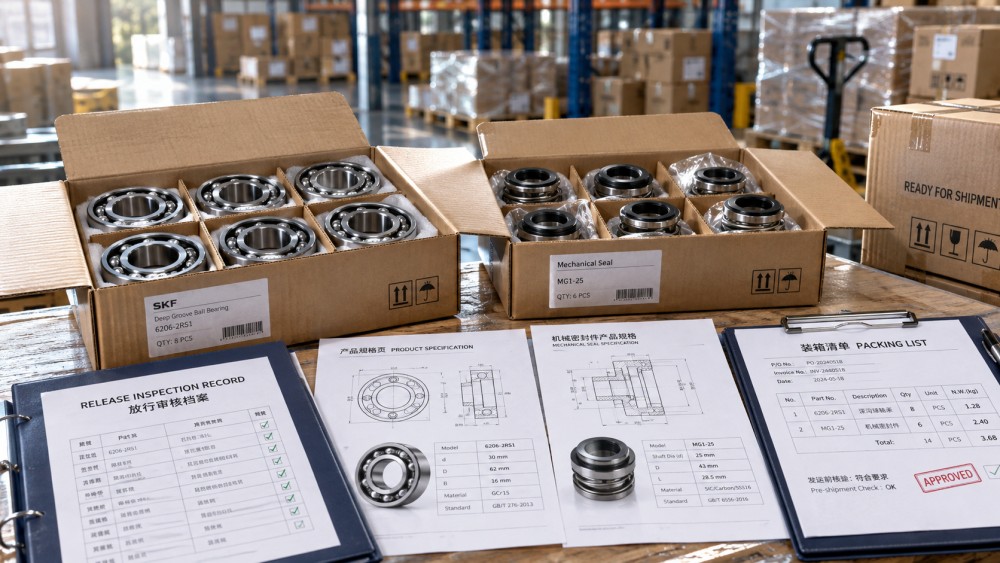
Compare the approved transaction with the sales order, commercial invoice, packing list, transport instructions, and required export declarations. Product identity, quantity, value, parties, and destination should remain consistent across the file.
Descriptions need enough detail to identify the goods. “Machine parts” can conceal differences between bearings, pumps, seals, and electronic monitoring equipment. At the same time, avoid speculative descriptions that introduce unsupported claims about technical capability or application.
Samples, warranty replacements, and goods sent for repair still need assessment. A transaction without a sales payment does not automatically fall outside export controls, and customs valuation still requires an appropriate basis. Origin should also be recorded accurately; purchasing an item domestically does not necessarily make it locally originating.
Agree with the freight forwarder or customs broker on who prepares each filing, who supplies classification information, and who checks the submitted data. Delegating preparation does not by itself resolve the exporter’s responsibilities. Delivery terms allocate commercial obligations, but they do not establish that a transaction is legally permitted.
Use evidence to make the shipment decision
A readiness assessment should distinguish a missing administrative detail from a missing legal basis for export. Avoid reducing the outcome to a percentage score: several completed checks cannot compensate for an unresolved restriction.
Release the shipment only after every applicable requirement has been satisfied. Where a gap can be corrected, state the action needed, its owner, and the evidence required to close it. Where the transaction is prohibited, reject it and record the reason.
This approach also makes escalation more useful. Instead of asking a specialist to “check the shipment,” present the specific unresolved issue, supporting documents, and proposed transaction. Focused questions are easier to resolve than an incomplete file.
Make sure a hold survives operational pressure
Readiness depends on what happens after someone identifies a problem. Assign one person to coordinate the assessment, with defined contributions from engineering, sales, logistics, and finance. Establish who has authority to approve release and who handles matters requiring specialist advice.
The warehouse needs a visible release status before dispatch. A concern recorded in an email thread offers little protection if picking, packing, and collection continue independently. In a small business, a controlled approval register may be sufficient; a larger operation may need an order-management block.
Run a trial using the planned shipment. Ask the team to retrieve its classification basis, screening record, end-use information, authorization decision, and final documents. Then test a change: the consignee changes, the customer requests a substitute model, or the forwarder proposes another route. The process should identify which checks must be reopened.
Retain the records required by the applicable regimes, including approvals, supporting evidence, filings, and relevant correspondence. Preserve the facts used for the decision so the file remains understandable after staff changes or later inquiries.
Define what must trigger another review
Approval should apply to the documented transaction. Changes to product specifications, quantity, recipient, end use, destination, routing, or authorization conditions may alter the conclusion. Screening also needs to remain relevant to the release date because party status and restrictions can change.
Before the first shipment leaves, issue a concise release record linking the order to its supporting evidence and named approval. State any conditions that logistics must follow and the changes that require renewed review.
The practical test is whether someone outside the sales discussion can reconstruct why the shipment was allowed to proceed. When the file supports that decision and the warehouse acts on it, the business has a workable foundation for its next export.
Want to dive deeper into these market dynamics, or need data-driven support for your next business move? Drop a line below and let the analysts at PCTS provide customized insights.
We respect your privacy. Your information is strictly confidential.
Related News
- 00
0000-00
How sealing technology reduces contamination in semiconductor manufacturing - 00
0000-00
Where to install vibration sensors on rotating machinery - 00
0000-00
NTSB Probe Finds Boeing Warned of MD-11 Engine Bearing Risk Years Earlier - 00
0000-00
How to size pneumatic grippers for packaging system integration - 00
0000-00
How to size alloy steel power transmission chains for heavy loads
Weekly Insights
Stay ahead with our curated technology reports delivered every Monday.