





Yes—condition monitoring solutions for motors can detect bearing faults, often before damage produces obvious noise, overheating, or loss of performance. The most useful systems identify changes in bearing-related signals, track their development, and provide enough diagnostic evidence to guide inspection or repair. Their effectiveness depends on the measurement method, sensor installation, operating conditions, and how the data is interpreted.
A system that reports rising vibration is not necessarily diagnosing a bearing defect. Reliable detection requires distinguishing bearing damage from imbalance, misalignment, looseness, and vibration transmitted from connected equipment. It also requires separating normal changes in speed or load from developing deterioration.
What bearing faults can motor monitoring detect?
Most motor bearing diagnostics focus on rolling-element bearings. As a damaged surface passes through the loaded contact zone, it can generate repeated impacts. These impacts travel through the bearing housing and motor structure, where a suitable sensor can measure their effects.
Different defects produce different patterns, although those patterns can overlap as damage progresses:
- Outer-race damage: A localized defect can generate repeated impacts as rolling elements pass over it. Visibility depends partly on whether the defect lies within the loaded zone.
- Inner-race damage: A defect rotates through the load zone, often creating changes in impact strength that help distinguish it from an outer-race defect.
- Rolling-element damage: Damage to balls or rollers can produce more complex patterns because contact conditions and rolling-element motion affect the signal.
- Cage deterioration: Abnormal cage motion can create characteristic components, but diagnosis often needs supporting evidence because low-frequency mechanical disturbances can look similar.
- Lubrication distress: Inadequate lubrication, contamination, or lubricant degradation may increase friction-related vibration and acoustic activity before a clear localized defect pattern appears.
Detecting abnormal bearing behavior does not always establish its cause. Electrical erosion, contamination, incorrect mounting, excessive belt tension, and poor lubrication can all lead to surface damage. Monitoring can reveal deterioration while the maintenance investigation determines why it developed.
Motors with sleeve or journal bearings require a different diagnostic approach. Shaft vibration, bearing temperature, lubrication conditions, and shaft position may be more relevant than the rolling-element defect patterns discussed here.
Why vibration analysis and enveloping work together
Overall vibration measurements provide a useful view of machine condition. They can reveal changes associated with imbalance, misalignment, looseness, and advanced bearing damage. However, a small bearing defect may generate impacts that contribute little to the overall vibration level. A motor can therefore remain within an acceptable overall vibration range while localized bearing damage develops.
Conventional frequency analysis separates vibration into its frequency components. This helps identify rotational effects and other repeating events. For early bearing damage, however, the useful information may be hidden within higher-frequency structural resonances excited by small impacts.
Envelope analysis helps extract that information. It selects a suitable frequency band and examines the repeating changes in signal amplitude. This can make bearing-related impact repetition easier to recognize than it is in an ordinary vibration spectrum.
The interpretation depends on bearing geometry and shaft speed. Calculated defect frequencies describe the expected repetition rates associated with the inner race, outer race, rolling elements, and cage. Actual peaks can shift because rolling elements slip and operating conditions vary. Harmonics, sidebands, and trends provide additional evidence; a single peak near a calculated frequency is insufficient for a confident diagnosis.
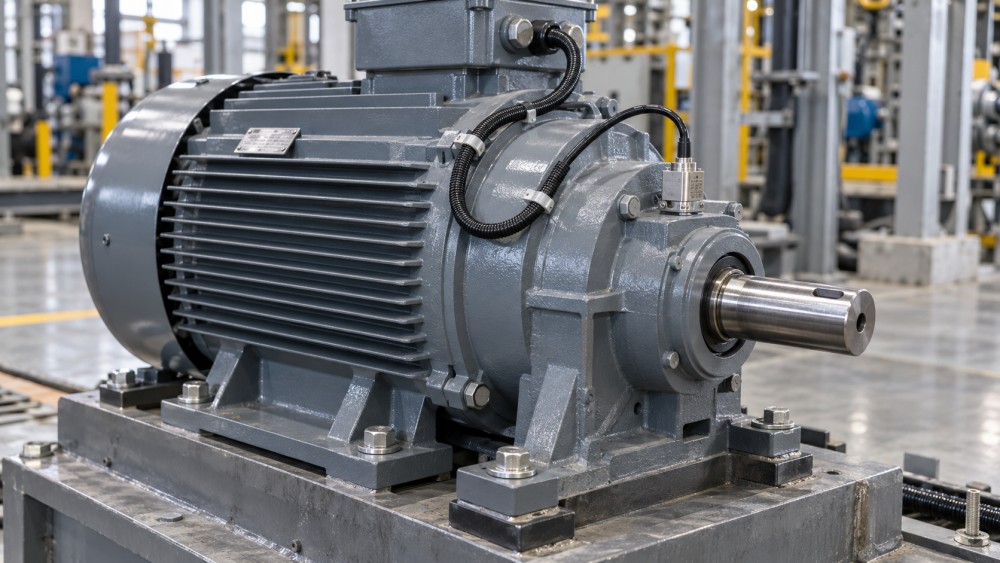
A useful diagnostic display connects the time waveform, conventional spectrum, and envelope spectrum with the operating speed recorded during measurement. Together, these views help explain whether an alarm reflects repeated impacts, general mechanical vibration, or a transient disturbance.
What other monitoring methods contribute
Vibration is often the primary method for rolling-element bearing diagnosis, but complementary measurements can resolve uncertainty. Their value depends on the failure mechanism and the conditions under which the motor operates.
Temperature alone is usually insufficient when the objective is early localized bearing-fault detection. It becomes more useful when interpreted alongside vibration, speed, and load. Similarly, an increase in ultrasound can justify a lubrication investigation, but it should not automatically trigger additional grease: overgreasing can also increase friction and temperature.
Current-based monitoring deserves application-specific assessment. A bearing defect must influence the electromechanical system strongly enough to become distinguishable in the measured current. Performance demonstrated for a stable operating condition may not transfer directly to a lightly loaded, variable-speed motor.
Operating conditions can determine whether a fault is visible
Sensor position and mounting
A sensor needs a good mechanical path to the bearing. A rigid mounting position on the bearing housing generally provides more useful high-frequency information than a flexible cover, cooling fin, or distant structural surface. Interfaces along the transmission path can attenuate or alter the signal.
Mounting method also affects usable frequency response. Stud mounting, suitable adhesive mounting, and magnetic mounting have different practical limits. A sensor specification cannot compensate for a poor installation. For repeatable measurements, the location, orientation, mounting condition, and acquisition settings should remain consistent.
Monitoring both the drive-end and non-drive-end bearings can help establish where a signal originates. One sensor may detect activity from both ends, but that does not guarantee equal sensitivity or reliable localization.
Speed, load, and measurement timing
Variable-speed operation changes bearing defect frequencies. Comparing spectra without accounting for speed can make a normal shift appear abnormal or cause a real defect pattern to be missed. Speed-referenced analysis, including order tracking where appropriate, helps compare behavior across operating states.
Load affects contact forces and the strength of defect-related impacts. Measurements taken during unloaded running may not represent bearing behavior during production. Baselines should therefore reflect the operating states that matter, rather than combine every condition into one reference.
Slow-speed motors present another challenge: impacts occur less frequently, and their energy may be low. A short recording may contain too few events for reliable interpretation. Longer acquisition windows and methods suited to slow-speed bearings can be necessary.
Measurement frequency matters as much as analytical capability. Periodic wireless measurements may be suitable for a steadily operating motor with gradually developing damage. Intermittent duty or short production cycles may require measurements triggered during operation. Continuously acquired data provides closer observation, but does not guarantee useful diagnosis unless the signal quality and analysis are adequate.
Distinguishing bearing damage from other motor problems
A bearing alarm should be supported by a pattern of evidence. Imbalance commonly produces a strong rotational component; misalignment and looseness can introduce additional harmonics or directional changes. These conditions can also increase bearing loads, so a motor may have both a mechanical installation problem and bearing damage.
Connected equipment complicates diagnosis. Gear impacts, pump cavitation, belt disturbances, and process shocks can travel into the motor housing. A monitoring system that treats every impulsive signal as a bearing fault can generate unnecessary maintenance work.
A stronger diagnosis combines several observations: the signal repeats near an expected bearing frequency, related harmonics or modulation are present, the pattern persists across comparable measurements, and its spatial distribution supports the suspected bearing location. Changes after a controlled maintenance intervention can provide further evidence.
Electrical damage requires additional investigation. Vibration may reveal the resulting bearing surface deterioration, but identifying the electrical mechanism can require shaft-voltage or bearing-current measurements and examination of the drive, grounding, and insulation arrangement. Replacing the bearing without addressing the cause can allow the damage to recur.
How to evaluate a motor condition monitoring solution
Begin with the maintenance decision the system must support. Detecting general deterioration, identifying a likely bearing defect, and estimating the urgency of intervention are different capabilities. A single machine-health score does not demonstrate all three.
During technical evaluation, ask the supplier to show the evidence behind an alarm and explain the conditions required for detection. The following checks help establish whether a solution fits the intended application:
- Match the measurement chain to the fault. Review sensor bandwidth, mounting requirements, sampling settings, filtering, and recording duration. A high sampling rate alone does not establish diagnostic capability.
- Check operating-state awareness. Establish how the system handles speed changes, load variation, starts, stops, and measurements taken while the motor is idle.
- Inspect diagnostic access. Determine whether users can review waveforms, spectra, trends, speed information, and the reasons behind a fault classification.
- Assess data quality controls. The system should distinguish a healthy reading from missing data, poor sensor attachment, or a measurement captured under unsuitable conditions.
- Define the maintenance response. Alerts should lead to a practical action, such as confirmatory analysis, lubrication inspection, alignment checks, or planned bearing replacement.
A representative pilot should include the motor types, speed ranges, mounting constraints, and background vibration found in service. Assess repeatability and nuisance alarms as well as detection. A demonstration on a bearing with deliberately introduced damage can establish that a method responds to that damage; it does not by itself establish performance across all field conditions.
Use standards and trends without overinterpreting them
General machine-vibration severity criteria and bearing diagnostics serve different purposes. Overall vibration limits can support an assessment of machine vibration under defined measurement conditions. They do not, by themselves, establish that a bearing is free of localized damage.
When a supplier claims standards compliance, ask what the cited document covers: measurement procedure, sensor performance, machine-vibration evaluation, diagnostic practice, or personnel competence. Compliance with one category should not be treated as proof of every diagnostic claim.
Alarm thresholds also need context. A baseline recorded on a newly installed motor can contain problems caused by mounting, lubrication, or alignment. Confirming the initial mechanical condition makes subsequent comparisons more meaningful. Trends should compare similar operating states and retain enough history to distinguish persistent deterioration from isolated events.
Even a well-supported diagnosis rarely provides an exact remaining bearing life. Progression depends on loading, lubrication, contamination, and how the damage develops. Maintenance timing should combine the diagnostic trend with equipment criticality, inspection findings, replacement access, and available shutdown opportunities.
The most useful next step is to define the bearing arrangement, operating envelope, and required maintenance response for each motor group. Then select a monitoring method that can produce interpretable evidence under those conditions. A dependable solution makes it possible to understand why an alert occurred and what inspection or intervention should follow.
Want to dive deeper into these market dynamics, or need data-driven support for your next business move? Drop a line below and let the analysts at PCTS provide customized insights.
We respect your privacy. Your information is strictly confidential.
Related News
- 00
0000-00
How sealing technology reduces contamination in semiconductor manufacturing - 00
0000-00
Where to install vibration sensors on rotating machinery - 00
0000-00
NTSB Probe Finds Boeing Warned of MD-11 Engine Bearing Risk Years Earlier - 00
0000-00
How to size pneumatic grippers for packaging system integration - 00
0000-00
How to size alloy steel power transmission chains for heavy loads
Weekly Insights
Stay ahead with our curated technology reports delivered every Monday.