





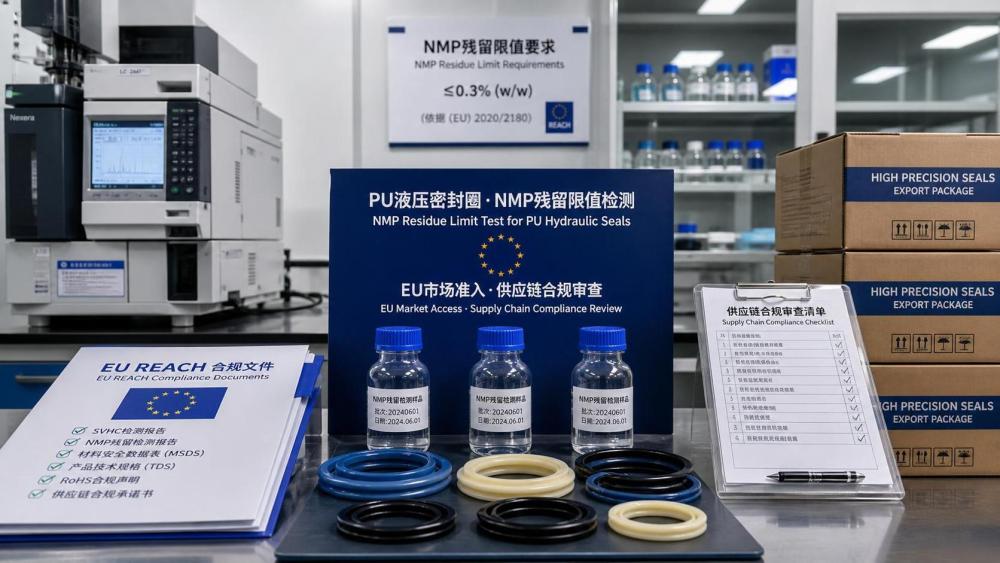
On August 9, 2026, the EU published a REACH amendment that adds a new restriction under Annex XVII for PU hydraulic seals, setting a maximum residual N-methyl-2-pyrrolidone (NMP) content of 0.1% (w/w) from February 1, 2027. For exporters, manufacturers, buyers, testing providers, and compliance teams involved in supplying PU hydraulic seals to the EU, this is a practical market-access change rather than a routine regulatory update, because it directly affects formulation review, testing arrangements, documentation updates, and shipment readiness.
What the new REACH entry confirms
The confirmed facts are limited but commercially significant. The Official Journal of the European Union published Regulation (EU) 2026/1352 on August 9, 2026, amending REACH. Under the new rule, residual NMP used during the manufacture of polyurethane (PU) hydraulic seals must not exceed 0.1% (w/w) from February 1, 2027. The limit applies to all PU hydraulic seals imported into the EU regardless of country of origin. The supplied event summary also indicates that the change will directly affect formulation adjustments by Chinese exporters, third-party testing requirements, and updates to CE declarations of conformity. Products that do not meet the requirement may be denied customs clearance or face market recall.
Where the pressure will appear first in the supply chain
Manufacturing and formulation review move to the front
Manufacturers of PU hydraulic seals are likely to feel the impact first because the new restriction is tied to residual NMP from the manufacturing process. In practice, the immediate pressure falls on formulation review, process verification, and whether current materials and production conditions can support the 0.1% threshold. From an industry perspective, what deserves closer attention is that compliance risk no longer sits only at the finished-goods shipment stage; it begins earlier in production control and technical file preparation.
Export transactions face a higher documentation burden
Exporters supplying the EU market may be affected through customs clearance risk, contract performance risk, and document readiness. The event summary already points to third-party testing and CE declaration updates, which means exporters should pay close attention to whether current product files, declarations, and test evidence remain aligned with the amended restriction before shipments are scheduled. Observably, the commercial issue is not only whether a seal can be produced, but whether it can be delivered into the EU market without compliance disputes.
Procurement and sourcing teams may need tighter supplier checks
Buyers and sourcing teams dealing with PU hydraulic seals may need to revisit supplier qualification and incoming compliance evidence. Analysis shows that once a substance limit is written into a market-entry rule, procurement decisions can no longer rely only on product specification and price; they also depend on whether upstream suppliers can support the required documentation, testing, and traceability linked to NMP content. This is especially relevant where delivery commitments depend on uninterrupted EU access.
Testing and certification-related services become more operationally relevant
Testing service providers and compliance support teams may see a more direct role because the event summary explicitly mentions third-party testing requirements and updates to CE declarations of conformity. It is more appropriate to understand this as a change that increases the operational importance of verification and document alignment, particularly for businesses that export into regulated markets and need evidence that can withstand import checks or post-market scrutiny.
What companies should review before the effective date
Check whether existing product files still match the new threshold
Companies supplying PU hydraulic seals to the EU should review whether current technical files, internal compliance statements, and supporting records are still adequate once the 0.1% NMP limit becomes mandatory on February 1, 2027. Analysis shows that businesses should not assume older documentation remains sufficient if it was prepared before the new Annex XVII restriction was issued.
Prepare for testing evidence to become a transaction issue
The supplied facts already identify third-party testing as a direct area of impact. What deserves closer attention is whether testing arrangements are built into delivery planning early enough, since evidence generation may affect shipment timing, customer acceptance, and internal release decisions. Where contract performance depends on EU importability, testing can become part of the trade workflow rather than a separate compliance exercise.
Review CE declarations and related product statements carefully
Because the event summary specifically refers to CE declaration updates, companies should examine whether current declarations and associated product statements need revision to stay consistent with the amended REACH requirement. This should be treated as a documentation control issue as much as a regulatory issue, especially for businesses managing multiple product variants or multiple EU customers.
Watch for changes in tender, customer, and after-sales requirements
Observably, the rule may also influence how compliance is checked in procurement documents, customer qualification requests, and post-delivery quality handling. The input does not provide detailed enforcement practice, so this cannot be stated as an established outcome. Still, companies should monitor whether customers begin asking for updated test reports, revised declarations, or stronger traceability support before or after the effective date.
How this change should be read at this stage
Analysis shows that this is better understood as a landed compliance change with a defined future enforcement date, rather than a tentative policy signal. The core rule has already been published, the threshold is specific, and the scope covers all PU hydraulic seals imported into the EU regardless of origin. At the same time, observably, the market still needs to watch how the requirement is reflected in customer documentation, certification practice, shipment review, and post-market scrutiny. That makes the current phase one of preparation and alignment rather than speculation.
Why the development matters now
For the sector, the significance of this update lies in how a substance restriction moves directly into product access, trade execution, and document control for a defined product category. It is more appropriate to understand this as an implemented rule change that already gives companies a clear compliance direction, while some execution details still need continued market observation. Businesses exposed to EU-bound PU hydraulic seals should read it as a practical trigger for formulation review, testing preparation, and document updates ahead of the February 2027 deadline.
Basis of this article and what still needs verification
This article is based on the user-provided news title, event date, and event summary. For developments of this type, relevant source categories typically include official notices, regulatory publications, customs or trade authority information, industry association updates, standards-related documents, and reporting by authoritative media. A specific official source link was not provided in the input, so the exact official link still needs to be verified. Follow-up attention should remain on implementing details, certification interpretation, changes in tender or customer document requirements, industry feedback, and how companies execute compliance in practice.
Want to dive deeper into these market dynamics, or need data-driven support for your next business move? Drop a line below and let the analysts at PCTS provide customized insights.
We respect your privacy. Your information is strictly confidential.
Related News
- 00
0000-00
Where to install vibration sensors on rotating machinery - 00
0000-00
NTSB Probe Finds Boeing Warned of MD-11 Engine Bearing Risk Years Earlier - 00
0000-00
How to size pneumatic grippers for packaging system integration - 00
0000-00
How to size alloy steel power transmission chains for heavy loads - 00
0000-00
Where are axial piston pumps used in mining equipment?
Weekly Insights
Stay ahead with our curated technology reports delivered every Monday.