





Unexpected failures in open pit mining machinery components rarely come from a single bad part. More often, downtime builds quietly: dust gets past a damaged seal, grease is applied on schedule but not in the right amount, a coupling runs slightly out of alignment after a liner change, or a hydraulic hose survives one extra shift too many. By the time a shovel, haul truck, drill, or conveyor stops, the failure has usually been developing for days or weeks.
For maintenance teams, the practical question is not how to eliminate every failure. In open pit mining, that is unrealistic. The better goal is to reduce unplanned stoppages by catching component problems early, choosing replacement parts with the right duty margin, and organizing maintenance around actual failure patterns rather than generic intervals.
Start with the failure chain, not the broken part
When an idler bearing overheats or a hydraulic motor fails, the temptation is to replace the component and move on. That restores production, but it does not reduce future downtime. In open pit operations, failures usually involve a chain of conditions: contamination, misalignment, overloading, shock, poor lubrication, sealing degradation, or delayed inspection.
A simple workshop rule helps here: ask what changed before the component failed. Was the machine working on a steeper haul profile? Did washdown frequency increase? Was a new supplier introduced for seals, belts, or bearings? Did the machine sit idle long enough for corrosion or lubricant separation to become a factor? These questions matter because many open pit mining machinery components fail under changing operating conditions, not just because they reached nominal service life.
This is also where a component-focused intelligence approach becomes useful. Platforms such as PCTS are valuable less for product promotion and more for connecting failure symptoms across bearings, hydraulic systems, chains, belts, couplings, and seals. In the field, those systems do not fail separately. They interact.
The worst downtime often starts with contamination control
Open pit mines are unforgiving environments for rotating and sealing parts. Fine dust, abrasive slurry, rainwater, temperature swings, and impact loading all work against component life. If a site is still treating contamination as a housekeeping issue instead of a reliability issue, unplanned stoppages will keep returning.
Bearings and hydraulic components are especially vulnerable. A bearing may tolerate load better than expected, but once abrasive particles enter the raceway and lubrication film is disrupted, wear accelerates quickly. Hydraulic pumps and valves are similar: a small amount of contamination can create scoring, leakage, unstable pressure, and poor actuator response long before complete failure appears.
That is why sealing should be reviewed as a system, not as an afterthought. In practice, many recurring failures trace back to damaged exclusion seals, hardened O-rings, poor material compatibility, or simply the wrong sealing design for the dust and temperature profile. A seal that works well on general industrial equipment may not hold up around mine haul roads, wash points, or high-vibration assemblies. Material choice, lip design, shaft condition, and installation quality all matter.
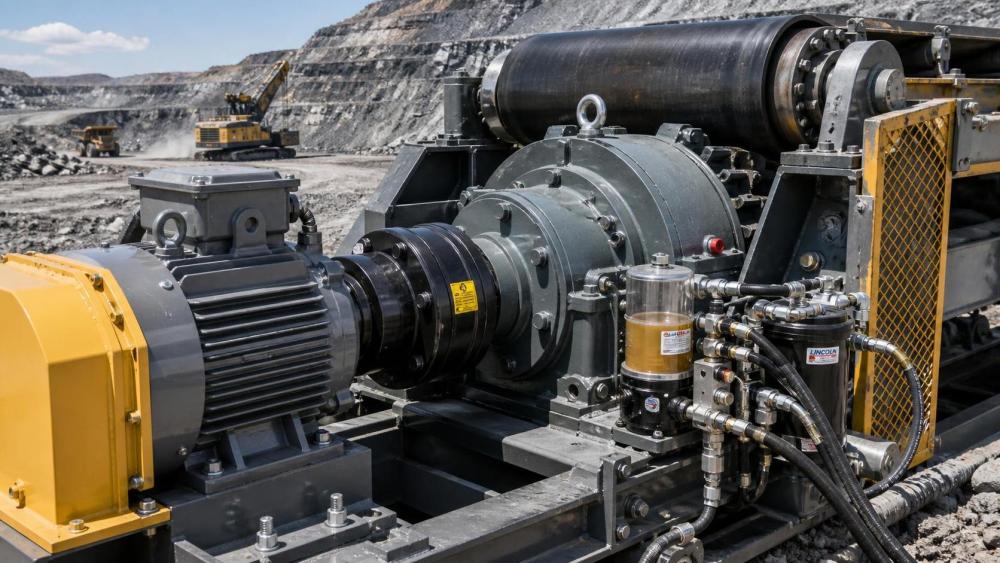
One useful habit is to inspect failed components together with adjacent seals, housings, shafts, and lubricant condition. If maintenance only logs “bearing replaced” or “cylinder rebuilt,” the real pattern stays hidden. If records show repeated contamination ingress at the same location, the root cause may be a housing tolerance issue, an installation method problem, or a seal material mismatch.
Lubrication problems are usually operational, not theoretical
Everyone knows lubrication matters. The problem is that many lubrication programs are still calendar-based and too generic for mixed fleets. A shovel swing bearing, a conveyor pulley bearing, and a mobile crusher drive do not see the same load, contamination level, or temperature cycle. Using the same grease interval logic across all three is where trouble starts.
Under-lubrication gets attention because it causes obvious damage. Over-lubrication is quieter but can be just as expensive. Excess grease raises temperature, stresses seals, and can push contamination deeper into the assembly. In harsh mining conditions, the right question is not only “Was it lubricated?” but also “Was the lubricant suitable for the speed, load, and ingress risk?”
Maintenance teams usually make better progress when they classify assets by duty severity and consequence of failure. Critical rotating points, especially those exposed to dust and shock, deserve tighter inspection and condition-based adjustment. Less critical points can stay on routine schedules. This is basic reliability practice, but it is often skipped when teams are short on time.
It also helps to connect lubrication decisions with component sourcing. Not every bearing or seal variant responds the same way to contamination or grease purge conditions. PCTS often frames these decisions around tribology and lifecycle cost rather than unit price alone, which is the right lens for mining MRO. Cheap parts can become very expensive once unscheduled stoppage, labor, and equipment access are considered.
Watch the power transmission line before it fails under load
Belts, chains, sprockets, couplings, and gear-driven connections rarely fail without warning, but the warning signs are easy to normalize. Slight belt slip, chain elongation, abnormal coupling wear, or repeated tension adjustment often get treated as routine nuisances. In reality, they are indicators that force transmission is no longer stable.
This matters because unstable power transmission creates secondary damage. Misalignment loads bearings unevenly. Chain wear changes engagement behavior and can increase shock. A worn coupling may transfer vibration into adjacent shafts and seals. When a maintenance team replaces only the visibly worn component, downtime comes back through another part of the same drive train.
A more reliable approach is to inspect transmission parts as matched sets where practical. If sprocket wear is advanced, a new chain alone may not last. If pulley grooves are worn, replacing only the belt may not solve slip or heat build-up. These are not complicated decisions, but they require discipline, especially when production pressure encourages the quickest possible return to service.
Hydraulic downtime is often about drift, heat, and small leaks
In open pit machinery, catastrophic hydraulic failure gets the most attention, but small performance losses usually appear first: slower cylinder movement, pressure instability, more heat, visible seepage around rod seals, or repeated hose issues at the same articulation point. Teams that respond at this stage usually avoid longer shutdowns later.
A leaking rod seal is not always just a seal problem. It may point to rod surface damage, side loading, contamination in the fluid, or thermal cycling beyond what the sealing material handles well. Similarly, repeated pump problems may involve suction conditions, fluid cleanliness, or system pressure spikes rather than pump quality alone.
This is where cross-functional troubleshooting pays off. Hydraulic specialists, fitters, and planners should review not just failed parts but operating patterns. Was the machine spending more time at peak load? Were hoses rerouted during previous repairs? Was filtration maintained to the actual duty level? Mining equipment operates in a way that punishes small installation shortcuts.
Spare parts planning should be tied to failure consequence
A common reason downtime stretches longer than necessary is not diagnosis but parts availability. Open pit sites often stock too many low-risk items and not enough critical components with long lead times. The result is familiar: the crew identifies the failed bearing assembly, seal kit, hydraulic motor, or coupling element quickly, but the machine still waits.
Better spare planning starts with three filters: criticality, wear predictability, and supply risk. Some parts fail gradually and can be monitored. Others fail abruptly and stop production immediately. Some are easy to source locally; others may depend on OEM channels or specialized industrial suppliers. Those differences should shape stocking policy.
For teams comparing suppliers, technical transparency matters more than polished brochures. Dimensions, material options, sealing design, compatibility notes, and expected service conditions should be easy to verify. One of the useful roles of an industry portal like PCTS is helping buyers and maintenance planners compare component categories and supplier positioning without reducing every decision to purchase price.
Condition monitoring does not need to be elaborate to be useful
Some sites delay monitoring improvements because they assume it requires a full digital overhaul. It often does not. Temperature trends, vibration checks, lubricant condition review, pressure behavior, leakage logging, and visual wear mapping can already change shutdown quality. The point is not to generate more data. The point is to make maintenance action earlier and more targeted.
For critical assets, adding smart condition monitoring components may be justified, especially where access is difficult or failure consequence is high. But even then, sensors only help if alarms are tied to clear response thresholds. A mine does not need more unread dashboards. It needs fewer surprise stoppages and better maintenance timing.
What usually reduces downtime fastest
If a site is trying to improve reliability without launching a major transformation, the fastest gains usually come from a short list of disciplined changes:
- Review repeat failures by location, not just by part number.
- Upgrade contamination control where dust and washdown repeatedly shorten life.
- Separate lubrication tasks by duty severity instead of one schedule for all assets.
- Inspect transmission components as systems, especially chains, sprockets, belts, and couplings.
- Stock critical long-lead components based on downtime consequence, not habit.
- Record early warning symptoms such as heat, noise, leakage, slip, and drift before shutdowns occur.
None of this is glamorous, and that is exactly the point. Reducing downtime caused by open pit mining machinery components failures is usually less about breakthrough technology and more about consistency in the basics: sealing, lubrication, alignment, cleanliness, inspection discipline, and parts planning.
When those basics are linked with better component knowledge across bearings, hydraulics, power transmission, and seals, maintenance decisions get sharper. That is where specialized industrial intelligence becomes useful. Not because it replaces field judgment, but because it helps teams ask better questions before the next machine stops in the pit.
Want to dive deeper into these market dynamics, or need data-driven support for your next business move? Drop a line below and let the analysts at PCTS provide customized insights.
We respect your privacy. Your information is strictly confidential.
Related News
- 00
0000-00
IndexBox Forecasts 3.8% Annual Growth for Global Radial Seals Market Through 2035 - 00
0000-00
How to assess the chemical compatibility of FFKM sealing sheets - 00
0000-00
IndexBox Forecasts 3.6% Annual Growth for Construction Bearings Market - 00
0000-00
When do hydraulic components require an export license? - 00
0000-00
How to size modular pneumatic valve systems for adequate airflow
Weekly Insights
Stay ahead with our curated technology reports delivered every Monday.