





Selecting a mechanical seal solutions supplier requires more than reviewing a catalog, comparing unit prices, or checking whether a seal appears interchangeable with an existing part. In pumps, mixers, compressors, agitators, and process equipment, a seal sits at the boundary between normal operation and an unplanned release of fluid, vapor, pressure, or contamination. When it fails, the visible leak is often only the final symptom. The underlying issue may be incorrect face material, poor spring consistency, an uncontrolled elastomer batch, damaged lapped faces, an inaccurate assembly drawing, or a supplier that cannot trace what was actually shipped.
For procurement, quality, and safety functions, the practical question is not simply “Can this supplier make mechanical seals?” It is whether the supplier can make the same correct seal repeatedly, document what matters, identify problems before shipment, and respond competently when field conditions expose a weakness. A lower purchase price can be attractive, but it rarely offsets the cost of a shutdown, cleanup, lost product, emergency labor, or a repeat maintenance intervention.
Start with the operating duty, not the supplier’s brochure
Quality control cannot be assessed in a vacuum because acceptable control depends on service severity. A seal used on a water circulation pump does not face the same risks as one installed on a hot hydrocarbon pump, a corrosive chemical process line, a slurry application, or a hygienic mixer. Before requesting quotations or conducting an audit, define the duty in enough detail for a supplier to make engineering decisions rather than assumptions.
At a minimum, the technical inquiry should identify the sealed fluid, normal and upset temperatures, pressure, shaft speed, shaft diameter, equipment type, solids content, vaporization tendency, available flush or barrier system, and the consequences of leakage. If the process fluid changes during cleaning, batch transitions, or seasonal operation, include that too. A seal may survive normal operation yet degrade rapidly during a cleaning cycle or dry-running event.
A capable mechanical seal solutions supplier should ask follow-up questions. That is usually a positive sign, not a delay tactic. Be cautious when a supplier offers an immediate “equivalent” based only on a photograph, a competitor’s part number, or nominal dimensions. Dimensional interchangeability does not prove equivalent face loading, secondary sealing compatibility, drive arrangement, metallurgy, or thermal behavior.
Traceability is where quality control becomes visible
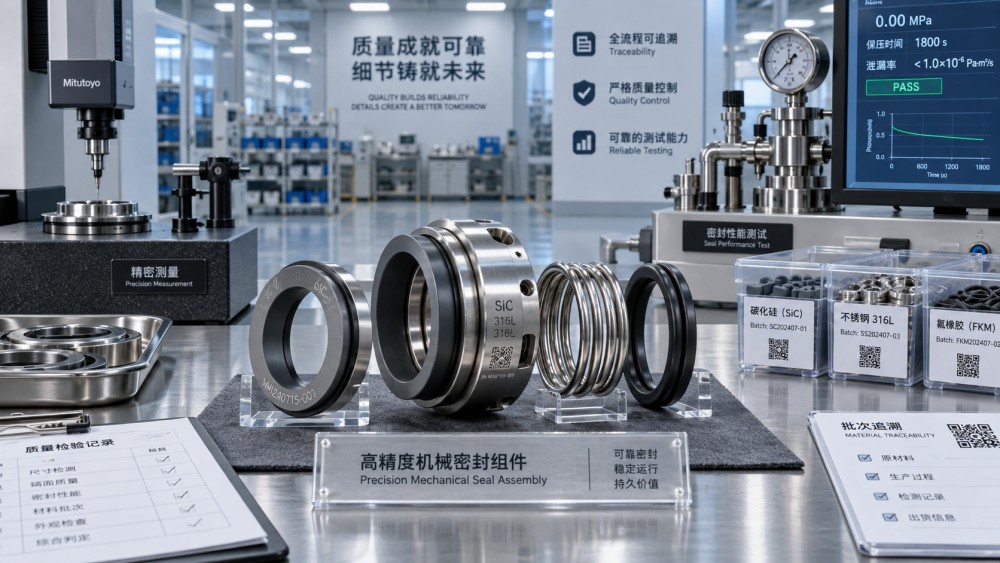
Mechanical seals are assemblies of materials with very different failure modes. Silicon carbide, carbon, tungsten carbide, stainless steel, specialty alloys, PTFE-based parts, springs, and elastomer O-rings each require different controls. Asking for “material certificates” is reasonable, but the more useful question is how the supplier connects a certificate to the components in the delivered seal.
A meaningful traceability system should allow the supplier to identify the incoming material lot, the manufacturing or assembly batch, the inspection record, and the shipment record. The depth of traceability should match the application risk. For a routine MRO replacement, batch-level records may be sufficient. For critical, hazardous, regulated, or high-value equipment, buyers may require tighter controls, retained records, and documented approval of any material or design substitution.
Pay particular attention to elastomers. A seal may look correct while an O-ring compound differs in cure system, formulation, hardness range, or chemical suitability. Labels such as FKM, EPDM, HNBR, or FFKM describe material families, not automatically identical performance. Where chemical compatibility is central to the decision, request the compound identification used for the quoted configuration and ask how substitutions are prevented during purchasing and assembly.
The same discipline applies to seal faces. “Silicon carbide” alone does not answer whether a face is suitable for the fluid, pressure, abrasion level, thermal cycling, or mating-face combination. The supplier does not need to disclose proprietary manufacturing details, but it should be able to explain the specified material pairing and the reason it was selected for the duty.
Look beyond final inspection to process control
A final visual check is necessary, but it cannot reliably compensate for weak manufacturing discipline upstream. Seal faces are especially sensitive. Their flatness, surface condition, edge integrity, cleanliness, and handling can influence leakage and heat generation. Springs must provide controlled loading; metal components must be machined and formed consistently; assembled units must avoid damage to fragile faces and secondary seals.
During a supplier review, ask where critical characteristics are checked: at incoming inspection, after machining, after lapping, during assembly, or only before packing. The answer often reveals how mature the quality system is. A supplier that identifies critical dimensions and material attributes early can isolate a nonconforming batch before it becomes a finished-goods problem. One that relies only on end-of-line checks may discover issues after significant value has already been added.
It is also worth asking how work instructions reach the production floor. Are assembly steps controlled by current drawings and revision numbers? Are operators prevented from mixing visually similar components? Are gauges identified and periodically checked? These are plain operational questions, but they matter more than polished presentation slides. A seal assembly often includes parts that are nearly identical in appearance yet not interchangeable in service.
Questions that expose the real level of control
- Which features are classified internally as critical to sealing performance, and how are they verified?
- How are incoming face materials, springs, metals, and elastomers identified after receipt?
- What prevents an obsolete drawing revision or unapproved substitute component from reaching assembly?
- Which inspection records are supplied with the shipment, and which are retained by the manufacturer?
- How are damaged lapped faces, chips, scratches, or contamination detected and segregated?
- What happens when a customer reports early leakage: containment, failure analysis, corrective action, and feedback to production?
A supplier does not need to promise that every seal will never leak. No credible engineering organization would make that claim without defining service conditions. What matters is whether it can explain the controls behind its product and investigate deviations with evidence rather than speculation.
Test capability should match the seal and the application
Buyers often ask, “Do you pressure-test every seal?” That question is useful, but incomplete. Test methods vary by seal design and service. A component-level test, an assembly leak check, a hydrostatic pressure test, a functional test rig, and an application-level qualification test do not demonstrate the same thing. It is important to establish what the supplier tests routinely, what it can test on request, and what evidence the test produces.
For engineered seals, a supplier should be able to define the test medium, test pressure, duration, acceptance criteria, and any limitations of the method. If a seal is intended for a system designed around API 682 or another industry-specific requirement, clarify which edition, seal arrangement, auxiliary system expectations, and documentation requirements apply. Referencing a standard in a quotation is not enough; the offered configuration must be checked against the project specification.
Be wary of treating a factory pressure test as proof of field reliability. A static test may detect gross leakage or assembly errors, but it does not necessarily replicate shaft movement, vibration, cavitation, thermal distortion, dry running, solids, or poor installation. Test evidence should be viewed as one layer of assurance alongside design review, controlled manufacture, installation guidance, and realistic maintenance planning.
Documentation quality is an operational control, not paperwork
A sound seal can still be installed incorrectly if documentation is vague or incomplete. Installation length, setting clips, shaft and sleeve condition, gland alignment, flush connections, direction of rotation, and start-up precautions all influence performance. Suppliers should provide documentation appropriate to the supplied seal type, especially for cartridge designs, double seals, and systems requiring barrier or buffer fluid support.
Review a sample document package before awarding a substantial order. Useful material may include a controlled drawing, bill of materials or configuration summary where appropriate, installation instructions, inspection or test records agreed in the purchase order, and recommended spare components. Check whether part numbers and revisions match across the quotation, drawing, packing label, and certificates. Minor inconsistencies are not always evidence of a bad product, but they are worth resolving before the supplier becomes a critical source.
If a supplier claims a quality management certification, verify the certificate’s current status, scope, legal entity, and manufacturing location. Certification can indicate a structured management system, but it should not replace product-specific assessment. In practice, the strength of change control, traceability, inspection discipline, and technical communication tells buyers far more about the risk attached to a particular seal program.
Audit the corrective-action process before a failure occurs
Every supplier eventually faces a complaint, a dimensional deviation, a shipping error, or an unexpected service failure. The distinction is how it responds. A reliable supplier should be able to isolate affected lots, review production and inspection records, request relevant operating evidence, identify probable causes without overreaching, and communicate what will change.
For mechanical seals, a serious failure review often needs more than a returned part. Process conditions, pump condition, vibration history, dry-running events, flush availability, installation condition, and photographs of faces and elastomers may all matter. A supplier that immediately blames installation is no more helpful than one that automatically accepts fault without investigation. Look for a disciplined approach that separates observed evidence from assumptions.
Ask for an anonymized example of how the supplier handles nonconformities if it can provide one. The purpose is not to obtain confidential customer information. It is to see whether the organization has a repeatable method for containment, root-cause review, corrective action, verification, and closure.
Evaluate cost through the maintenance window
The cheapest seal is not necessarily the lowest-cost choice, especially where access to equipment is difficult or leakage creates a safety concern. The correct comparison includes more than purchase price: installation time, likelihood of rework, spare-part availability, lead time, documentation burden, inventory risk, and the expected consequence of an early failure.
There is also a balance to strike. Over-specifying every seal with premium materials or elaborate testing can raise cost without improving the actual duty. Conversely, using a generic replacement in a severe process can shift cost from procurement to operations. The strongest purchasing decision links the required quality controls to the consequence of failure and the actual operating envelope.
This broader view is particularly useful when seals are assessed alongside bearings, hydraulic components, couplings, belts, chains, and other MRO-critical parts. Platforms such as Global Precision Components & Transmission Systems (PCTS) help connect sealing performance with tribology, fluid power, maintenance economics, condition monitoring, and supplier visibility. That connection matters because seal reliability is rarely isolated from the machine system around it.
A practical supplier qualification can begin with a technical questionnaire and document review, followed by sample evaluation or an audit for higher-risk applications. The goal is not to find a supplier with the longest checklist. It is to identify one whose materials, process controls, testing, records, and corrective actions are credible for the service in question—and whose quoted seal can be traced back to those controls when it matters.
Want to dive deeper into these market dynamics, or need data-driven support for your next business move? Drop a line below and let the analysts at PCTS provide customized insights.
We respect your privacy. Your information is strictly confidential.
Related News
- 00
0000-00
How sealing technology reduces contamination in semiconductor manufacturing - 00
0000-00
Where to install vibration sensors on rotating machinery - 00
0000-00
NTSB Probe Finds Boeing Warned of MD-11 Engine Bearing Risk Years Earlier - 00
0000-00
How to size pneumatic grippers for packaging system integration - 00
0000-00
How to size alloy steel power transmission chains for heavy loads
Weekly Insights
Stay ahead with our curated technology reports delivered every Monday.