





A replacement bearing is needed before a planned shutdown ends. The equipment manual gives a part number, the local distributor has limited stock, and several overseas suppliers respond within hours with quotations that look attractive. One offers a lower unit price, another promises a short lead time, and a third says it can provide an “equivalent” part. At this point, the difficult question is rarely where to find a supplier. It is whether the part arriving at the plant will match the drawing, perform under the actual load and environment, clear customs without surprises, and remain available when the next replacement is needed.
This situation is common when sourcing global industrial components USA supply channels. Bearings, hydraulic pumps, pneumatic cylinders, seals, chains, belts, couplings, and MRO spares may appear straightforward on a quotation sheet, yet small gaps in material, fit, documentation, packaging, or revision control can become expensive once a component reaches a production line. A low purchase price does not help if a hydraulic seal swells in the operating fluid, a chain has inconsistent heat treatment, or a replacement spindle bearing arrives with uncertain preload specifications.
Start with the failure risk, not the supplier list
The most reliable supplier-vetting process begins internally. Before comparing factories, traders, and distributors, define what failure would mean for the application. A standard conveyor idler bearing and a bearing used in a high-speed spindle should not be assessed with the same level of technical scrutiny. Likewise, a general-purpose pneumatic fitting is different from a chemical-resistant seal used in a process line where leakage creates cleanup, product loss, or safety exposure.
Ask the engineering, maintenance, and operations contacts to clarify the operating reality behind the part number. Useful information includes load direction, speed, pressure range, temperature, vibration, media exposure, contamination level, duty cycle, installation space, lubrication method, and expected service interval. For transmission components, capture torque, shock loading, alignment tolerance, and the consequences of unexpected elongation or belt slip. For hydraulic components, identify fluid compatibility, filtration conditions, pressure spikes, and port standards.
This step prevents a familiar sourcing mistake: treating every alternate supplier as a price comparison exercise. A supplier can be fully suitable for non-critical replenishment items while being unsuitable for a machine component with tight dimensional, metallurgical, or traceability requirements. Categorizing items by criticality makes the effort proportional to the risk.
- Routine MRO items: standard hardware, common belts, basic fittings, and low-consequence consumables may require verification of identity, consistency, delivery, and basic documentation.
- Performance-sensitive components: bearings, mechanical seals, hydraulic cylinders, precision couplings, and engineered chains need more detailed technical review.
- Production-critical or safety-relevant parts: items where failure stops a line, damages equipment, or creates a significant operational hazard require formal engineering approval, sample validation where feasible, and controlled release procedures.
Write these requirements in a supplier inquiry package rather than leaving them in email conversations. Include the manufacturer’s part number where applicable, drawing revision, required material or elastomer, dimensional tolerances, applicable performance conditions, packaging expectations, requested documents, order quantity, annual demand estimate if appropriate, and destination details. Clear input produces comparable quotations; vague input produces vague promises.
The quotation is only the beginning of due diligence
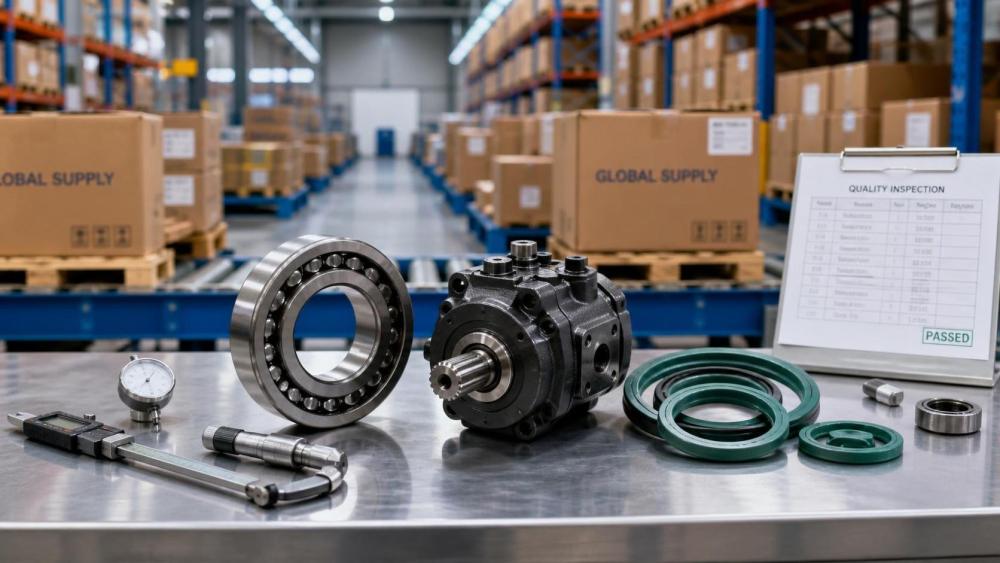
When evaluating global industrial components suppliers serving the United States, an initial quote can reveal useful signals, but it cannot establish capability by itself. Look beyond unit price and ask how the supplier identified the item. Did it quote against a controlled drawing, a full manufacturer reference, photographs, measurements, or only a generic description? A supplier that immediately substitutes “similar” products without confirming critical parameters may create problems later in the approval process.
For bearings, request the exact designation and configuration, including clearance class, cage type, sealing arrangement, precision level where relevant, lubrication condition, and any special internal geometry. For hydraulic pumps and motors, confirm displacement, rotation direction, mounting interface, shaft type, porting, pressure rating, and fluid requirements. For O-rings and other seals, dimensions alone are insufficient; compound selection, hardness, temperature exposure, chemical compatibility, and compression behavior may determine whether the part works.
It is also important to establish the supplier’s commercial role. Some companies manufacture the quoted product. Others are authorized distributors, independent stockists, export traders, or sourcing agents. None of these models is automatically unacceptable, but each changes the questions you need to ask. A manufacturer may offer direct technical access and production control. A distributor may provide domestic stock, mixed-brand sourcing, and easier support. An independent stockist may solve an urgent shortage but requires closer attention to origin, storage conditions, and authenticity controls.
Questions that expose whether a supplier understands the component
A capable supplier should be able to answer practical questions without relying only on broad marketing language. Ask for the production location or source route for the quoted item, how the part is identified through receiving and shipment, whether batch or lot traceability is available, and what inspection records can be supplied. If a drawing is involved, ask who reviews it and how revision changes are controlled.
For application-sensitive items, move one level deeper. Ask how bearing runout or noise is checked when those characteristics matter. Ask how a seal supplier confirms compound selection for the media and temperature. Ask what inspection approach is used for bore, rod, piston, or port dimensions in hydraulic cylinders. Ask how chain pitch consistency, lubrication, and corrosion protection are maintained for the intended environment. The goal is not to force every supplier into a lengthy audit; it is to determine whether the quoted product is understood as an engineered component rather than a commodity label.
Separate product evidence from company claims
Supplier websites, catalogs, and online marketplace listings can be useful starting points, but they should not be treated as proof of current capability. Product images may be generic. Catalog ranges can include items that are no longer produced, outsourced, or available only in limited quantities. A professional review separates visible claims from evidence tied to the actual part being purchased.
Request documents that relate directly to the proposed supply. Depending on the component and risk level, this may include dimensional inspection records, material declarations, test reports, certificates of conformity, batch records, packing photographs, marking examples, product drawings, and quality-management information. Do not request documents merely because they sound official. Define what document is needed, what characteristic it should support, and whether it must relate to the shipped lot.
Documentation deserves careful reading. A certificate with no part number, lot number, issuer identity, or connection to the order has limited value. An inspection report that lists only broad acceptance language may not confirm the dimensions that matter for assembly. Where a component is represented as genuine branded stock, compare marking, packaging, source information, and traceability expectations against the manufacturer’s guidance or authorized-channel information when available.
For U.S.-bound orders, also clarify the commercial documentation early: product description, country of origin, tariff classification responsibility, invoice details, packing list format, and any importer-specific data requirements. Classification and import obligations should be handled with qualified customs and trade professionals when needed. The sourcing team’s role is to make sure the supplier can provide accurate, consistent information rather than discovering missing details after goods are in transit.
Use samples and first orders as controlled tests
Many problems emerge not during a sales call but during receiving, installation, and early operation. For this reason, a first purchase should be managed differently from an established replenishment order. Where the part is critical and sampling is practical, obtain a sample or a limited initial quantity before committing to a larger release.
The receiving inspection should be based on the internal requirement package, not on a general impression that the part “looks right.” Verify label identity, quantities, dimensions, marking, packaging condition, documentation, and any defined critical features. For elastomeric seals, check that the supplied material designation matches the approved specification. For bearings, ensure suffixes and clearance requirements have not changed. For power transmission items, confirm pitch, profile, width, length, bore, keyway, or hub details as applicable.
Installation feedback matters just as much. Maintenance teams often notice fit issues, unusual noise, inconsistent machining, missing accessories, or unsuitable protective packaging before formal quality systems capture them. Create a simple route for that feedback to return to engineering and purchasing. If the supplier response is prompt, specific, and corrective, that is useful evidence. If it is evasive or repeatedly shifts responsibility, treat that as a warning before expanding the relationship.
Calculate landed and lifecycle cost before calling a quote “lower cost”
The quoted unit price is only one part of the cost decision. A lower overseas price may be offset by freight, insurance, brokerage, duties and taxes where applicable, packaging, inspection, internal handling, inventory carrying cost, and the capital tied up in longer lead-time orders. Emergency air freight after a missed delivery can erase savings from several planned shipments.
For components that influence uptime, include the potential cost of shortened service life, rework, installation labor, machine downtime, rejected output, fluid leakage, or collateral damage. This does not require inventing a precise number when internal cost data is incomplete. It does require identifying where a low-priced alternative could create exposure and deciding whether that exposure is acceptable for the component class.
Build approval levels instead of approving a supplier once and for all
A practical supplier file should not end with a single “approved” status. Capability can vary by product family, factory location, source route, and component criticality. A supplier that performs well on standard pneumatic accessories may not automatically be approved for precision bearings or high-pressure hydraulic assemblies.
Consider recording approval by scope: approved for routine stocked MRO items, conditionally approved for a defined part family, approved after first-article review, or restricted to emergency purchases with receiving inspection. This approach gives maintenance teams reasonable purchasing flexibility without silently exposing critical equipment to untested substitutions.
Keep the record useful rather than bureaucratic. Capture the reviewed part categories, source type, documents received, sample or first-order findings, known lead-time assumptions, agreed packaging standards, escalation contacts, and any open technical limitations. Review the file when the supplier changes manufacturing location, proposes a substitute, has a quality issue, or begins supplying a more critical item.
When a supplier should be paused
Not every concern means a supplier must be rejected permanently, but some patterns justify stopping the process until answers are verified. These include reluctance to identify the product source, inconsistent part numbers across quote and documents, refusal to clarify material or configuration, unexplained price changes after order placement, missing lot information where traceability is required, or repeated claims that technical details are “all standard” when the application is not standard.
Another concern is excessive certainty without evidence. A supplier may say a seal is suitable for every chemical, a bearing is interchangeable with every major brand, or a hydraulic component can meet any pressure requirement. Industrial components operate within specific material, geometry, lubrication, load, and environmental limits. A credible supplier recognizes those limits and asks for the information needed to make a responsible recommendation.
The strongest approach to global industrial components USA sourcing is not to eliminate international suppliers or to assume domestic supply is automatically risk-free. It is to make the decision traceable. Define the application, test the supplier’s technical understanding, verify evidence tied to the actual item, control the first order, and compare total exposure rather than quoted price alone. That process takes more effort at the beginning, but it reduces the chance that an apparently simple replacement part becomes an avoidable maintenance event.
Related News
- 00
0000-00
How FFKM O-rings reduce seal failure in corrosive media - 00
0000-00
What global equipment manufacturing in the USA means for supply chain risk - 00
0000-00
How FFKM outgassing performance affects vacuum seal selection - 00
0000-00
When should heat resistant metallurgy belts be replaced? - 00
0000-00
When does a fluid power maintenance service reduce unplanned downtime?
Weekly Insights
Stay ahead with our curated technology reports delivered every Monday.