





Precision Mechanical Components Tolerance: How Tight Is Too Tight?
In precision manufacturing, precision mechanical components tolerance directly affects safety, fit, service life, and production consistency.
But how tight is truly necessary?
And when does tighter control only raise cost, inspection burden, and failure risk?
That question matters in shafts, bearings, seals, couplings, hydraulic parts, and transmission assemblies.
It also shapes supplier approval, process capability, and field reliability.
A useful tolerance is not the tightest number on a drawing. It is the narrowest range that still protects function, safety, manufacturability, and total cost.
Why precision mechanical components tolerance matters
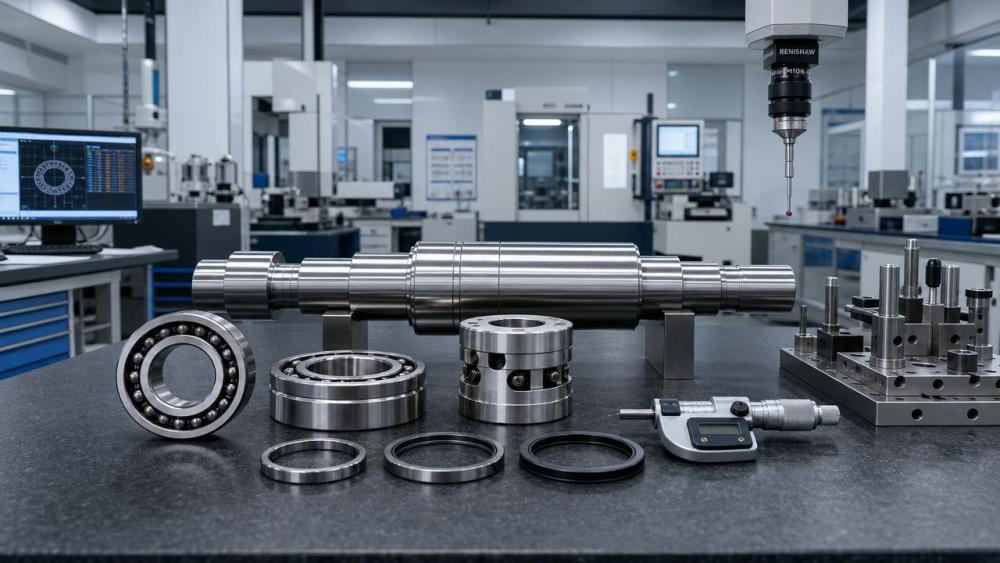
Every component carries variation.
Tolerance defines how much variation is acceptable before function starts to drift.
In precision mechanical components tolerance decisions, the real issue is not numbers alone.
The issue is what the part must do in service.
A spindle bearing seat needs different control from a chain guard bracket.
A hydraulic valve spool needs different control from a general mounting plate.
If the tolerance is too loose, parts may rattle, leak, seize, misalign, vibrate, or wear early.
If the tolerance is too tight, production yield drops, measurement uncertainty grows, and assembly stress can increase.
That is why precision mechanical components tolerance should always link to function, interface, and risk level.
What “too tight” really means
A tolerance becomes too tight when it stops adding functional value.
This happens more often than many teams admit.
Sometimes a designer copies a legacy drawing.
Sometimes a buyer assumes tighter means safer.
Sometimes a supplier promises ultra-precision without discussing process limits.
In practice, precision mechanical components tolerance is too tight when it triggers one or more warning signs:
- Cp or Cpk cannot stay stable in normal production.
- Inspection consumes excessive time with little quality benefit.
- Scrap and rework rise faster than field performance improves.
- Assembly needs force, sorting, or selective fitting.
- Measurement error becomes a large share of the allowed band.
- Temperature, coating, or surface finish shifts push good parts out of spec.
A tight number only makes sense when it clearly prevents a defined failure mode.
Functional zones where tolerance decisions change risk
Fits for bearings and rotating parts
Bearing fits are a classic example.
Overly loose shaft or housing tolerances can cause creep, fretting, and vibration.
Overly tight fits can reduce internal clearance and build heat.
For high-speed applications, that can shorten grease life and damage raceways.
Hydraulic and pneumatic sealing interfaces
In fluid power systems, precision mechanical components tolerance interacts with surface finish and seal compression.
A bore that is too loose may leak.
A groove that is too tight may over-compress an O-ring and accelerate wear.
The safest choice is not automatically the smallest tolerance.
It is the one matched to pressure, fluid, temperature, and dynamic movement.
Transmission parts and alignment surfaces
Chains, sprockets, couplings, and belt drives depend on alignment.
Here, flatness, concentricity, runout, and center distance often matter more than one single size callout.
This is where geometric control can outperform blindly tightening dimensional tolerance.
Standards, capability, and measurement reality
Technical drawings often reference ISO, ASME, GD&T, and fit standards.
Those standards are essential, but they do not replace engineering judgment.
Precision mechanical components tolerance should be checked against three realities.
- Can the process hold it repeatedly?
- Can the gauge measure it confidently?
- Does the application need it under real operating conditions?
A common mistake is tolerancing near or below normal measurement capability.
If gauge R&R is high relative to the tolerance band, decisions become noisy.
Teams may reject good parts and ship risky ones.
That is not strong control. It is hidden instability.
A practical framework for setting the right tolerance
A balanced decision process keeps precision mechanical components tolerance aligned with safety and cost.
A simple framework works well in most industrial programs.
- Start from function. Define load, speed, pressure, sealing duty, and assembly conditions.
- Identify failure modes. Focus on leakage, fatigue, misalignment, seizure, vibration, or unsafe loosening.
- Allocate tolerance by interface. Control critical mating surfaces first.
- Use capability data. Review historical Cp, Cpk, and supplier process windows.
- Check metrology limits. Match tolerances to stable, repeatable inspection methods.
- Validate in assembly. Confirm the stack works in real fixtures and operating temperatures.
This approach usually reveals that only a few dimensions are truly critical.
The rest can often be relaxed without harming function.
Where quality and safety teams should look first
From a control standpoint, several checkpoints deserve early attention.
These checks help separate real risk from cosmetic precision.
How tighter tolerance can create new failure modes
The hidden cost of excessive precision is not only money.
It can introduce fresh technical risk.
A forced interference fit may distort a bearing ring.
An aggressively controlled seal groove may leave no room for thermal expansion.
A polished dimension may still fail because roundness or perpendicularity was ignored.
This is why precision mechanical components tolerance should be treated as a system issue.
Size, geometry, material behavior, lubrication, and assembly method all interact.
If one factor changes, the “right” tolerance may also change.
Supplier evaluation and change control
Supplier review should go beyond quoting a tolerance number.
Ask how the tolerance is achieved, measured, and maintained over time.
For precision mechanical components tolerance, good supplier evidence often includes process studies, MSA results, control plans, and reaction plans.
It is also wise to review what happens after tooling changes, material changes, or machine relocation.
Change control matters because many tolerance failures appear after “minor” adjustments.
A strong supplier can explain the functional reason behind every critical characteristic.
That level of clarity usually predicts better long-term consistency.
Final takeaway: choose useful precision, not maximum precision
The best precision mechanical components tolerance is not the smallest number available.
It is the one that consistently protects function, safety, and durability.
When tolerances are linked to real failure modes, drawings become clearer and processes become more stable.
Inspection also becomes faster and more meaningful.
In practical terms, the right next step is simple.
Review critical dimensions by function, confirm measurement capability, and challenge any tolerance that lacks a clear purpose.
That is usually where better quality, lower risk, and better economics start to meet.
Related News
- 00
0000-00
How FFKM O-rings reduce seal failure in corrosive media - 00
0000-00
What global equipment manufacturing in the USA means for supply chain risk - 00
0000-00
How FFKM outgassing performance affects vacuum seal selection - 00
0000-00
When should heat resistant metallurgy belts be replaced? - 00
0000-00
When does a fluid power maintenance service reduce unplanned downtime?
Weekly Insights
Stay ahead with our curated technology reports delivered every Monday.