





Why does OEM Supplier Evaluation often fail before production even starts?
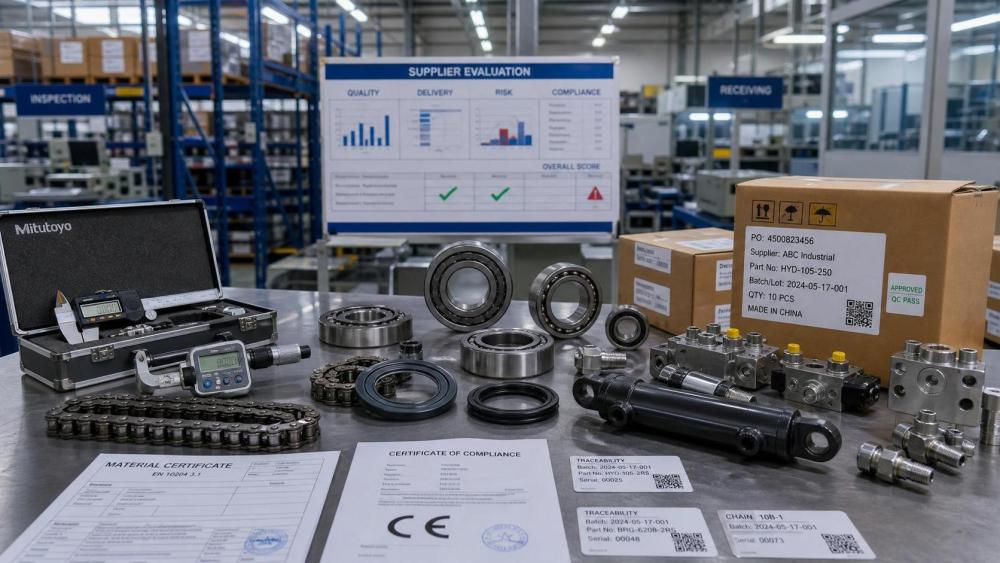
A supplier can look capable on paper and still become a cost problem later.
That is why OEM Supplier Evaluation should begin before price comparison becomes the main discussion.
In practice, risk management is less about finding a perfect vendor.
It is about spotting weak signals early, before quality escapes, shipment delays, or compliance gaps turn into downtime.
This matters even more in industrial supply chains tied to bearings, seals, hydraulic assemblies, chains, belts, couplings, and MRO-critical parts.
A late bearing delivery can stop a machine build.
An unstable seal supplier can raise leakage risk, warranty claims, and maintenance cost across multiple sites.
The smarter approach is to connect commercial review with technical reality.
That includes process discipline, traceability, engineering response speed, and the supplier’s ability to support lifecycle reliability.
PCTS often highlights this broader view by linking component performance, maintenance economics, and sourcing visibility in one place.
Which early warning signs deserve attention before a contract is signed?
The most useful warning signs are usually small, repeated inconsistencies.
A single delayed email is not the issue.
A pattern of vague answers, changing specifications, and incomplete records is the issue.
During OEM Supplier Evaluation, these signals often reveal deeper operational weakness:
- Samples pass, but inspection methods are undocumented or inconsistent.
- Lead times look attractive, yet raw material sources are unstable.
- Certificates exist, but revision control and validity checks are weak.
- Corrective actions are promised quickly, but root-cause analysis stays shallow.
- Pricing changes too often without clear links to steel, elastomer, or freight exposure.
- Engineering questions are routed through sales only, slowing technical decisions.
For precision components, this is not a minor concern.
A supplier making spindle bearings or hydraulic pump parts needs repeatable process control, not just a good first article.
The same applies to O-rings, mechanical seals, pneumatic cylinders, and transmission parts where hidden variation shows up only after installation.
A quick way to classify risk signals
A simple decision table helps separate manageable issues from structural risk.
This kind of OEM Supplier Evaluation table supports better risk management because it turns vague concern into specific checks.
How can you tell whether quality consistency is real or only sample-deep?
A polished sample proves almost nothing by itself.
What matters is whether the same result can be repeated at volume, under schedule pressure, with normal operators and normal raw material variation.
That is where OEM Supplier Evaluation becomes a process review, not just a part review.
For machined shafts, bearing rings, sprockets, or hydraulic housings, look at process capability and measurement discipline.
For seals and elastomer parts, verify compound control, cure consistency, storage practice, and batch traceability.
A few practical questions usually reveal the truth faster than a presentation deck:
- Can the supplier show recent SPC or Cp/Cpk data for critical dimensions?
- Are gauges calibrated internally, externally, or both?
- How are mixed lots prevented during packaging and dispatch?
- What failure modes appear most often, and how were they reduced?
The answers should be concrete.
If the discussion stays general, risk management should become stricter, not softer.
In sectors covered by PCTS, quality consistency is closely tied to equipment life, lubrication behavior, vibration performance, leakage control, and replacement intervals.
That means weak process control eventually becomes a maintenance cost issue, not just a quality issue.
Is delivery risk mainly about lead time, or is there more behind it?
Quoted lead time is only the visible layer.
The real delivery risk sits behind production planning, subcontractor dependence, material exposure, and export readiness.
A supplier may promise six weeks, yet rely on a single heat-treatment partner or imported sealing compound with volatile supply.
In OEM Supplier Evaluation, delivery stability should be tested through scenario questions.
Ask what happens if forecast demand rises by 20%.
Ask what happens if one machining center fails.
Ask how they prioritize urgent MRO orders versus serial production.
The best responses explain trade-offs, backup routes, and escalation rules.
Another useful indicator is packaging and logistics discipline.
For bearings, corrosion protection matters.
For seals, contamination control matters.
For chains and belts, storage conditions affect field performance long before installation.
Risk management improves when lead time is reviewed together with packaging standards, export documents, and recovery plans after disruption.
What compliance and documentation gaps usually cause trouble later?
Many sourcing problems do not start on the shop floor.
They start in incomplete files, unclear material declarations, or mismatched drawings across teams.
This is especially relevant when components enter regulated, export-sensitive, or safety-critical equipment.
Good OEM Supplier Evaluation checks whether documentation supports the actual product, not just the audit file.
Typical gaps include expired certificates, unclear PPAP-style submission logic, and testing reports that cannot be traced to delivered lots.
For industrial components, there may also be issues around REACH, RoHS, origin statements, pressure-related testing, or material compatibility declarations.
Need-to-check documents usually include:
- Controlled drawing and latest revision acknowledgement
- Material certificates linked to batch numbers
- Inspection plan for critical characteristics
- Nonconformance handling and deviation approval route
- Country-of-origin and export documentation process
This may sound administrative, but it directly affects cost.
Missing compliance evidence can delay customs clearance, customer approval, and equipment release.
In risk management terms, document weakness is often a multiplier of every other sourcing problem.
When does a low quote stop being a savings opportunity?
A low quote becomes risky when the supplier cannot explain how the cost structure works.
Reasonable savings can come from automation, local material access, tooling efficiency, or simplified packaging.
Unreasonable savings often come from hidden compromises.
Those compromises may include softer material, narrower inspection scope, thinner coating, shorter testing time, or low inventory resilience.
This is where OEM Supplier Evaluation and risk management must connect price with lifecycle exposure.
A cheaper chain that wears faster can raise shutdown frequency.
A lower-cost hydraulic seal that fails in aggressive media can trigger leakage, contamination, and service labor cost.
A lower-priced bearing with poor lubrication performance can shorten equipment life far beyond the initial savings.
More reliable cost comparison usually includes:
- Unit price versus warranty and failure exposure
- Tooling ownership and replacement responsibility
- Expedite risk and inventory carrying cost
- Field service cost if parts fail early
- Technical support quality during change or launch
PCTS often frames these questions through total cost of ownership, which is a practical way to avoid false savings.
What is a sensible next step if several risk signals appear at once?
Do not treat every red flag as a reason to walk away immediately.
Some gaps are fixable with tighter controls.
Others point to a structural mismatch between supply capability and application risk.
A useful response is to build a short validation plan before commitment.
- Rank risks by business impact, not annoyance level.
- Request evidence for the top three concerns within a fixed timeline.
- Run a pilot order tied to measurable quality and delivery targets.
- Define escalation rules before serial release.
- Keep an alternative source warm for critical components.
This approach keeps OEM Supplier Evaluation practical.
It also keeps risk management connected to evidence, not instinct alone.
For components that affect rotation, sealing, fluid power, or transmission reliability, early discipline pays back quickly.
The clearest path forward is to define application needs, verify process control, compare lifecycle cost, and test the supplier’s response under real conditions.
That is usually the difference between a vendor that looks competitive and one that remains dependable after launch.
Related News
- 00
0000-00
When wireless intelligent condition monitoring justifies retrofit costs - 00
0000-00
When does an export compliance service reduce shipment delays? - 00
0000-00
How to assess a mechanical seal solutions supplier’s quality control - 00
0000-00
How to use chain wear analysis to prevent mining conveyor failures - 00
0000-00
How to select PU timing belts for automation with high positioning accuracy
Weekly Insights
Stay ahead with our curated technology reports delivered every Monday.