





Replace industrial equipment when the cost and risk of keeping it in service outweigh the value of its remaining useful operation. Age helps frame that decision, but it cannot settle it. An older gearbox with stable condition may justify continued service, while a newer hydraulic system with recurring contamination and production losses may require intervention much sooner.
Equipment lifespan management connects physical condition, failure consequences, maintenance economics, and replacement lead time. Its practical output is a decision for each important asset: continue operating, repair, rebuild, replace a component, or replace the complete machine. The objective is to schedule that intervention while production, purchasing, and maintenance still have workable options.
Start by separating asset life from component life
A machine rarely reaches the end of its useful life all at once. Bearings, seals, belts, controls, structural parts, and hydraulic components deteriorate at different rates. Treating every component failure as evidence that the whole asset is exhausted can lead to unnecessary capital spending.
A leaking cylinder may need new seals and inspection of the rod and bore. A worn bearing may justify replacement of the bearing and correction of shaft alignment. Neither condition automatically supports replacing the complete production machine.
The opposite mistake is continuing to replace inexpensive components when the surrounding equipment causes repeated failures. New seals will not resolve excessive shaft movement. A replacement pump may deteriorate again if contamination, inlet restrictions, or operating conditions remain unresolved.
Before approving expenditure, define the boundary of the problem. Establish whether deterioration is confined to a serviceable component, extends across a subsystem, or reflects a machine that can no longer meet production requirements. This distinction determines which options deserve a financial comparison.
Build a decision record that explains deterioration
An asset register becomes useful for replacement planning when it describes how equipment operates and how its condition is changing. Installation dates and purchase prices alone provide little evidence of remaining service potential.
For each important asset, bring together:
- Operating duty: running hours, starts and stops, loading, temperature, contamination exposure, and changes in production demand.
- Maintenance history: failure modes, repair scope, repeat work, labor, parts consumption, and downtime.
- Condition evidence: inspection findings, vibration trends, lubricant condition, leakage, temperature, and relevant performance measurements.
- Production consequences: bottleneck status, available standby capacity, quality losses, and recovery time after an interruption.
- Supply constraints: spare availability, repair capability, supplier support, and the time required to install and commission a replacement.
Record causes as clearly as symptoms. “Bearing replaced” does not explain whether the bearing suffered from contamination, inadequate lubrication, misalignment, or unsuitable loading. Without that distinction, repeated maintenance can look like normal aging when it actually reflects a correctable operating problem.
Compare condition measurements under similar operating conditions. Higher vibration after a speed change or greater hydraulic temperature under heavier load needs interpretation before it becomes a replacement trigger. Trends are most useful when the operating context is recorded alongside them.
Use condition and failure consequences to set priorities
Equipment lifespan management should not produce a replacement queue sorted only by age or repair spending. A low-cost component can deserve immediate attention if its failure stops a production bottleneck. An expensive asset may remain a lower priority when its condition is stable and a dependable standby unit exists.
Assess both the likelihood of failure during the planning period and what that failure would cause. Include secondary damage, lost output, quality disruption, environmental exposure, and the practical difficulty of restoring service. Safety and mandatory operating requirements establish limits that a favorable cost calculation cannot override.
These are decision directions, not automatic rules. A serviceable machine can still become a replacement candidate if demand changes and it cannot deliver the required capacity or quality. Conversely, high maintenance spending during a planned overhaul may restore useful service rather than indicate an ongoing decline.
Read component signals without treating them as a countdown
Condition monitoring can reveal deterioration, but a single measurement rarely provides a dependable failure date. Use measurements to identify the likely fault, its progression, and the time available for action.
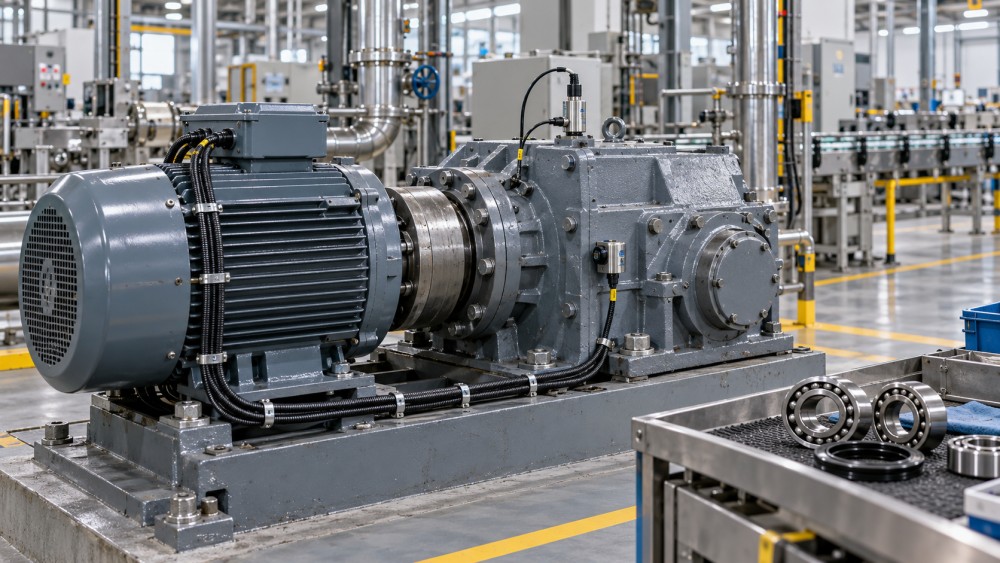
For bearings and gearboxes, vibration patterns, lubricant debris, temperature, noise, and inspection findings can support diagnosis. A rising temperature alone does not establish that replacement is due; loading, lubrication, alignment, and cooling conditions can also affect it.
For hydraulic equipment, declining flow under comparable conditions, difficulty maintaining pressure, increasing case-drain flow where applicable, and persistent heat can indicate internal wear or system problems. A pump assessment should also consider fluid condition, filtration, inlet conditions, and control settings. Otherwise, a new pump may inherit the same damaging environment.
Chains and belts require attention to wear, alignment, tension, sprocket or pulley condition, and the driven load. Replacing only the visibly worn element can leave the cause of deterioration in place. Seal failures similarly require examination of material compatibility, pressure, temperature, surface condition, and movement.
Supplier life estimates and bearing life calculations can support planning under stated assumptions. They do not account for every installation defect, contamination event, or operating change. Use them alongside field evidence, and express remaining useful life as a planning range when the evidence does not support a precise forecast.
Compare the options over the same future period
The relevant financial question is what each option will cost from today onward. Original purchase cost and money already spent on repairs cannot be recovered by continuing to operate the asset. Book value may affect accounting and tax treatment, but it does not establish mechanical fitness.
Compare continued maintenance, targeted repair, rebuild, and replacement over a common operating horizon. Allow for differences in useful service remaining at the end of that period, so a short-lived repair is not compared with a longer-lived replacement solely on initial expenditure.
A practical comparison includes:
- Purchase or repair price, installation, engineering, and commissioning.
- Planned maintenance, consumables, energy, and necessary spare inventory.
- Expected unplanned downtime, recovery work, and potential secondary damage.
- Scrap, rework, or throughput losses attributable to equipment performance.
- Training, integration changes, disposal costs, and remaining asset value.
Use downtime costs that reflect the operation. Lost production hours do not always equal lost sales: some output can be recovered later. Elsewhere, a short interruption at a constrained process can disrupt several connected operations. Include recoverable production, overtime, restart losses, and delivery consequences without counting the same loss twice.
Failure probabilities are often uncertain. Rather than presenting one precise forecast, compare favorable, expected, and adverse scenarios. If replacement remains attractive across plausible assumptions, the decision is stronger. If the preferred option changes with a small adjustment in downtime or repair life, identify which missing evidence would most improve the decision.
Decide whether a rebuild buys useful service
A rebuild can make sense when the machine’s structure remains sound, its capability suits future demand, and worn systems can be restored to a defined condition. It becomes less attractive when the work leaves unresolved obsolescence, inadequate capacity, or recurring faults outside the rebuild scope.
Consider a hydraulic power unit with deteriorating pump performance but a serviceable reservoir, controls, and distribution system. A pump replacement combined with contamination control may provide a credible extension of service. If the same unit also has persistent overheating, unsupported controls, and insufficient capacity for planned production, isolated repairs may postpone a broader investment without resolving the constraints.
Require rebuild proposals to state what will be inspected, restored, replaced, and tested. Define acceptance in terms of required function under agreed operating conditions. A low quotation with an unclear scope is difficult to compare with a replacement that includes installation and commissioning.
Also consider the outage itself. A rebuild that depends on findings after disassembly may carry schedule uncertainty. Where production continuity is critical, an exchange assembly or a replacement prepared before shutdown may justify a higher purchase price.
Work backward from the installation window
The latest sensible order date comes before the expected end of service. Replacement requires time for specification, supplier evaluation, manufacturing or stock allocation, delivery, site preparation, installation, and commissioning. Include contingency where supply or installation uncertainty could disrupt production.
Separate a planning trigger from an operating limit. A planning trigger starts quotations, engineering, or spare procurement while the asset remains serviceable. An operating limit defines when continued use requires restriction or shutdown. Waiting until the operating limit is reached before starting procurement removes much of the value of condition monitoring.
Confirm technical compatibility before placing an order. Matching a bearing’s dimensions, a pump’s nominal pressure, or a belt’s profile does not establish suitability. Speed, load, duty cycle, fluid compatibility, mounting, controls, and environmental conditions can affect selection. A replacement with different interfaces may also require changes to foundations, guards, piping, or electrical systems.
Supplier comparison should therefore cover documented suitability, delivery commitments, technical support, repair options, and future spare availability. These factors determine whether a purchase can be installed and supported as planned.
Make each replacement approval actionable
A useful approval proposal names the asset, explains its condition, compares realistic alternatives, and identifies the recommended intervention window. It should also state the assumptions that could change the recommendation, such as reduced demand, worsening wear, or loss of spare-parts support.
Assign responsibility for monitoring the asset until intervention and define what would bring the work forward. An approved replacement planned for a future shutdown still needs active condition management; approval does not stop deterioration.
Begin with assets whose failure consequences, condition trends, or supply constraints create the greatest exposure. For each one, establish the next decision date, procurement trigger, and operating limit. That turns a general intention to replace aging equipment into a practical schedule for protecting production and allocating capital.
Related News
- 00
0000-00
How to check a heavy-duty chain drive distributor’s stock availability - 00
0000-00
Can condition monitoring solutions for motors detect bearing faults? - 00
0000-00
Changsheng Bearings Reports 22.68% Revenue Growth for First Nine Months of 2026 - 00
0000-00
How to assess export compliance readiness before your first shipment - 00
0000-00
Is the Cheapest Replacement Part Really Lower Cost Over Time?
Weekly Insights
Stay ahead with our curated technology reports delivered every Monday.