





An industrial component distribution service can reduce lead times—but only when its inventory access, technical support, and delivery capabilities match your procurement needs. For buyers sourcing bearings, hydraulic parts, seals, or power transmission components, delays often begin before a shipment leaves the warehouse: stock information is unclear, specifications are incomplete, or an alternative part is waiting for engineering approval.
The right distributor can remove these obstacles. The wrong one may simply add another layer between your purchase order and the manufacturer. For procurement teams, the useful question is not “Who promises the fastest delivery?” It is “Who can consistently deliver the correct, documented component when our operation needs it?”
Identify which part of your lead time needs reducing
A quotation showing “three-day delivery” may describe transit time alone. It may exclude sourcing, order processing, technical clarification, export documentation, and receiving inspection. That distinction matters when a machine is stopped and every department is working toward a different arrival date.
Assess the complete cycle, from a clearly defined requirement to a component released for use. Separate it into the following stages:
- Requirement clarification: confirming the part number, operating conditions, drawings, and acceptance criteria.
- Source confirmation: locating usable stock and verifying that it is available for your order.
- Technical and commercial approval: reviewing substitutions, documentation, price, and purchasing terms.
- Order fulfillment: picking, inspection, packaging, and dispatch.
- Transport and release: freight, customs clearance where applicable, and incoming acceptance.
If technical approval consumes most of the cycle, a faster courier will achieve little. If your approved bearing is already on the shelf but purchase authorization takes several days, an agreed release process may deliver more value than another stock location.
What an industrial component distribution service must do well
A large catalog is not evidence of short lead times. Buyers need to understand how a distributor converts a listed item into a reliable delivery commitment.
Available stock must mean available to your order
“In stock” can describe physically held inventory, stock at a partner warehouse, or an upstream supplier’s availability feed. These are different fulfillment situations. Ask whether the quoted quantity is unallocated, whether it can be reserved, and when the availability information was last confirmed.
Condition matters as much as quantity. An elastomer seal may require storage and age checks; a bearing may need confirmation of packaging integrity and preservation. Stock that cannot pass your receiving requirements is not a shortcut.
Logistics needs a destination-level commitment
Confirm whether a date refers to dispatch, arrival at a freight terminal, or delivery to your facility. For international orders, establish who handles customs clearance, which documents accompany the shipment, and whether duties or clearance activities could delay release.
A nearby warehouse is useful only if the required item is actually there. Conversely, a well-managed cross-border shipment may be more dependable than an uncertain local sourcing promise.
A faster substitute is valuable only after technical approval
When the specified component is unavailable, a distributor’s technical capability becomes especially important. Procurement teams often feel pressure to accept a cross-reference quickly, but matching a catalog number or envelope dimension is only the beginning.
Build the comparison around the application rather than the product description:
- Bearings: check load capability, speed suitability, internal clearance or preload, precision class, lubrication, seals, and cage design. A dimensionally interchangeable bearing may not suit a high-speed spindle.
- Hydraulic pumps and valves: verify pressure and flow ratings, mounting, port configuration, fluid compatibility, control characteristics, and relevant electrical interfaces.
- Pneumatic actuators: compare bore, stroke, mounting, operating pressure, cushioning, sensor compatibility, and behavior under the application’s load.
- Chains and belts: confirm pitch or profile, load capacity, construction, environmental resistance, and compatibility with existing sprockets or pulleys.
- Seals and O-rings: assess dimensions, compound, hardness, temperature limits, media compatibility, and any application-specific cleanliness requirements.
A material family alone is not a complete specification. Two FKM compounds, for example, may have different suitability for a particular fluid or temperature exposure. Likewise, choosing FFKM does not eliminate the need for compound-level assessment.
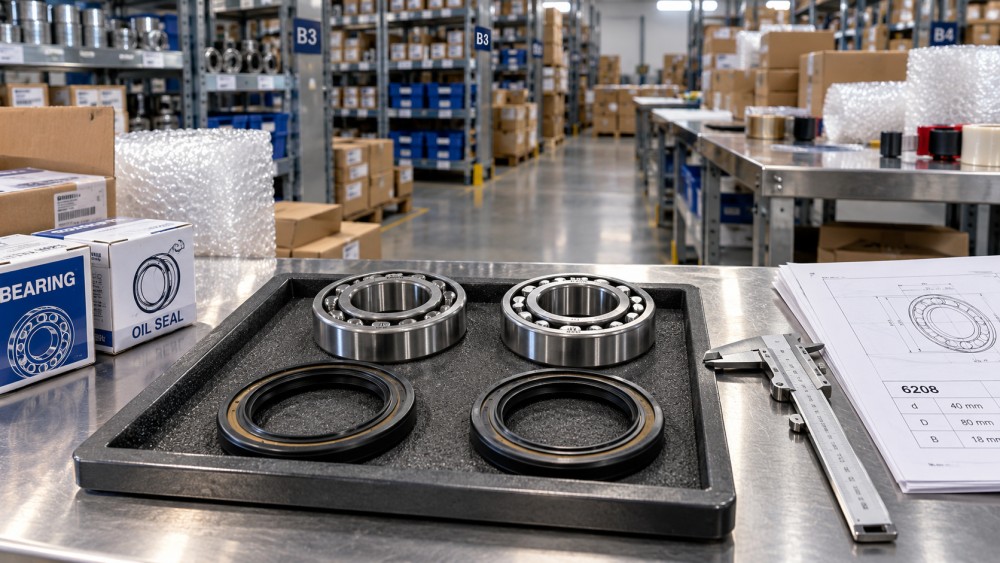
Ask the distributor to identify differences explicitly rather than issuing a blanket “equivalent” statement. The approval should show what matches, what differs, and which differences require engineering review. For safety-critical or tightly controlled equipment, obtain the necessary OEM or internal engineering authorization before substitution.
This review takes time, but it is usually less disruptive than installing an unsuitable part and repeating the procurement cycle after a failure.
Choose a distribution model that fits the demand
Emergency maintenance, routine MRO replenishment, and scheduled OEM production do not benefit from exactly the same service model.
For breakdowns, prioritize certainty and responsiveness
During an unplanned stoppage, useful capabilities include rapid stock verification, access to application specialists, clear after-hours arrangements, and a realistic dispatch commitment. The best response may be a partial shipment that restores one critical machine rather than waiting to consolidate every item on the order.
Before an emergency occurs, agree who can approve premium freight and alternative parts. Otherwise, a distributor may locate the component quickly while the order remains trapped in internal approvals.
For recurring MRO, move the decision earlier
For regularly consumed bearings, belts, filters, and seals, blanket orders, scheduled releases, vendor-managed inventory, or consignment arrangements can reduce replenishment delays. Their effectiveness depends on consumption data, review frequency, and clear ownership of stock.
Define minimum and maximum quantities, replenishment triggers, emergency allocation, and responsibility for obsolete inventory. A consignment shelf with no reliable replenishment process offers little protection.
For OEM production, protect the bill of materials
Production buyers need schedule visibility, revision control, and repeatable supply. A distributor may simplify ordering across several component categories, but consolidation should not obscure manufacturer identity or approved specifications.
Check whether kits can be supplied against a controlled bill of materials and whether one missing item will hold the entire kit. Agree how shortages, substitutions, and engineering changes will be communicated.
Where distributors cannot reliably compress the schedule
Distribution is most effective when it improves access to existing stock or organizes predictable demand. It cannot automatically remove manufacturing constraints for custom cylinders, special bearing configurations, proprietary assemblies, or made-to-order sealing compounds.
In these cases, the distributor’s contribution may be earlier order placement, better production visibility, or a jointly agreed buffer—not immediate delivery. Buying directly from the manufacturer may remain appropriate when design coordination dominates the purchasing process.
Supplier consolidation also has limits. One distributor can simplify administration, but relying on a single source for every critical component may concentrate risk. Maintain an approved backup where operational consequences justify it, particularly if several distributors depend on the same upstream factory.
Compare usable delivery, not just quoted speed
Consider an illustrative maintenance purchase: a plant needs a replacement hydraulic pump. One supplier offers an earlier dispatch but cannot yet confirm the control configuration. Another offers a later dispatch with the correct configuration, source documentation, and a confirmed arrival date.
The earlier shipment is not necessarily the faster solution. If it requires clarification, modification, or rejection after arrival, the machine remains unavailable. Compare the expected date on which each option can be accepted and installed—not merely the day a parcel leaves a warehouse.
The same principle applies to cost. Evaluate the full purchasing consequence:
- Component price, freight, duties, and order-handling charges.
- Engineering review, inspection, and any additional testing.
- Inventory carrying cost and potential obsolescence.
- Expediting effort and the operational impact of late or incorrect supply.
A higher-priced stocked component may be economical when it prevents a costly interruption. However, emergency freight should not become the default replenishment strategy. Repeated expediting often signals a planning or stocking problem rather than a transport problem.
Test the service before expanding the relationship
Give shortlisted distributors the same representative basket: a common stock item, a technically demanding component, a recurring MRO requirement, and a hard-to-source part. Include quantities, delivery locations, documentation requirements, and the same response deadline.
Then evaluate the quality of the commitment. Does the quotation distinguish confirmed stock from estimated replenishment? Are alternatives clearly labeled? Does the delivery promise include technical approval and documentation, or assume they are already complete?
A practical pilot should track more than average delivery time:
- Request-to-usable-receipt time: measure from a complete requirement to acceptance for use.
- Delivery reliability: compare receipts with the originally agreed date, not only a subsequently revised date.
- Line fill rate: monitor how many order lines are supplied in the required quantity and timing.
- Technical and documentation exceptions: record mismatches, missing records, and receiving holds.
- Expediting frequency: check whether urgent intervention decreases as the relationship develops.
Separate emergency orders from planned replenishment when reviewing results. Otherwise, a changing order mix can make performance appear better or worse without showing whether the service itself has improved.
The buying decision comes down to evidence
An industrial component distribution service can shorten procurement cycles when it removes identifiable delays: uncertain availability, slow technical clarification, fragmented sourcing, or poorly coordinated delivery. Its value is weaker when it merely passes along manufacturer estimates without controlling stock, approvals, or fulfillment.
Before committing, ask for a written stock position, a technically defensible substitution process, a clear delivery basis, and measurable service expectations. Start with the components where delays hurt most, then expand only after performance is demonstrated. The objective is not the fastest promise—it is a dependable path from purchase requirement to a correct component ready for use.
Related News
- 00
0000-00
How to check a heavy-duty chain drive distributor’s stock availability - 00
0000-00
Can condition monitoring solutions for motors detect bearing faults? - 00
0000-00
Changsheng Bearings Reports 22.68% Revenue Growth for First Nine Months of 2026 - 00
0000-00
How to assess export compliance readiness before your first shipment - 00
0000-00
Is the Cheapest Replacement Part Really Lower Cost Over Time?
Weekly Insights
Stay ahead with our curated technology reports delivered every Monday.