





Selecting a Precision Transmission Systems exporter is rarely a price-only decision. The right source affects uptime, spare parts continuity, maintenance planning, and the real cost of running industrial equipment over time.
That matters across a wide range of components. Bearings, couplings, chains, belts, seals, hydraulic units, and related transmission parts all sit close to equipment performance and failure risk.
A capable exporter should therefore prove more than export experience. It should show process control, technical understanding, application fit, documentation discipline, and stable support after shipment.
Why exporter evaluation deserves closer attention
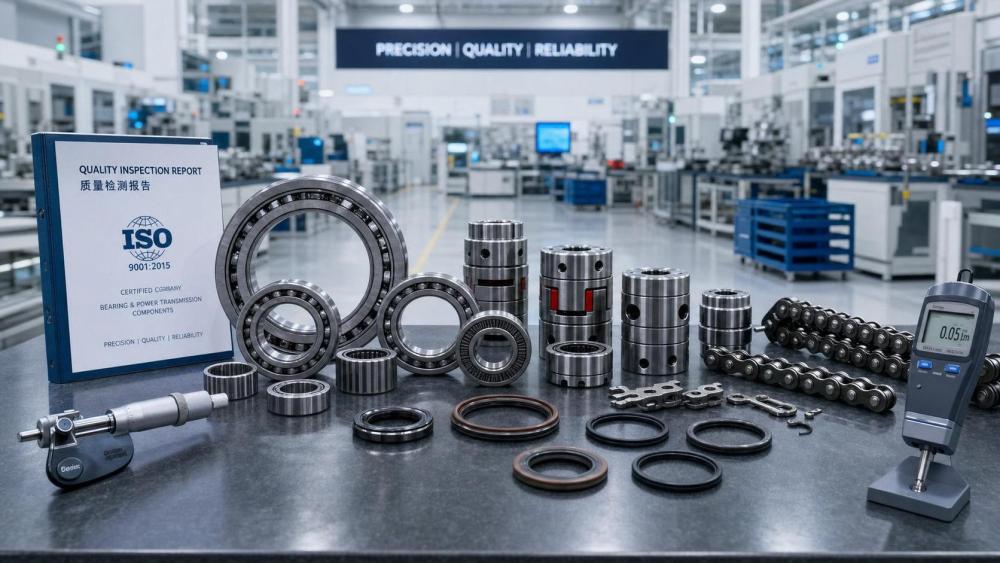
In transmission systems, small deviations can create large operational problems. A bearing with inconsistent raceway quality or a belt with poor dimensional stability can shorten service life quickly.
The same is true for seals, sprockets, chains, and couplings. If tolerances drift, lubrication behavior changes, leakage increases, vibration grows, and replacement intervals become harder to predict.
This is why the evaluation of a Precision Transmission Systems exporter now goes beyond catalog review. Buyers need evidence that the supplier can support reliability under real industrial conditions.
That broader view is also reflected in platforms such as PCTS. Market intelligence increasingly connects mechanical design, fluid power, sealing technology, condition monitoring, and lifecycle cost into one sourcing framework.
What a Precision Transmission Systems exporter actually supplies
The term can cover much more than gears or shafts. In practice, a Precision Transmission Systems exporter may handle rotating, sealing, driving, and motion-control components used in interconnected machinery systems.
Common categories include high-precision bearings, hydraulic pumps, hydraulic motors, pneumatic actuators, industrial chains, belts, sprockets, couplings, mechanical seals, and O-rings.
Some exporters focus on standard replacement parts. Others support engineered assemblies, OEM drawings, material upgrades, or application-specific solutions for heavy load, chemical exposure, or high-temperature service.
This distinction matters during supplier screening. An exporter suited to MRO replenishment may not be strong enough for custom, high-precision, or compliance-sensitive projects.
The first questions to answer before comparing suppliers
Exporter evaluation is easier when internal requirements are already clear. Many sourcing problems begin because specifications are incomplete, operating conditions are underestimated, or substitute criteria are undefined.
Before sending inquiries, clarify the working environment, expected load, speed range, media exposure, lubrication method, service interval, and critical failure consequences.
It also helps to define what can change and what cannot. Material grade, hardness, seal compound, dimensional tolerance, coating, packaging, traceability, and test standards should not be left open by accident.
- Identify whether the part is for OEM production, scheduled maintenance, or urgent replacement.
- Separate mandatory technical requirements from preferred commercial terms.
- List failure modes already seen in service, such as belt slip, chain wear, leakage, or premature bearing noise.
- State the required certificates, inspection reports, and destination market regulations early.
Quality control is the strongest signal
A serious Precision Transmission Systems exporter should explain how quality is built into production, not only how defects are sorted at the end.
Look for control over raw material sourcing, machining consistency, heat treatment, grinding, surface finish, assembly discipline, and final inspection. The best exporters can show where variation is monitored.
For bearings, that may include raceway precision, internal clearance control, lubrication cleanliness, and vibration testing. For seals, it may involve compound validation, dimensional checks, and media compatibility records.
For chains and belts, tensile performance, wear resistance, pitch accuracy, and fatigue testing deserve attention. For hydraulic and pneumatic products, pressure stability and leakage control are central.
Technical depth matters as much as manufacturing scale
A good exporter should understand how the part behaves in service. That includes friction, load transfer, sealing integrity, contamination exposure, lubrication needs, and installation sensitivity.
This is where technical communication becomes a useful filter. A reliable Precision Transmission Systems exporter can answer specific questions without relying on generic sales language.
For example, can it explain why one bearing design fits high-speed spindles while another suits wind turbine loads? Can it compare NBR, FKM, and FFKM sealing behavior under heat or chemical attack?
Can it discuss chain wear, belt slip prevention, or hydraulic piston pump stability in a way that reflects real application knowledge? If not, sourcing risk usually moves upstream to the buyer.
Signs of real technical capability
- Clear comments on load cases, duty cycles, and failure modes.
- Ability to suggest material or design alternatives with tradeoffs.
- Understanding of lubrication, contamination control, and installation effects.
- Use of drawings, performance curves, and test data instead of broad claims.
Compliance, documentation, and export readiness
Documentation quality often reveals how dependable an exporter will be after the order is placed. In many industrial projects, paperwork errors cause delays before product defects do.
A Precision Transmission Systems exporter should be able to provide dimensional reports, material certificates, test records, packing details, labeling consistency, and shipping documents without repeated correction.
Compliance readiness is especially important when parts enter regulated sectors or cross multiple customs environments. REACH, RoHS, origin records, and customer-specific declarations should be handled in a structured way.
This is also where supplier visibility platforms such as PCTS are useful. They help compare exporters not only by product range, but by technical credibility, market positioning, and documentation maturity.
Delivery reliability and after-sales support
An exporter may pass technical review yet still create operational disruption through unstable lead times. Delivery performance should be checked with the same discipline as product quality.
Ask how capacity is planned, how critical raw materials are secured, and how shipment priorities are managed when demand spikes. This matters for both OEM schedules and MRO replenishment cycles.
After-sales response also deserves attention. If a batch issue appears, the exporter should have a process for containment, replacement, corrective action, and technical follow-up.
Fast reaction is valuable, but structured reaction is better. A dependable Precision Transmission Systems exporter documents root causes and prevents recurrence across future lots.
How to compare exporters in practical terms
Shortlisting works best when qualitative and quantitative factors are reviewed together. Unit price alone usually hides later costs in rework, downtime, expedited freight, and shortened replacement intervals.
A simple comparison model can keep decisions grounded.
Pilot orders are often worth the effort. They expose packaging quality, labeling discipline, communication speed, document accuracy, and part consistency before larger commitments are made.
Where long-term value usually appears
The strongest exporter relationships improve over time because technical and commercial data accumulate. Replacement cycles become more predictable, part substitutions become safer, and inventory planning becomes less reactive.
This is especially relevant in sectors dealing with high uptime pressure, harsh media, precision motion, or recurring maintenance exposure. Transmission parts and sealing components rarely fail in isolation.
When a Precision Transmission Systems exporter understands that system context, sourcing becomes more resilient. The discussion shifts from unit cost toward lifecycle cost, risk control, and performance stability.
A useful next step is to score current suppliers against technical depth, quality evidence, compliance readiness, and delivery consistency. That creates a clearer baseline for RFQs, audits, and future sourcing decisions.
Related News
- 00
0000-00
How FFKM O-rings reduce seal failure in corrosive media - 00
0000-00
What global equipment manufacturing in the USA means for supply chain risk - 00
0000-00
How FFKM outgassing performance affects vacuum seal selection - 00
0000-00
When should heat resistant metallurgy belts be replaced? - 00
0000-00
When does a fluid power maintenance service reduce unplanned downtime?
Weekly Insights
Stay ahead with our curated technology reports delivered every Monday.