





Why does choosing a chain and belt drives supplier affect more than unit price?
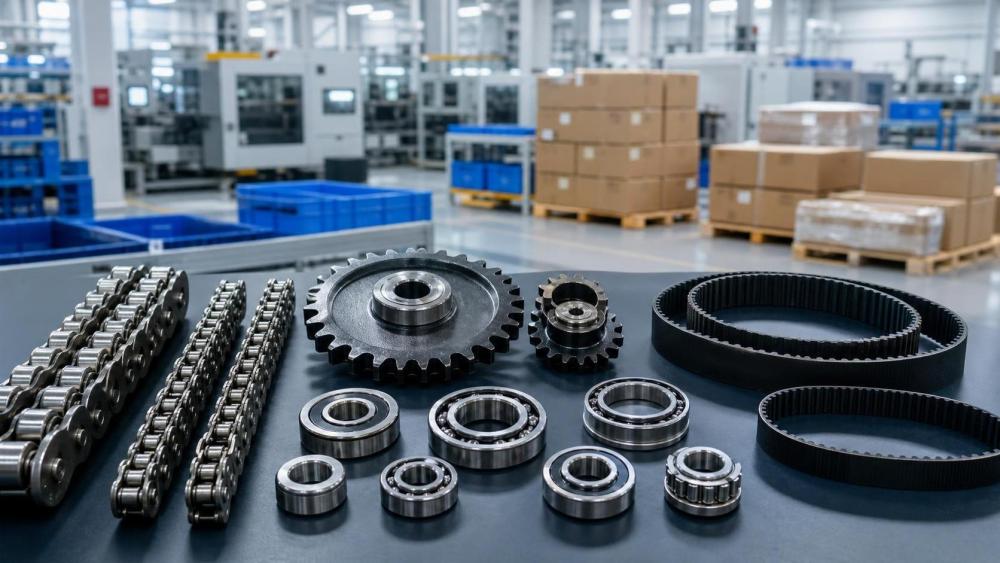
A chain and belt drives supplier influences uptime, maintenance frequency, and how smoothly replenishment works when demand changes.
That matters because transmission parts sit inside wider systems. A delayed belt or out-of-spec chain can stop an otherwise healthy machine.
In practice, the lowest quote often hides other costs. Rush freight, emergency stock buys, extra installation labor, and short service life add up quickly.
A stronger evaluation starts with total cost logic. Ask how the supplier performs across price, consistency, engineering support, and lead time stability.
This is especially relevant in industrial MRO and OEM supply. Chains, belts, sprockets, couplings, bearings, and seals usually interact under the same reliability targets.
That broader view is why industrial intelligence platforms such as PCTS organize supplier information around component performance, maintenance economics, and operating risk.
When reviewing any chain and belt drives supplier, the key question is simple: will this source reduce disruption over the full lifecycle, not just on the purchase order date?
What should be confirmed before comparing supplier quotations?
Price comparisons fail when specifications are still loose. Two quotations may look similar while covering very different product quality and service scope.
Before asking for final pricing, clarify the operating context. Load, speed, duty cycle, temperature, contamination, lubrication method, and shock conditions all affect selection.
It also helps to define whether the requirement is for OEM production, scheduled replacement, or emergency MRO. Each situation changes stocking and delivery expectations.
A capable chain and belt drives supplier should be able to discuss these details without drifting into vague claims.
The shortlist becomes more reliable when the same checklist is used for every quote request.
- Exact chain type, belt type, pitch, width, material, and dimensional tolerances.
- Required standards, test reports, and traceability expectations.
- Annual volume, order frequency, and minimum batch assumptions.
- Packaging, labeling, and export compliance needs.
- Target lead time, safety stock policy, and replacement urgency.
When these points are clear, the quote becomes a decision tool instead of just a number sheet.
How can you judge cost without falling into the cheapest-offer trap?
A good cost review separates purchase price from ownership cost. That is where the better chain and belt drives supplier usually stands out.
For example, a lower-cost belt may need more frequent retensioning or replacement. A lower-cost chain may stretch faster and increase sprocket wear.
Those effects create hidden expenses outside the invoice. Downtime, scrap risk, maintenance labor, and extra inventory can outweigh a modest unit-price saving.
A practical way to compare offers is to convert them into operational impact.
If a chain and belt drives supplier cannot explain life expectancy, quality stability, or claim handling, the cheapest quote is usually incomplete.
How do you verify lead time reliability instead of trusting promises?
Quoted lead time and actual lead time are not the same thing. Reliable sourcing depends on repeatable delivery performance.
Start by asking whether the supplier manufactures in-house, assembles from stocked parts, or depends heavily on upstream subcontractors.
Each model can work, but the risk profile changes. The more external dependencies involved, the more carefully delivery control should be checked.
A dependable chain and belt drives supplier should be comfortable sharing lead time by stage, not only a single promised date.
- Raw material availability and alternate sourcing options.
- Capacity planning during demand spikes.
- Average on-time delivery rate over recent months.
- Buffer stock for standard SKUs and critical spare parts.
- Communication speed when a delay becomes likely.
It is also worth testing responsiveness with a small urgent order. Trial behavior often reveals more than formal presentations.
In transmission and MRO categories, consistency matters as much as speed. A five-week lead time that holds steady can be easier to plan than a nominal three-week lead time that keeps slipping.
What signals show that a supplier is likely to be reliable over time?
Long-term reliability is rarely proven by certificates alone. Documentation helps, but operating discipline matters more.
Look at how the chain and belt drives supplier manages process control, material traceability, dimensional inspection, and corrective actions.
For chains, ask about wear testing, tensile strength validation, pin and bushing consistency, and corrosion protection when relevant.
For belts, review compound quality, reinforcement design, tolerance stability, and resistance to heat, oil, dust, or chemical exposure.
The better suppliers can link product behavior to application conditions. They do not treat every failure as a generic warranty issue.
This is where broader component knowledge helps. Platforms like PCTS often frame transmission parts beside bearings, seals, and condition monitoring, which reflects real machine behavior.
A reliability-minded source should understand that belt slip, chain wear, lubrication failure, contamination, and shaft misalignment often appear together.
Useful signs include clear failure analysis, lot-level traceability, and practical installation guidance. Weak signs include generic brochures and vague assurances about quality.
Where do buyers usually misjudge a chain and belt drives supplier?
One common mistake is treating all standard-looking products as interchangeable. Small differences in materials, tolerances, and finishing can change field performance significantly.
Another mistake is skipping application evidence. A supplier may be strong in light-duty conveyor belts but weak in shock-loaded industrial chain systems.
There is also a tendency to overvalue sample quality. One acceptable batch does not confirm process stability over repeated orders.
More careful evaluations usually check these points before scaling volume:
- Does the supplier have repeat business in comparable industries and load conditions?
- Can they show how nonconforming lots are isolated and corrected?
- Are commercial terms clear on replacements, claims, and delivery changes?
- Is there enough technical depth to discuss failure causes, not just part numbers?
The strongest decisions usually come from combining commercial review with technical questioning. Neither side is enough on its own.
What is a practical next step when narrowing the final shortlist?
Build a simple scorecard using cost, lead time consistency, quality control, responsiveness, and application fit.
Then test the shortlisted chain and belt drives supplier options with one controlled order, one technical review, and one logistics check.
That approach keeps the decision grounded in evidence. It also reduces the chance of being persuaded by price alone or by polished sales language.
Where possible, compare supplier answers against broader industry references. PCTS-style market intelligence can help validate whether quoted performance and lead times are realistic.
In the end, the right chain and belt drives supplier is the one that delivers stable transmission performance, predictable supply, and fewer surprises across the operating lifecycle.
A useful next move is to document critical specifications, rank risk points, and request evidence for each claim before expanding order volume.
Want to dive deeper into these market dynamics, or need data-driven support for your next business move? Drop a line below and let the analysts at PCTS provide customized insights.
We respect your privacy. Your information is strictly confidential.
Related News
- 00
0000-00
How sealing technology reduces contamination in semiconductor manufacturing - 00
0000-00
Where to install vibration sensors on rotating machinery - 00
0000-00
NTSB Probe Finds Boeing Warned of MD-11 Engine Bearing Risk Years Earlier - 00
0000-00
How to size pneumatic grippers for packaging system integration - 00
0000-00
How to size alloy steel power transmission chains for heavy loads
Weekly Insights
Stay ahead with our curated technology reports delivered every Monday.