





Precision grade affects bearing prices because tighter dimensional and running-accuracy limits require more controlled manufacturing, inspection, and quality assurance. The premium can extend beyond the bearing itself: a system designed to preserve higher accuracy may also need tighter shaft and housing tolerances, controlled assembly, and more extensive verification.
A higher grade is not automatically the best purchase. Its value depends on whether the machine can use the additional accuracy and whether other parts of the assembly can preserve it. Comparing precision bearing systems price quotations therefore starts with separating the cost of the grade from differences in bearing design, matched sets, inspection, and delivery scope.
What a precision grade actually changes
Bearing precision grades define permissible limits for selected characteristics, including dimensional accuracy and running accuracy. Depending on the bearing type and applicable standard, these can cover bore and outside diameter tolerances, width variation, and radial or axial runout. Tighter limits reduce the allowable deviation; they do not mean every bearing of that grade will have the same measured result.
Common ISO tolerance-class designations include Normal, Class 6, Class 5, Class 4, and Class 2, with lower numbers generally representing tighter precision classes. ABEC designations are also used for certain ball bearings. The two systems should not be treated as interchangeable labels without checking the applicable standard, bearing type, and individual tolerance requirements. A supplier’s catalog designation and drawing are more useful than an informal description such as “high precision.”
Precision grade is also distinct from internal clearance, preload, load capacity, material, and lubrication. A higher-grade bearing does not necessarily carry more load or last longer. Those outcomes depend on the complete operating conditions and the bearing’s design. Likewise, a low-noise or low-vibration requirement should be stated separately when it matters; a precision class alone may not define the acceptance criteria needed for that application.
Why tighter tolerances raise the quoted price
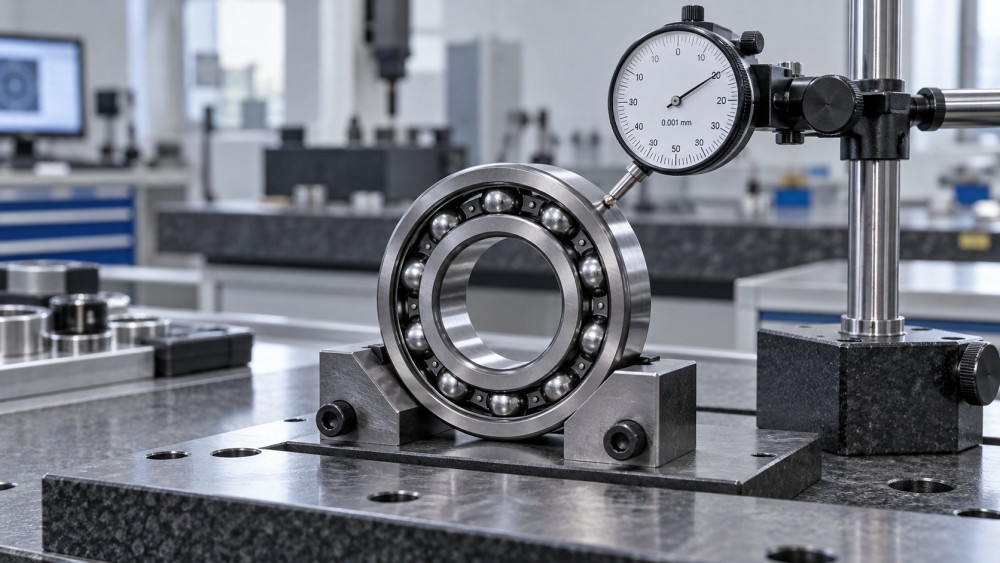
The price difference is not simply a charge for a different marking. A tighter tolerance reduces the manufacturing variation that can be accepted. Producing within narrower limits can require finer finishing, more stable processes, better-controlled measurement conditions, and additional checks. Bearings that fall outside the requested limits cannot be shipped as that grade, even if they are usable for a less demanding specification.
Inspection itself can add cost. A dimensional certificate, an individual runout report, or traceability to a production lot involves a different level of work from supplying standard catalog bearings with routine quality documentation. Requesting individual measurement records for every unit may be justified for a critical spindle, but it should not be assumed to be included in a grade designation.
The effect becomes more pronounced when bearings are supplied as matched sets. An angular-contact spindle arrangement, for example, may require a specified mounting configuration and preload. Selecting and matching components, controlling their orientation, and documenting the set can add work beyond manufacturing the individual bearings. A quote for two loose bearings is therefore not necessarily comparable with a quote for a matched pair, even when the nominal size and precision class appear identical.
Availability also matters. A standard size and grade may be offered from stock, while a tighter class, special preload, or unusual combination of requirements may need a dedicated production run. Order quantity, inspection scope, and lead time can change the unit price as much as the nominal grade change. There is no reliable universal multiplier for moving from one precision class to another.
Where the system premium comes from
The bearing is only one source of error in a rotating assembly. Shaft journals, housing bores, shoulders, spacers, and assembly methods influence the position and alignment of the bearing rings. If these features introduce substantial runout or distortion, the benefit of a tighter bearing class can be reduced before the machine begins operating.
For a high-accuracy spindle, the bearing premium may therefore be accompanied by costs for precision-ground shaft seats, controlled housing geometry, suitable spacers, clean assembly, and spindle-level checks. A higher grade may also make dimensional compatibility more important: an inappropriate fit can distort a ring, alter internal clearance or preload, and undermine the expected performance.
Temperature and operating speed complicate the decision. Thermal expansion changes fits and operating clearance; excessive preload can increase friction and temperature. A tighter precision class does not resolve those issues by itself. The required accuracy should be assessed at the operating condition, not just from a bearing measured at rest.
These dependencies matter when comparing a bearing-only quote with a complete spindle or bearing-system quote. The latter may include shaft and housing machining, mounting, balancing, lubrication, testing, and documentation. A system price can be higher because it includes work needed to achieve an assembly-level result, not solely because it uses a higher-grade bearing.
How to tell whether the grade premium is justified
The starting point is the machine requirement that the bearing must support. In a grinding or machining spindle, tool-position variation, surface finish, and allowable spindle runout can make running accuracy commercially important. If an accuracy shortfall causes rejected workpieces or prevents the equipment from meeting a customer specification, the cost of a tighter bearing and supporting assembly controls may be justified.
In a conveyor roller or a general-purpose drive where load capacity, sealing, and contamination resistance dominate the failure risk, a tighter precision class may have little measurable value. Paying for accuracy that the surrounding structure cannot maintain is especially difficult to justify. A change to sealing, lubrication, or mounting practice may address the actual problem more directly.
The decision becomes less obvious when the current problem is described only as “vibration” or “short bearing life.” Those symptoms can result from imbalance, misalignment, contamination, incorrect fits, lubrication problems, or unsuitable preload. A higher precision grade may be part of a solution in a specific design, but it is not a substitute for identifying the cause.
For an existing machine, the original equipment specification provides a starting point. Substituting a lower grade solely to reduce the purchase price can create an unapproved change in accuracy or interchangeability. Equally, specifying a higher grade than the original design requires should be supported by an engineering reason rather than an assumption that a higher grade is always safer.
Make supplier quotations genuinely comparable
A grade comparison is meaningful only when the rest of the specification is held constant. Before interpreting the premium, request quotations against the same bearing designation and the same technical and commercial scope. Items that can materially alter the comparison include:
- Bearing design and materials: bearing type, dimensions, contact angle where applicable, ring and rolling-element material, cage design, and seal or shield configuration.
- Operating configuration: internal clearance or preload, mounting arrangement, and whether bearings are supplied individually or as a matched set.
- Accuracy requirements: the applicable standard and precision class, plus any separately specified runout, vibration, or noise limits.
- Quality evidence: certificates, lot traceability, individual measurement reports, inspection method, and acceptance criteria.
- Commercial scope: quantity, packaging, lead time, warranty terms, and whether machining, assembly, testing, and freight are included.
Where a supplier offers an alternative grade or standard, ask for the relevant tolerance values and confirmation of interchangeability against the drawing. A broad claim that two classes are “equivalent” is not enough if the application depends on a particular runout or dimensional limit. The comparison should identify both what is tighter and what remains unchanged.
It is also useful to request an itemized quotation for the bearing, matching, documentation, and any system-level work. Itemization does not require the supplier to disclose its internal manufacturing costs; it shows which deliverables create the price difference. If one offer includes a matched pair and a spindle runout report while another includes only loose bearings, the lower figure is not a like-for-like alternative.
Evaluate the premium against the cost of an accuracy shortfall
A practical comparison puts the additional acquisition cost beside the consequences of not meeting the required performance. Consider the expected service period, replacement labor, production interruption, rejected output, and the cost of verifying or reworking an assembly. Include the cost of the supporting shaft, housing, and inspection requirements if they change with the grade.
For example, suppose two technically acceptable proposals differ by $200 per bearing set. If the higher-grade option also requires $300 of additional assembly and inspection work, its decision premium is $500 per set—not $200. The higher-cost option is economically justified only if its expected benefit or avoided risk over the relevant period supports that additional cost. These figures illustrate the calculation; they are not market price benchmarks.
Not every benefit can be converted into a dependable savings estimate. Where a contractual accuracy limit must be met, the relevant question may be whether a lower-grade configuration has adequate evidence of compliance. Where both configurations satisfy the requirement, a controlled trial or comparison against an existing qualified design can help establish whether the extra precision produces a useful machine-level difference.
The strongest specification is the least restrictive one that reliably meets the application requirement, including the necessary evidence. State the precision class explicitly, define any critical performance limits outside that class, and price the complete scope needed to achieve them. That approach makes the grade premium visible without confusing it with unrelated differences in design, documentation, or system assembly.
Want to dive deeper into these market dynamics, or need data-driven support for your next business move? Drop a line below and let the analysts at PCTS provide customized insights.
We respect your privacy. Your information is strictly confidential.
Related News
- 00
0000-00
How to assess a chain and belt drive manufacturer's quality control - 00
0000-00
How intelligent condition monitoring detects conveyor bearing faults - 00
0000-00
How misalignment affects belt drive components - 00
0000-00
Trelleborg Sealing Solutions Uses AI to Optimize Rotary Shaft Seal Design - 00
0000-00
How turbine operating speed affects precision bearing selection
Weekly Insights
Stay ahead with our curated technology reports delivered every Monday.