





Choose a semiconductor equipment sealing manufacturer by examining the contamination controls applied to the specific seal, manufacturing route, and final packaging. A cleanroom designation or a favorable material data sheet is not enough to establish that a finished part will meet a chamber’s cleanliness requirements. The decisive evidence connects defined contamination limits to controlled processing, suitable test methods, and traceable lot records.
Start with the seal’s location and process exposure. A static seal on an external utility line does not face the same contamination risk as an elastomer exposed to a vacuum chamber, plasma by-products, or high-purity process gas. Establish which surfaces are process-facing, what contaminants could affect the application, and where the seal will be opened and installed. Those conditions determine which supplier controls deserve the closest scrutiny.
Define contamination in terms that can be measured
“Semiconductor clean” is too broad to use as an acceptance criterion. Convert the application’s concerns into agreed requirements for the finished part and its packaging. These could include particles above specified sizes, extractable ionic or metallic species, organic residues, or outgassing behavior. The relevant limits must come from the equipment specification and process sensitivity; a number taken from an unrelated component does not establish suitability.
Particle results are meaningful only when the sampling method is understood. Ask whether the result represents the entire seal, a defined area, or a liquid extract; which particle sizes are counted; and whether the reported value is per part, per unit area, or per volume of extraction liquid. A low count obtained from a gentle rinse cannot be directly compared with a result from a more aggressive extraction.
Chemical testing has the same limitation. Extraction solvent, temperature, duration, and analytical detection limits affect what appears in a report. An aqueous extract may reveal ionic contamination while leaving other organic residues poorly represented. Request the method, blank results, reporting limits, and acceptance criteria alongside the reported values. A result below the detection limit establishes only that the analyte was not detected at the method’s stated sensitivity.
Agree on where acceptance applies: after the supplier’s final clean, after transit, or at incoming inspection. If the receiving method differs from the supplier’s release method, define how disagreements will be investigated before the first lot arrives.
Follow the seal through the manufacturing route
Review the actual sequence from compound preparation through molding or machining, finishing, cleaning, inspection, and packaging. A facility tour is useful when it follows the part’s route and identifies where contamination can be introduced or removed. A controlled packaging room offers limited assurance if finished seals are handled on an uncontrolled bench immediately before entry.
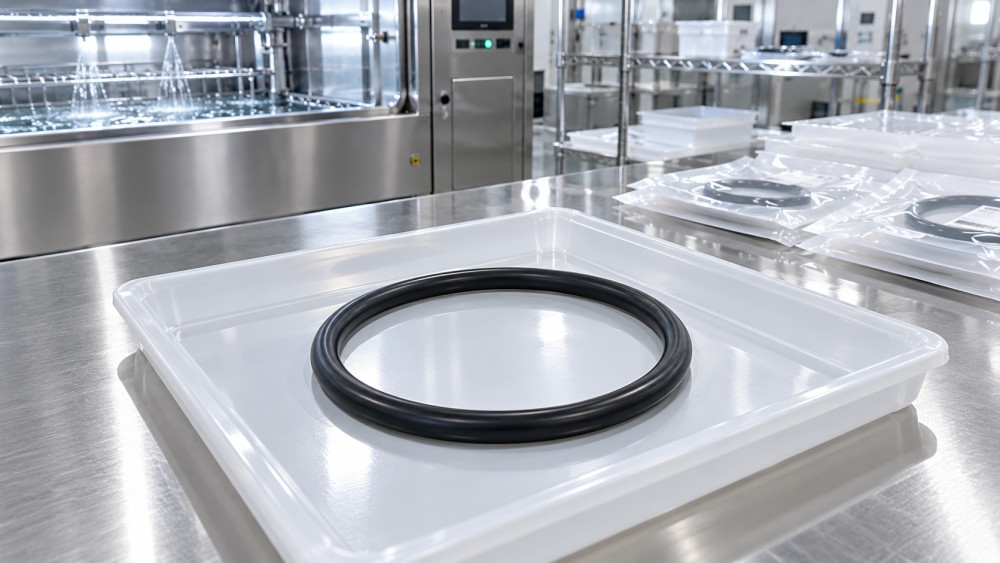
Pay particular attention to finishing operations. Trimming flash, grinding, and removing mold release residue can introduce loose material or leave fragments attached to the sealing surface. Ask how tooling is cleaned, how debris is removed, and whether rework sends a part back through the validated cleaning and inspection sequence. A visually smooth seal can still carry fine particles; conversely, a particle count alone will not reveal a nick that later sheds material during installation.
Material segregation matters as well. Shared equipment, containers, or work surfaces can transfer residue between compounds or production lots. Examine how raw materials, intermediate parts, and cleaned components are identified and kept separate. Where equipment is shared, request the changeover and cleaning procedure and evidence that it addresses the residues of concern.
For elastomer seals, composition and cure conditions influence both performance and contamination behavior. Extractables, fillers, processing aids, and degradation products are not captured by a generic statement that a material is FKM, FFKM, or another polymer family. Evaluate the specific compound and manufacturing route against the intended chemistry and temperature. A material that withstands a process medium mechanically is not automatically suitable for its contamination limits.
Evaluate cleaning as a controlled process
A credible cleaning record identifies the approved process, equipment, cleaning agents, water or solvent quality, operating limits, and monitoring arrangements. Ask which steps remove particles, which address chemical residues, and how the part is protected between cleaning and packaging. The supplier should be able to explain why the sequence is suitable for the seal’s geometry and material.
Cleaning can itself introduce contamination. A rinse fluid, drying gas, bath, or handling fixture may transfer residue if its condition is not controlled. Review how bath replacement, filtration, container cleanliness, and drying equipment are monitored. For reusable fixtures, determine how cleaning effectiveness is verified and how damaged or worn fixtures are removed from service.
Drying also deserves attention. Residual solvent or moisture can affect a sensitive process, while excessive thermal exposure can change the seal. The relevant question is whether drying conditions remove the targeted residue without exceeding the material’s approved limits. Request supporting data for the actual process, including any restrictions on part thickness or geometry.
Distinguish process qualification from routine release. A one-time study can demonstrate that a cleaning method is capable under defined conditions; it does not prove every subsequent lot was processed correctly. Routine records should show that the required steps were completed within their limits and that deviations were resolved before release.
Inspect the clean environment and handling controls
Ask for the environmental classification or internal cleanliness specification for each area that matters, together with monitoring locations, frequency, and recent trends. A room classification describes airborne particles under specified conditions; it does not directly certify the cleanliness of a seal surface. Link environmental data to the operation performed there, particularly final inspection and the first packaging closure.
Observe how personnel enter the area, change gloves, handle parts, and respond to dropped items. Gloves can protect a clean seal and still become a source of transfer after touching a cart, label, or workstation. Handling tools and contact surfaces need defined cleaning and replacement practices. The separation between uncleaned and cleaned material should be evident in the physical flow, not just in a procedure.
Environmental monitoring results become more useful when paired with an action process. Ask what happens after an excursion: how affected production is identified, whether parts are held, how the cause is investigated, and what evidence supports release or reprocessing. Look for completed records rather than a statement that excursions are rare.
Test reports should represent the delivered part
Compare the tested article with the intended order. A report for a different compound, cross-section, curing cycle, cleaning route, or packaging configuration may provide background but cannot establish equivalence on its own. Request an explanation of any differences and their potential effect on contamination results.
Sampling plans also need context. Determine whether results apply to every lot, selected lots, or periodic qualification samples. A composite extraction can indicate the contamination associated with several seals, but it can conceal variation between individual parts. Destructive testing may require representative samples rather than the exact delivered items; in that case, review how samples are selected and kept representative.
Surface inspection, particle extraction, and chemical analysis answer different questions. Visual inspection can identify flash, cuts, discoloration, and obvious debris, subject to the inspection conditions and magnification used. It cannot establish trace metal content. Likewise, a satisfactory chemical extract does not show that the sealing lip is free of damage. Acceptance should combine the methods that address the actual failure mechanisms.
If outgassing is a concern, compare the test temperature, vacuum conditions, conditioning, and measured species with the intended service. A result obtained after extensive preconditioning may not describe a seal installed without the same treatment. Request the complete test conditions rather than relying on a single headline value.
Packaging is part of the contamination boundary
Review the packaging specification from the seal outward: approved contact materials, bag cleanliness, closure method, labeling, and protection against abrasion or compression. Double packaging can support controlled transfer into a clean area, but only if the inner and outer layers have defined cleanliness and handling controls. An extra bag does not compensate for a contaminated inner surface.
Ask whether packaged parts are tested or inspected after simulated handling or transport when shedding or package integrity is a concern. Friction between the seal and its packaging can create particles after a successful final clean. A punctured bag, broken closure, or unreadable lot label should have a defined disposition, including whether repackaging is permitted and whether it requires renewed cleaning.
Storage conditions and shelf-life controls must suit the compound and packaging. Excessive heat, light exposure, deformation, or contact with incompatible materials can affect seal properties before installation. Confirm that the label links each package to the correct part revision and lot without requiring the clean inner package to be opened.
Use traceability and change control to compare suppliers
Request a sample documentation package for the proposed part. It should connect the delivered lot to the material batch, relevant production and cleaning records, inspection results, packaging, and release decision. Where subcontractors perform molding, cleaning, or testing, the chain should remain intact across those handoffs. A certificate that states only “conforms” is difficult to investigate after a contamination event unless supporting records are retrievable.
Assess how the supplier handles changes to compound ingredients, production sites, tooling, cleaning agents, packaging, and test methods. Define which changes require advance notification, technical review, and renewed qualification. Even a change intended to improve cleanliness can alter extractables or the comparison with historical particle data.
Before approval, resolve any gaps in writing: the affected part and process, the evidence required, the acceptance limit, and the disposition of material produced in the meantime. For an unresolved contamination failure, preserve the original packaging and retain traceability through investigation; cleaning or repackaging the evidence too early can remove the clues needed to identify the source.
Want to dive deeper into these market dynamics, or need data-driven support for your next business move? Drop a line below and let the analysts at PCTS provide customized insights.
We respect your privacy. Your information is strictly confidential.
Related News
- 00
0000-00
How to check vibration analysis software for sensor compatibility - 00
0000-00
IndexBox Forecasts 3.8% Annual Growth for Global Radial Seals Market Through 2035 - 00
0000-00
How to assess the chemical compatibility of FFKM sealing sheets - 00
0000-00
IndexBox Forecasts 3.6% Annual Growth for Construction Bearings Market - 00
0000-00
When do hydraulic components require an export license?
Weekly Insights
Stay ahead with our curated technology reports delivered every Monday.