





Which ISO Standards Apply to Crane Hydraulic Systems?
A crane hydraulic system is rarely governed by one single ISO document. The relevant requirements sit across several layers: fluid-power safety rules, hose and fitting specifications, cylinder testing, oil cleanliness, control-system safety, and the crane’s own inspection and operating framework. That distinction matters. A system can use correctly rated hoses and still be unsafe because of poor routing, contaminated oil, an undocumented pressure-setting change, or a control function that does not fail in a predictable way.
For quality-control and safety teams, the practical question is not simply “Which ISO standard applies?” It is: which standards should be reflected in the design file, supplier documents, incoming inspection, maintenance procedures, and risk assessment for this particular crane? A truck-mounted loader crane, port crane, overhead crane, telescopic mobile crane, and offshore lifting unit can all use hydraulic power, yet their duty cycles, environmental exposure, safety functions, and local regulatory obligations differ substantially.
The following guide maps the most relevant Crane Hydraulics ISO standards and explains where they are useful. It should not be treated as a substitute for the crane manufacturer’s technical documentation, the applicable national legislation, or a project-specific conformity assessment.
The core starting point: ISO 4413 for hydraulic fluid power safety
ISO 4413, Hydraulic fluid power — General rules and safety requirements for systems and their components, is usually the central reference for a crane hydraulic circuit. It is not a crane-specific standard. Its value lies in establishing the safety logic for hydraulic systems: pressure containment, energy isolation, unintended movement, component selection, installation, testing, information for use, and maintenance access.
In lifting applications, the clauses that deserve the closest reading are those dealing with stored hydraulic energy and predictable failure behaviour. An accumulator, suspended boom cylinder, or load-holding circuit can retain hazardous energy after the prime mover stops. A maintenance instruction that only says “switch off the machine” is not enough if pressure remains trapped between a check valve and a cylinder port.
ISO 4413 also supports sensible engineering discipline around line routing, guarding, pressure relief, test procedures, markings, and documentation. It does not prescribe every valve arrangement needed for every crane. Instead, it requires the designer and system integrator to identify hazards and provide a system that can be installed, operated, adjusted, and serviced without exposing people to avoidable risk.
One recurring quality issue is treating ISO 4413 as a paperwork item. On site, its relevance becomes obvious when a hose passes close to an exhaust surface, a pressure gauge point has no safe test connection, or a relief valve setting cannot be traced to a controlled document. These are not cosmetic defects; each can turn routine maintenance into a lifting-operation risk.
Hoses, fittings, tubes, and connections: where failures often begin
Flexible hose assemblies need more than a pressure rating that appears adequate on a catalogue page. Crane motion introduces bending, vibration, abrasion, temperature cycling, torsion, external damage, and pressure impulses. The hose standard must match the hose construction and intended service, while the completed assembly must be installed and maintained correctly.
ISO 18752 is widely relevant for wire- or textile-reinforced rubber hydraulic hoses used in many mobile hydraulic applications. It classifies hose performance by pressure and impulse requirements rather than relying only on traditional wire-braid or spiral-wire construction descriptions. Where thermoplastic hose is used, particularly in compact routing or specific environmental conditions, ISO 3949 may be the more relevant specification.
ISO 17165-2 addresses the selection, routing, installation, inspection, and maintenance of hydraulic hose assemblies. For safety managers, this standard is especially practical. It reinforces familiar but often neglected checks: prevent twist during installation, respect minimum bend radius, avoid abrasive contact, support long runs without clamping the hose so tightly that it cannot move naturally, and replace damaged assemblies rather than attempting informal repairs.
For rigid tube and hose-end interfaces, the applicable references may include the ISO 8434 series for metallic tube connections and the ISO 12151 series for hydraulic hose fittings. Flange connections used in higher-flow or higher-pressure sections may fall within the ISO 6162 series. The exact part matters because thread form, sealing method, pressure class, and port geometry must be compatible. “It fits” is not a compliance criterion.
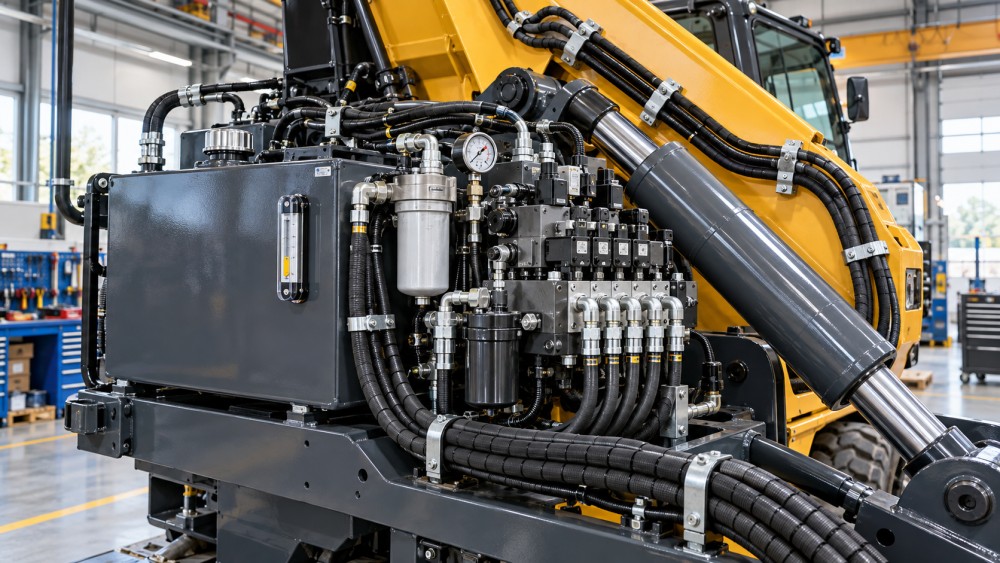
A good incoming-inspection routine should verify the hose assembly as supplied, not merely the loose hose and fitting part numbers. Check the assembly identification, crimp or attachment traceability where required, hose length and routing allowance, fitting orientation, protective sleeves, cleanliness of open ends, and any evidence of freight damage. Mixed-brand hose and fittings deserve particular scrutiny unless the assembler can demonstrate that the combination is approved for the intended duty.
Hydraulic cylinders and load-holding performance
Boom lift, telescope, outrigger, steering, and luffing functions place hydraulic cylinders at the centre of crane safety. The applicable cylinder standard depends on the cylinder type and its dimensional interface. ISO 6020-1, ISO 6020-2, and ISO 6022 cover dimensional and mounting interchangeability for certain industrial hydraulic cylinder families. They can be useful when evaluating a replacement cylinder, but they do not automatically establish that a cylinder is appropriate for a particular crane load case.
ISO 10100, covering acceptance tests for hydraulic cylinders, is more directly useful to quality personnel. It provides a reference framework for testing such matters as pressure integrity, function, leakage, and performance. A procurement specification can refer to relevant acceptance testing, but it should still define crane-specific requirements where necessary: stroke, mounting geometry, rated pressure, test pressure, cushioning, corrosion protection, temperature range, seal compatibility, and documentation.
It is also important not to confuse cylinder integrity with load security. A cylinder may pass a pressure test while the overall function remains vulnerable to hose rupture, internal valve leakage, pilot-pressure loss, or an unsuitable counterbalance arrangement. Load-holding valves, hose-burst protection arrangements, and motion-control valves need to be assessed as part of the complete circuit and the crane’s risk control strategy.
Cleanliness standards are reliability standards in disguise
In crane hydraulics, contamination control is often discussed after a proportional valve starts sticking or a pump shows abnormal wear. That is late in the process. Oil cleanliness should be defined before commissioning, particularly where servo or proportional components, variable-displacement pumps, fine-clearance valves, and condition-monitoring devices are present.
ISO 4406 provides the familiar coding method for reporting particulate contamination levels in hydraulic fluid. It does not itself prescribe a universal cleanliness target. The target must come from component supplier recommendations, system sensitivity, expected duty, and the consequences of failure. A cylinder-only circuit may tolerate a different cleanliness level from a system with electrohydraulic control valves and high-performance pumps.
When automatic particle counters are used, ISO 11171 is relevant to calibration practices. ISO 16889 is commonly referenced for multi-pass filter performance testing. Together, these standards help procurement and maintenance teams ask better questions: Is the selected filter tested by a recognized method? Is the reported particle count comparable? Is sampling taken from a representative live line rather than from a dirty reservoir bottom or a freshly opened port?
Fluid selection should also be documented. ISO 11158 classifies mineral-oil-based hydraulic fluids, while ISO 15380 addresses environmentally acceptable hydraulic fluids. For cranes operating near water, sensitive ground, food-related sites, or environmentally controlled areas, an environmentally acceptable fluid may be specified. That decision cannot be made on environmental criteria alone; seal materials, pump approvals, viscosity behaviour, operating temperature, and changeover procedures must be checked.
Crane standards and machinery-safety standards still matter
Hydraulic standards explain how the fluid-power system should be safely designed and managed. They do not replace standards governing crane classification, inspection, safe use, or machinery risk reduction. Depending on the crane type and jurisdiction, the technical file may also need to consider standards such as ISO 12100 for machinery risk assessment and risk reduction, ISO 13849-1 for safety-related parts of control systems, and crane-specific documents from the ISO 4300 series.
For example, ISO 9927 provides guidance related to crane inspections, while ISO 12480-1 addresses safe use of cranes. These documents do not dictate hose construction or filter media, but they influence how hydraulic leaks, drift, abnormal movements, degraded safety devices, and maintenance findings should be handled operationally. If a hydraulic defect can affect load control, it should not be treated as an ordinary oil-leak maintenance item.
What should be in a defensible inspection and procurement file?
A reliable compliance file connects standards to actual components and decisions. Merely listing “ISO compliant” on a purchase order leaves too much room for misunderstanding. The bill of materials should identify critical hoses, fittings, valves, cylinders, filters, accumulators, seals, and pressure instruments, along with their required ratings and evidence of conformity. Where a component is safety-critical, the supplier’s declaration should be supported by traceable technical data rather than a generic marketing statement.
During final inspection or major repair, reviewers should be able to establish the intended relief settings; verify that valves and fittings match the circuit drawing; confirm hose routing and protection; review cylinder test documentation where applicable; record oil cleanliness results; and check that warning labels, isolation steps, and maintenance instructions remain legible and relevant. Changes made in the field deserve the same discipline. Replacing a fitting type, changing hose length, or fitting a different seal compound can alter reliability even if the crane initially appears to operate normally.
For complex equipment, it is useful to separate three questions: whether a component meets its own ISO product standard, whether it is correctly integrated under ISO 4413 principles, and whether the complete crane meets its applicable crane and machinery safety requirements. Those are related questions, but they are not interchangeable.
A practical way to apply Crane Hydraulics ISO requirements
The strongest approach is to build a standards matrix around the real hydraulic functions: lifting, lowering, telescoping, slewing, outriggers, braking, and emergency recovery. For each function, identify the pressure-containing parts, foreseeable failure modes, load-holding measures, inspection points, and required records. Then link the relevant standards to each decision rather than applying a broad list to the entire machine.
PCTS tracks the practical intersection of fluid power, seals, transmission components, condition monitoring, and industrial MRO because hydraulic reliability is never just about one part number. A contaminated reservoir can damage a valve; a seal-material mismatch can create a leak; a poorly routed hose can fail before its nominal service life; and an undocumented replacement can complicate incident investigation. For crane hydraulic systems, ISO standards provide the framework, but disciplined specification, inspection, and maintenance determine whether that framework holds up in service.
Related News
- 00
0000-00
Which ISO standards apply to crane hydraulic systems? - 00
0000-00
How preload affects angular contact bearing stiffness and service life - 00
0000-00
Which documents are essential for seal export compliance? - 00
0000-00
When do fluid power systems need closed-loop control? - 00
0000-00
How to vet an industrial sealing solutions supplier for critical equipment
Weekly Insights
Stay ahead with our curated technology reports delivered every Monday.